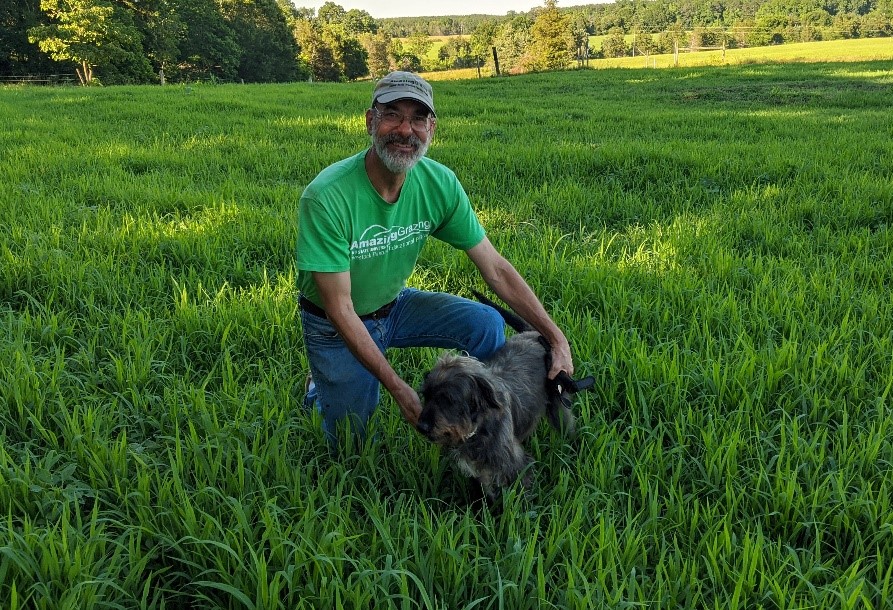
Meet my dog Pup. He was found as an 8 week-old puppy running around Virgilina by my nephew Korey who carried him home. It was rumored that he was a valuable puppy and belonged to someone in town, but no one ever came forward to claim him. He grew up on the farm with a clowder of cats, several other dogs and of course many cows and calves. Pup was never really anyone’s dog….he was just the farm dog. We don’t know his breeding for sure, but he doesn’t shed at all and resembles a cross between a German Wirehair Pointer and Poodle. Now when folks ask what breed he is we say he is a “Pupperdoodle”!
When my last nephew moved away from the farm in 2019, Pup was left alone with his cats, and he was fine for a while. In time he got lonely and really mourned each time we left him alone at the front gate. Once he decided to follow me and he ended up in Virgilina, where a well-meaning person carried him to the pound in Roxboro. We picked him up and took him back to the farm, but the next day he did the same thing and ended up this time at the home of a friend who gave me a call. This started to be a frequent occurrence, so a new solution had to be found!
During the depth of the Covid-19 Pandemic we moved from Raleigh to our lake house between Roxboro and Virgilina. This allowed Pup to come to our house to live in “Doglandia”, a ½ acre dog park we created for our other dogs. He now goes with me everywhere (except for plane trips, and an occasional excursion during the heat of summer) and pretty much lives in my farm truck. He is clearly now my dog!
I was relating this to my sibs last month when we met at Triple Creek to put my Mom’s ashes on our “Memorial Pasture” where my Dad and Nephew Blake are already part of the mineral cycle. I asked them how many other folks they knew that had a dog living in their truck. Somewhat incredulously they quickly responded “What, like Dad?”. I had not thought about it, but Dad had a Dachshund named Oscar that lived in his truck for about 16 years…..I guess the apple really doesn’t fall far from the tree!
Due to Pup’s raising on the farm he loves to go to the pastures. He typically makes friends with the baby calves that slip under the polywire, and while their mothers are not too keen on that they tolerate him! Pup also loves to walk and explore pastures, and spends a surprising amount of time grazing on forages. Once someone saw him doing that and they said he must be sick. I realize that sometimes that is the case with both dogs and cats, but with Pup it is a regular part of his diet! However, I must say he is very discriminating about which forages he plays in and grazes.
When I had time during the pandemic to spend a lot of time walking and contemplating cattle and pastures I noticed that Pup had forages he really loves and others that he is indifferent to. In general when the grass is 6 inches or shorter he is likely to take a romp around the pasture no matter what the species. However, once the pasture gets taller he starts to balk at entering a tall fescue pasture, or any pasture with significant briars, horsenettles, etc.
I have had the pleasure to work with Dr. Deidre Harmon the last 6 years, and one of her favorite icebreakers is “what is your favorite forage”. Her favorite is Crabgrass. I can’t narrow it down to one, but my favorite warm-season is Dallisgrass, and my favorite cool-season is Novel Endophyte Tall Fescue. There are many forages I really like, but these two perennials can make a very strong system in the central Piedmont of NC and VA.
I realize there are many things Pup can’t understand like the subtle advantages of a perennial over an annual forage, but over the last few years it has become clear to me that he does have “favorite forages”. For Pup it does not get better than Annual Ryegrass in the spring and Crabgrass in the summer. He will aggressively graze both of these plants and then if it is not too hot or wet he will take a nice romp all around the pasture. It is especially cute to see him run through either forage when they are about 20 inches tall….about 6 inches over his head. You can see him moving through the grass and you can occasionally see him bounding above the sward so he can keep an eye on where he is going. In contrast, when I go into a similar strong stand of tall fescue, Pup goes a little ways in, and then turns and goes back out to sleep in the shade.
So what is it that Pup likes about these two annual forages? First, when vegetative they each are very tender and sweet, with a very low level of fiber, and a high level of crude protein and sugars. Additionally, the physical characteristics of these forages make them very smooth and soft as the Pup moves through them. In contrast, most tall fescue has a sharp serrated leaf margin, so when Pup runs through it, it will scratch his nose, and it can irritate his mouth when he grazes it. Cattle and other livestock are no different! Of course I don’t plant ryegrass and crabgrass for Pup, but his love of them is highly correlated with how the cattle feel about them.
We are now renovating tall fescue pastures around the farm, and if Pup could vote he would ask for either Bar Optima plus E34 or Tower with Protek. Each of which have smoother leaf margins than normal leaf tall fescue because soft leaf fescue is in their genetic background. Be aware that the characteristics that make these products more desirable to Pup (and grazing livestock) also make them more vulnerable to overgrazing and stand loss.
As you work on your grazing management skills, take a little extra time to be observant and think about how complex the pasture ecosystem is. It is a really fun when you start seeing how the plants, animals, and soils all interact to result in forage that can really put gain on livestock. In the meantime, Pup and I will continue to enjoy our favorite forages.
The Alliance for Grassland Renewal is a national organization focused on enhancing the appropriate adoption of novel endophyte tall fescue technology through education, incentives, self-regulation and promotion. For more resources or to learn more about the Alliance for Grassland Renewal, go to www.grasslandrenewal.org
 The Alliance for Grassland Renewal