Pastureland is a complex ecological system that provides many “Ecosystem Services” to mankind. The most obvious service is the production of food by livestock species, and the recreational benefits provided by horses and other companion or exotic herbivores. In addition, well-managed pastures sequester carbon, filter water, feed healthy soil, provide wildlife habitat and make for a more diverse landscape providing “greenspace”.
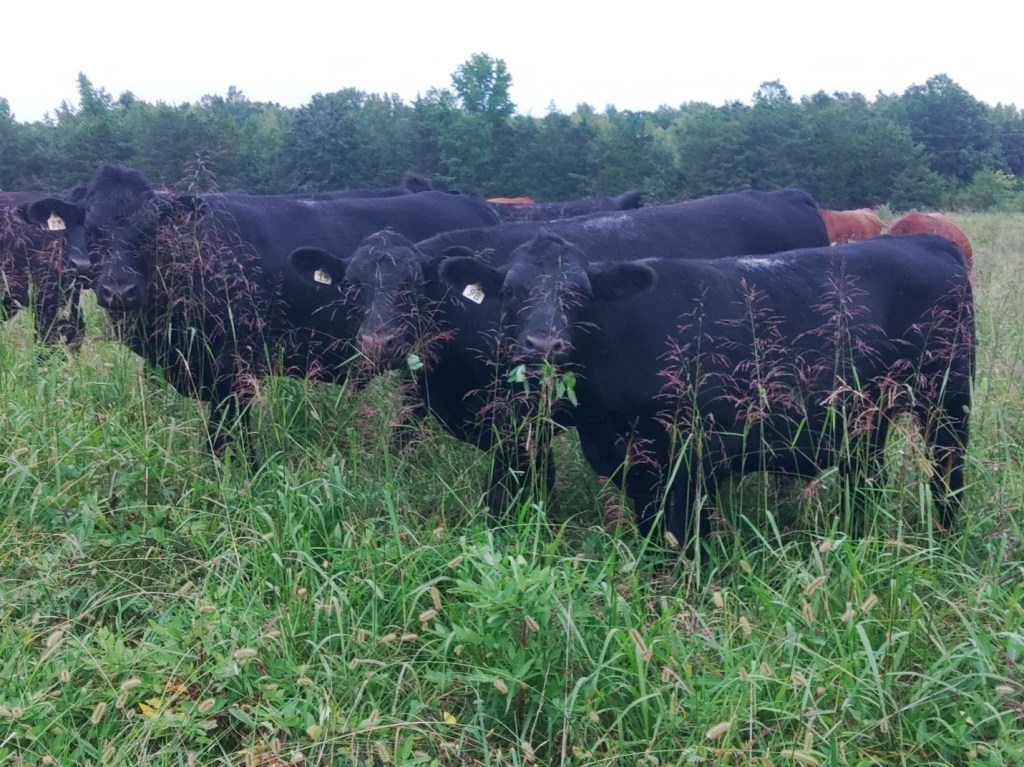
While many farmers and their advisors understand this, the vast majority don’t fully appreciate the importance of these ecosystem services and how the farmer’s management input is critical to optimizing those services.
An ecological system is comprised of both “abiotic” (non-living) and “biotic” (living) components. These components work together to create the ecosystem. The abiotic components include soil texture, minerals, water, and temperature. The biotic components include all the living organisms that live their days out either under or over the soil surface, and eventually die and are recycled.
In a pasture the biotic components include the livestock, the plants, wildlife (including birds, other large herbivores like deer, small mammals, and predators), insects (both above and below ground), and microorganisms (including bacteria, fungi, and protozoa). Each of these groups can be broken into individuals of each species, populations of each species, and communities of species. When all the pieces are working together in harmony then amazing things happen. A healthy pasture ecosystem is truly “Amazing Grazing!”
Natural systems work this way, and without the activity of humans then the ecosystem evolves based on the interactions of all these pieces. In a natural system, Mother Nature is the manager. A pasture on the other hand is not a natural system but rather is a “managed ecosystem”. To break that down, the fundamental concept is that a human manager puts their influence to work in an attempt to steer the system in the direction they desire.
I have seen many diagrams of the pasture ecosystem, and most of them don’t include the human manager as a central component of the system. I don’t really understand why this is; perhaps it is that as humans we think of ourselves as being on the outside looking in. In practice, many pastures are managed from the cab of a tractor, a spreader truck or a pickup truck, often with a “drive by” prescribed management style. This sometimes can work in the short-term, but often if there are disruptions in the system then the ecosystem can quickly get out of balance.
In recent years I have come to realize that to really manage a pasture ecosystem you have to be part of it. Over the years I have become more and more imbedded in the system, and I now understand why our progress has been so slow. Now that I see myself as a critical component that needs to be present in the pasture (rather than just looking from the outside in or down from the tractor) we are making progress. Being present to apply the principles of adaptive management is a critical component.
Adaptive management is an approach that has been developed for systems that have many variables that can’t be controlled. In our case, you can’t control temperature or rainfall, so a traditional plan usually does not work. You have to react to the changes you see in the system to keep it on track to reaching your goals of a high level of production while maintaining good soil health, water quality, and an aesthetically pleasing system.
There has recently been a lot of discussion in the scientific community about the appearance that many advisors (including me) preach the evils of continuous grazing and present rotational grazing as the only way to have a truly productive and sustainable system. I find myself on both sides of the argument. On the one hand the scientist in me agrees with the academic thinkers that interpret much of the research evidence that exists to say that you can have a very productive continuous grazing system. On the other hand I relate completely with the “artesian grazers” that reject the science and believe strongly in a rotational system with frequent movement of livestock.
A good review of the scientific literature has shown some key differences between a managed “continuous grazing” system and a “rotational grazing” system when “grazing intensity” is controlled. One thing that happens is that forage diversity is higher in rotational systems because some palatable species will be grazed out in the continuous system. Also, rotational systems provide more total productivity as measured in total gain per acre, because in the continuous system more forage is fouled and wasted. However, it is also clear that in a well-managed continuous grazing system soil health is not necessarily degraded, and the other important ecosystem services like water infiltration and filtration are maintained. In addition, individual animal performance is often higher in the continuous system because animals have more opportunity to select nutritious plants and plant parts and forage allowance is nearly consistent day to day..
The key word in this discussion is “well-managed”. In controlled research it is possible to manage the grazing intensity by adding animals or taking animals out of the system. In commercial practice most farmers using a continuous grazing system are really not applying any kind of management. In most cases animals get checked infrequently, and the manager is not present to make observations about the status of the forages and the grazing intensity. I would argue that it is a lot easier to manage for good pasture condition in a rotational system because you take control of the amount of forage on offer and the residual.
In a rotational system when there is no pasture that is ready to graze because of slow forage growth, then supplemental hay can be provided in a sacrifice are until growth starts back up. In the continuous system, when growing conditions are compromised, animals are almost always left on the land to find something to eat, and as a result the entire farm becomes over-grazed. At that point hard thunderstorms will result in runoff and pasture recovery will be slow. Also, because the cattle are not used to close human contact they can be wild and difficult to gather and handle.
My experience as a grazier and advisor has convinced me that a frequent rotation system is almost always the best. Over the 50 years we have owned the farms things have really changed. We used to be pretty much continuous grazing, but started doing a better job of rotation about 20 years ago. As we have become more and more intensive in our rotation things have really improved dramatically. Manure distribution is critical to building strong nutrient cycles, and this has allowed us to dramatically reduce fertilizer use, with many pastures that have not been fertilized in about a decade. Also, the cows are so tame that you can easily move them, gather them for working, etc. Finally riparian areas have flourished along with wildlife populations.
There are a few situations where well-managed continuous grazing is the recommended system, and I will give you an example. An old friend from the mountains has managed stocker cattle on the high elevations of the Smokey Mountains all her life. One specific location I have visited is a ski area during winter. The ski slopes are grazed by cattle during the summer to keep them from going back to brush and tree species. Obviously permanent fences on that land are not an option. Also, with the terrain and the interwoven forest, temporary fence is not really an option either. This is not specific to the ski area, with many high mountain pastures being in the same category.
To make this work, my friend provides a high level of management. The cattle are backgrounded in the early spring so they are healthy, and then they are turned out on these mountain pastures when forage is ready. Without further management this system might work, or it might crash depending on how good the decision about the stocking rate is and how much it rains. My friend makes it work by checking on those cattle frequently, and using a little feed to keep them coming and tame. If there are areas of good grass that they are not utilizing she will call them along and move them in the direction she wants, and move mineral feeders around. If the grass starts to get short, which often happens about mid-summer when the spring flush is over, then some of the cattle will be removed and marketed. Typically the better gaining cattle will be nearing a desirable marketing weight at that time. The reduction in stocking rate will help stabilize the available forage mass, will maintain animal performance and will keep the pasture from becoming overgrazed.
Why does this system work for my friend in the high mountains and not for many of the farmers that have cows across the lower elevations? Essentially my friend sees herself as an indispensable part of that ecosystem, whereas the typical cow/calf farmer lets the cows pretty much take care of themselves. Another fundamental problem with the cow/calf enterprise is that the stocking rate is not flexible, and actually the stocking rate increases through the grazing system as the calves grow. Because a cow/calf farmer is not likely to sell cows when grass gets short, then the rotational system is beneficial because it provides them with more total forage, and makes it more apparent when supplemental feed needs to be started to maintain pasture health.
This is not the end of this discussion, but I hope this will stimulate you to think about this. If it is a foreign idea to you that you are a critical part of your pasture ecosystem, spend some time walking pastures and contemplate it. Do you know the species of plants present? Do you know the most desired grazing height? Is the manure distributed evenly? Are there overgrazed and ungrazed patches? Do the cattle come to you rather than running away? All these things and many more should be on the mind of the person with responsibility for taking care of cows. Taking an interest and learning more about it is the key!
Finally, think about where you fit in the ecosystem. Are you outside looking in, or are you in the middle of it? There is great long-term reward for becoming a part of the ecosystem and applying adaptive management concepts to steer it in the direction you wish. This summer there will be many opportunities to attend Amazing Grazing workshop in North Carolina. Join us and get on the path to Amazing Grazing!
~ Matt Poore, Originally written for the Amazing Grazing Column in the Carolina Cattle Connection, July 2023.
 The Alliance for Grassland Renewal