
A few years ago one of my colleagues asked me what I wanted my legacy to be. I was a little taken aback as I had never really thought of such a thing. It made me realize that folks do think about their legacy, and I wasn’t really quite sure what that even was. So, I looked it up and found that like so many things it has several meanings. The first is simply something of value that is passed down to the next generation. That is simple and many of us have inherited a farm with all it’s assets and it’s debts because of the efforts of the past generation.
The second definition is some visionary accomplishment that has a recognized long-term impact beyond just your time. This second is much more complex and is of course what my friend was talking about. I don’t really know if I will have a legacy, but it is clear to me daily that my Dad did leave a multifaceted legacy. It starts with the farm that he bought and developed for us, but it is much deeper than that.
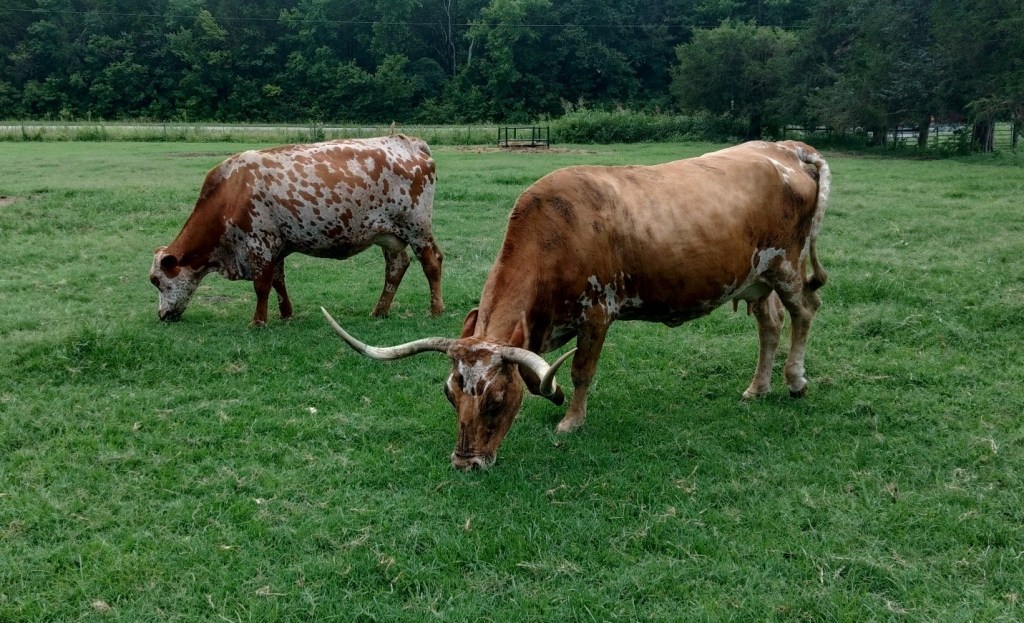
One piece of my Dad’s legacy is his Longhorns. At Triple Creek Ranch our genetics go back to purebred Hereford’s in the 70s and 80s, and then commercial Angus starting about 1985. We have used a little Simmental, Gelbvieh, but have mostly used Angus over the decades. Our herd is about 80% black with some reds and smokes, and a lot of white faces. One thing that will stick out to you are some very colorful cows that are clearly not Angus. Look closer and you will see solid black cows with good haircoats that look like something a little different than a straight Angus. They are Longhorn influenced cattle!
If you didn’t know my Dad, he had a lifelong love for the life of the Western Cowboy/Rancher. He grew up watching the Westerns at the movies as a kid, and then as a young man he loved to watch Rawhide, Bonanza and other westerns on TV. He developed a place in his heart for Texas Longhorn cattle, and many of his rancher friends in Arizona had a few around as ornamentals.
At one time we leased a ranch in Arizona way up in the mountains that allowed only for summer grazing. Dad bought a small herd of Longhorns that summered on the mountain and wintered on irrigated contract pasture down near Phoenix in the wintertime. We had many an argument about the relative merits of Longhorns as compared to Angus for beef production. Despite my data supporting using Angus, Dad still liked Longhorns. After about a decade Dad gave up this ranch which sold for development, so he had to sell his herd of cows. He was a little heartbroken because he was so proud of them. I remember at the time thinking “good riddance” as I didn’t have that romantic connection to the western ranching scene, and they didn’t carry much meat.
After my folks sold their Urgent Care Clinic in Flagstaff, AZ they retired and spent much of their time at the farm, which was a blessing to me. However, as always there were items of friction between me and my Dad. We had a terrible drought in 2007 that any readers around that year will surely remember. That year started with a historic Easter freeze, followed by virtually no rain from June through the rest of the summer and fall. It was devastating and we went through all the steps of drought management including selling down about 1/3 of our cows. After selling off several loads of good cows but seeing the drought get worse, Dad decided to go to the sale barn to see how the cows were selling in preparation for selling more.
Later that day I got a call from my nephew Mitch. He asked me to guess where he was headed. .I had no idea why he was calling me in the first place, so I had not a clue. “The Salebarn! I am picking up a cow/calf pair that Grandpa bought!” My temper was starting to rise as we were gripped in a really bad drought and we had sold some really good cows. Then he said “Oh yea….and they are purebred Longhorns!”
I was fit to be tied and needless to say that became an issue between my Dad and I that lasted several years. He knew I was going to be mad at the unplanned purchase, but he couldn’t stand to see a good Longhorn cow go to slaughter. Of course, we eventually got over that conflict, but the challenges that came with the decision to by that one cow continue today. As it turned out, we ended up keeping the cow, and developing and breeding her heifer calf, so we had two purebred longhorn cows. It quickly became clear that you can’t keep a horned cow with a herd of polled cattle as they terrorize the whole group constantly. The longhorns also make running through the chute very difficult. After a few attempts to integrate these cows into the main herd, they were delegated to the small pasture in front of the house. As you come up the entrance to the farm you will still see them on your right.
I have mellowed on my thoughts on the Longhorns as I have been learning more about the importance of genetic diversity in general, and these cows do bring a very different genetic package to the table. Unfortunately the colorful coat patterns are very discriminated against at the market. For this reason we breed many of the heifers which make great mama cows, and feed the steers for the beef program.
The original cow passed away in 2019 at an age of 22 years. The heifer calf that was on her side was born in 2007 and is now 15 years old and she looks like a young cow. We have a ½ blood polled cow (daughter of the original cow) that lives with her that is ½ Hereford and ½ Longhorn and is blind. This cow produces a great calf every year, and does well as long as she stays in that pasture where she was born.
Over the last 17 years we have had a lot of longhorn influenced cattle that have made it into our general herd. There are several 1/8 and 1/16 blood cows that are really good and that seem to have better hair coats in our tall fescue environment. As far as I can figure about 15% of the herd is influenced.
So one piece of my Dad’s legacy are his Longhorns. They have made the way into our genetics and will be there for the rest of my life. As I spend more time on the farm, I see things like this that my Dad put underway that we still deal with today.
The one piece of Dad’s legacy that is very difficult for us to deal with is Fescue Toxicisis. The decision to plant KY31 on so many acres in the distant past still plagues us all across the tall fescue belt. This was misunderstood and non-intended by our ancestors, but now that we understand it and what to do about it, we will have to live with the reality of passing this problem down to our successors if we don’t do something about it now.
I am really excited this year to be preparing to plant 30 more acres to Novel Endophtye Tall Fescue. I don’t have that many years left to convert our farm over to non-toxic forages. I am determined that part of my legacy will be getting the toxic tall fescue off the land that I am responsible for, and helping other farmers to do the same.
~ Matt Poore, NC State and Alliance for Grassland Renewal chair
The Alliance for Grassland Renewal is a national organization focused on enhancing the appropriate adoption of novel endophyte tall fescue technology through education, incentives, self-regulation and promotion. For more resources or to learn more about the Alliance for Grassland Renewal, go to www.grasslandrenewal.org
 The Alliance for Grassland Renewal