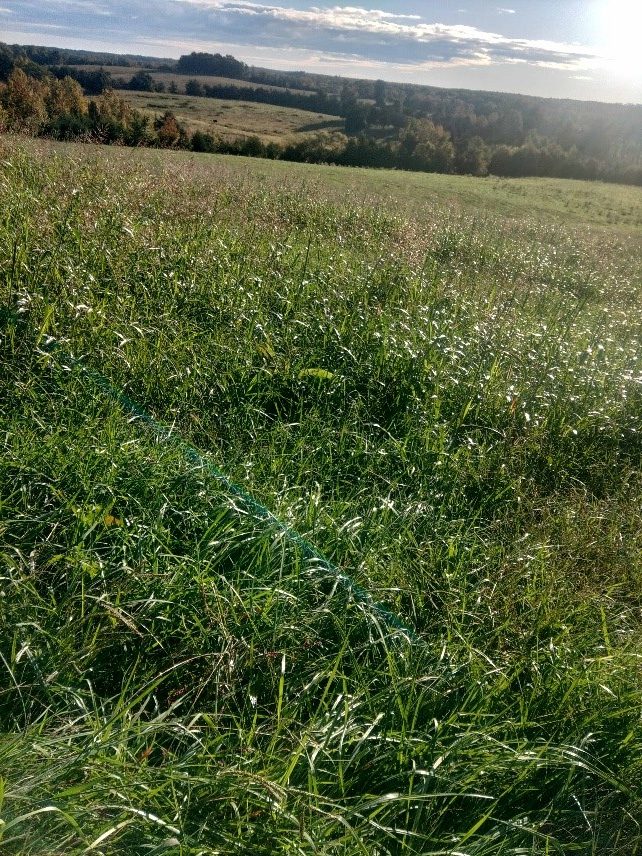
Things are looking pretty good at Triple Creek today. We are in the middle of a lot of fall activities, and so far things are on target. We had a very dry August and September; up until September 24 when it rained 3.2 inches. That set the fescue off growing like I have not seen in recent years. With the weather staying very mild we also had continued growth of summer annuals and dallisgrass. Things really started to slow as we got into October with no more rain, because it is still dry down deep. Blessedly, just when we really started to need it we had another 1.05 inch on October 14. I am writing this on the 17th and where there are good stands of tall fescue it is really piling up. I have not seen this for the last 5 years as we have been chronically dry in the fall. Where there is not much fescue, however, the growth of the crabgrass and other warm seasons has really slowed. It makes me long for strong stands of tall fescue again, and we doing something about that!
We are currently grazing a pasture we usually use as a sacrifice pasture in dry weather, so it is mostly warm season species with a lot of Red River Crabgrass and our local crabgrass. The cows are really grazing these areas close, so we plan to broadcast ryegrass there in the next week.
Brandon and I were standing in the middle of an especially beautiful growing stand of fescue and dallisgrass, and we pondered how it could be without any fertilizer or extreme investment in infrastructure. This particular area has been used for decades for unrolling hay in the winter and then rotationally grazed during the growing season. It has been frontal grazed with daily movement several times during each grazing season for the last 5 years. My conclusion is when a healthy forage stand, good soil fertility and biological activity, favorable temperatures and moisture all come together, some really great things can happen.
Our heifers and cows were due to start calving this year on October 15. We finished calving the heifers today, on October 17! This is the first year we used only one synchronized timed AI for breeding our replacement heifers. We bred 27 and ended up with 17 pregnancies. They were all due to the same superstar calving ease bull on the same day! The 10 open heifers went into our local finished beef program. The heifers started calving 15 days before their due date, and the last one was born today, only 2 days late. We had pretty good luck with them, with 14 unassisted births, two easy pulls, and one that came in the middle of the night and had an 80 lb calf that was born unassisted but DOA.
We calved the heifers in a crabgrass field next to the house that was recently cut for hay. We fed them 3 lbs of cottonseed in the evening and gave them access to hay only at night. Research has shown this approach will cause them to calve mostly in the day. Of the heifers that calved successfully, 15 calved between 8 am and 5 pm, and one we estimated to be about 4 am. We saw 10 of these calves being born! The heifer that lost her calf was put in with another group of cattle not on an evening feeding schedule because she was letting other cows’ calves nurse on her, steeling her colostrum. Because she had access to feed all day she calved at night as is natural for cattle. I really hate to lose a calf from a heifer, but it is almost always the case with a group this size. This heifer is needed to complete our commitments to the beef program, so it was actually part of the plan.

Babies everywhere!
Brandon and I milked the heifer to get her colostrum in case we need it later in the calving season or next year. I taught Brandon how to use a “Can’t Kick Rope” which is also sometimes called a “Flank Rope”. The rope is tied snuggly around the flank and just in front of the udder, which really inhibits the cow’s ability to kick. An old cowboy named Walter Swingle once taught us this trick, and it really works!
~ Matt Poore, NC State and Chair of the Alliance for Grassland Renewal
The Alliance for Grassland Renewal is a national organization focused on enhancing the appropriate adoption of novel endophyte tall fescue technology through education, incentives, self-regulation and promotion. For more resources or to learn more about the Alliance for Grassland Renewal, go to www.grasslandrenewal.org
 The Alliance for Grassland Renewal