My sister sent my Mom and Dad a card one time that showed a little girl stomping through a mud puddle, and the caption was “If you pray for rain, get prepared for some mud”. My folks put it up on the refrigerator and it stayed there for decades. It became one of our mottos around the farm, and reminded us that the one thing we need most, water in the form of rain, is something that is never a bad thing no matter when it comes and no matter how much mud it creates.
Over the last five years we have been having drier than usual growing seasons and wetter than usual winters. We have generally not stockpiled much fall growth due to the dryness, and as a result we had a long feeding season. Couple that with the wet, and we have progressively seen strong stands of tall fescue turn into crabgrass mixtures that are ok in summer, but don’t hold up well to grazing during winter. As a result of this, Mud has taken on a whole new meaning for me.
We made a critical decision during late summer this year to deal with this problem. We sold off 20 cows, reducing our mature cow herd from 110 to 90. The idea was to use the funds we received from the sale of the cows to renovate pastures to novel endophyte tall fescue. Those funds payed for all the fertilizer, seed, planting fuel, herbicides, etc. to plant those 40 acres. With the expected value of the cattle next year, and the reduced feed costs from the herd reduction, our net income will be higher next year as a result.
Many of us need to come to grip with the fact that we are slightly overstocked. I wrote about this last month, so recall that we have a goal of 300 days grazing, but in recent years our carrying capacity has been reduced, and we have been feeding more hay than we want. The stocking rate is the number of cows you have on the farm, while the carrying capacity is the number you should have given your level of forage production…. in our case to feed them for 300 days. If the number of cows you have exceeds this carrying capacity, then you have to purchase the feed for each extra cow you run.
To try to help you understand that, let me give you an example. If your carrying capacity is 90 cows, then it should be relatively inexpensive to provide feed for those animals. An average might be about $1.50/day or $550 a year for each cow. If you have more than 90 cows, then you must purchase hay to feed each extra one for the whole year. With current hay prices that cost would be $2.50/cow daily or $912 a year. With the current cattle prices it is easy to see that those first 90 cows have the chance of making a pretty good return, while those cows after 90 stand little chance to make any money.
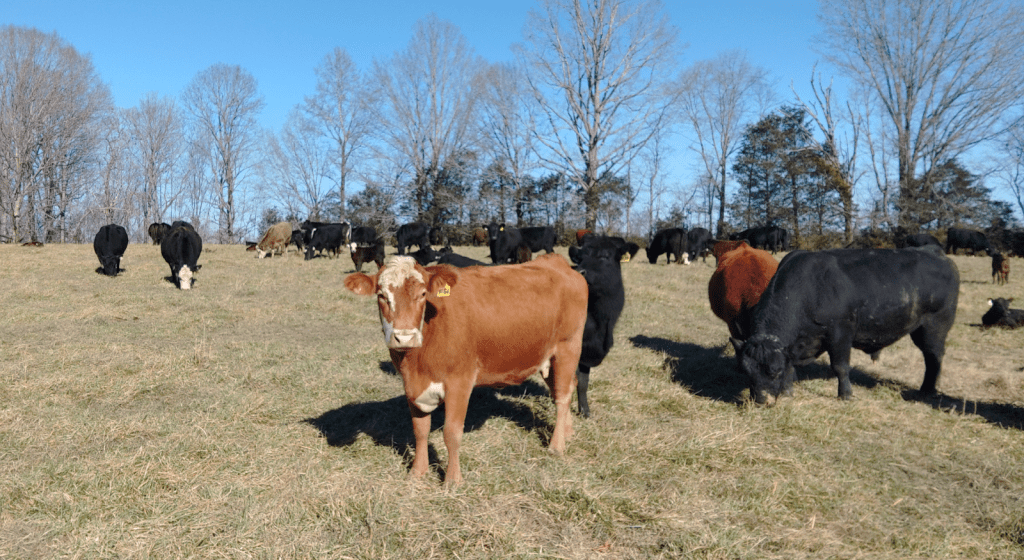
Our decision to cut back our stocking rate this year has turned out to be a really good idea. We had dry weather in the fall, so stockpile was less than desirable, but we did get some. As of today our two cow herds are on stockpiled grass, and the grass will last into February for the mature herd and into early March for the first-calf heifers.
I have been pretty worried about the very dry trend we saw this fall, but like recent years the weather pattern has taken a turn to wet. In these first two weeks of January we have had 6.6” of rain! We have a group of yearlings we are feeding hay and concentrate in a pretty traditional system, and we also have our replacement heifers (Bred January 4) that we are bale grazing. The yearlings are in pretty bad mud, while the group bale-grazing is in a much better situation.
WE are still grazing our two cow groups, using a daily move with a frontal grazing approach. While the pastures are a little soft, the cows are clean, there is minimal mud, and the calves are really enjoying slipping under the polywire and bedding in the clean grass. We are feeding cottonseed to the first-calf heifers, but the mature cows are holding up well without any energy or protein supplement. I am so glad now we sold those 20 cows, so we can stretch this grass further and keep our costs down, while keeping out of the mud!
Today we hit 21 days since the bulls went with the cows, and I am breathing easier about that. Our spare bull failed his breeding soundness exam, so if we had a bull to get hurt we would have needed to find one fast. The breeding has been fast and furious, and now that we are through the first 21 days, 2/3 of the cows should be pregnant. The work for the bulls need to do will go down dramatically, reducing the risk of a breeding injury.
Brandon and I are especially excited about our J55 bull, who is the first bull we have raised in years. He is breeding our first-calf heifers. He was a standout bull-calf out of a good registered Angus bull with good growth and carcass EPDs. His dam, A144, is 1/2 Angus, 1/4 Senepol, 1/8 Simmental and 1/8 Hereford. She is a 12-yr old, 1200 lb cow who usually raises one of the biggest calves. What is different about her is she has one copy of the “slick hair gene” that came from her Senepol grandsire. This gene is dominant and gives the animal a very short sleek hair coat and a high level of tolerance for toxic tall fescue.

The J55 bull was pointed out by some visitors who were really interested in him, so I decided to save him as a bull just to see how he would turn out. He was not pushed, but was fed about 8 lbs of grain a day after weaning up to yearling age. His weight when he went with the cows last year at 14 months was 1200 lbs. He bred 20 cows and then went with the other bulls for the summer. When we did the breeding soundness exam last month he passed with flying colors and weighed 1650 lbs. His calves are on the ground and as anticipated about half of them have the slick hair phenotype. We don’t plan on abandoning our more conventional genetics any time soon, but these slick cattle are interesting and will be something we will continue to watch.
I just returned from the American Forage and Grassland Council annual conference in Mobile, AL. This meeting is one of my favorites with a mix of forage researchers, extension workers, farmers, industry, and NRCS staff. This is a great meeting and is something I would recommend to any serious forage producers. After AFGC I went to Lexington, KY to speak about Tall Fescue at the Kentucky Cattlemen’s Convention.
I had a lot of interest and questions at both these meetings about how to best implement Novel Endophyte Tall Fescue in a forage system. One thing I stress is that the first acres you convert will pay the highest returns as you can use them strategically to manage toxin intake on the farm. Many producers are open to the idea of incrementally adding this forage to their system as they need to renovate, or when they need to upgrade their forage base to support a higher level of performance.
Some farmers will eventually convert all their land to non-toxic forages once they see the high level of performance that is possible, while others will find the optimum system for them involves leaving toxic KY-31 on some of their land. Either way, this Novel Endophyte Tall Fescue technology has a place on most farms in the region that depend on KY-31 Tall fescue as their main base forage.
Finally, we walked our new planting of Novel Endophyte Tall Fescue today. Each time we look at them the stands look better. At this point I would rate stands as good or very good in all but one field, which I would rate as fair. We have some winter annual weeds in all the plantings, and most of the tall fescue plants are now tillering, so we can spray as soon as we get a warm spell to control these weeds, allowing us to get stronger stands going into spring.
I hope your winter is progressing well and that you don’t have too much mud to deal with now that our prayers have been answered. Remember that everything you do on the farm is part of a bigger system that deserves more thought than it usually gets. Take some time to think through what you optimal stocking rate should be. While some will tell you the market signals are to expand your cowherd that is something you should only do if you are understocked and can add cows without increasing your need to purchase harvested forage or other feed.
~ Matt Poore, NC State and Chair of the Alliance for Grassland Renewal
The Alliance for Grassland Renewal is a national organization focused on enhancing the appropriate adoption of novel endophyte tall fescue technology through education, incentives, self-regulation and promotion. For more resources or to learn more about the Alliance for Grassland Renewal, go to www.grasslandrenewal.org
 The Alliance for Grassland Renewal