
Preparing for more pasture renovation in Fall 2024
I am really excited about our new plantings of novel endophyte tall fescue! Twelve years ago we sprayed some of our best fescue land with glyphosate and started planting summer and winter annuals. The plan was to convert to novel endophyte tall fescue, but we kind of fell in love with the annuals which gave us very high quality grazing and were fun to plant and grow.
There are benefits to the annuals, but the drawbacks of an imbalanced forage system and the twice a year purchase of seed finally made us realize that we really need to move on to non-toxic perennials. Many farmers consider novel endophyte tall fescue seed to be too expensive to pay off. The increased performance realized will more than pay for that seed and much more, but it is still hard to swallow over $120/acre for seed. But, consider this: Over the 12 years we grew annuals on this land we spent $1200 per acre on seed alone! After that, $120/acre does not seem like so much!
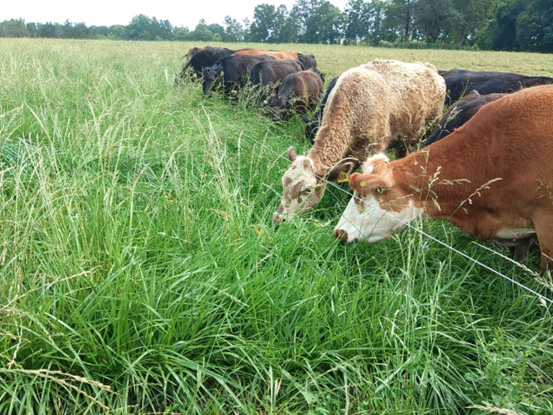
We finally planted novel endophyte tall fescue on 40 acres last fall. We did our best to get good healthy stands including soil testing to guide fertilizer and lime applications. Unfortunately, we had an extremely dry fall season, so we planted very late and into dry soil. We planted four varieties including Estancia with ArkShield, Martin2 Protek, Baroptima + E34, and Jesup MaxQ2. When rains finally came in late November seeds that didn’t come up after planting finally germinated, and by late winter the stands were there, and as good as you could hope for.
We scouted for weeds in January and February and found enough henbit, buttercup and chickweed to cause problems, so we sprayed we sprayed with a broad spectrum broad-leaf herbicide in late February. We applied 30 lbs/acre of N from granular urea about March 1, and after some timely rains the grass really took off.
The new fescue was growing well in March but so was ryegrass that came from volunteer seeds in the seedbank. The ryegrass was thick enough on two fields to cause trouble, so we grazed quickly to about 4 inches, which means the ryegrass was grazed more intensively than the tall fescue. By mid-April these early grazed fields and the fields that had not been grazed were all ready to be grazed again. We rotated across these quickly with our replacement heifers and finishing steers during April.
We applied another 30 lbs/acre nitrogen to these stands in late April which worked well with the 11.5 inches of rain we got in May! By the end of May these stands of fescue were again ready to graze. In fact, this grass was so thick we pulled back and decided to cut 5 acres of it for hay, which yielded 1.5 tons per acre, and that after having already grazed it twice!
These stands are all looking good now that we are going into the heat of summer, and I am confident that we will get excellent fall stockpile off these pure tall fescue stands. We have had pretty tough conditions with these stands so far, and because novel endophyte tall fescue is such a tough plant it is doing well anyway.
In the meantime, we are encouraged enough to be eyeing other land to convert this year. We have identified 15 acres that we will be planting to more novel fescue this fall. One 5-acre piece will be converted using the “Spray-Smother-Spray” technique. In this case, after the first grazing we sprayed with glyphosate and planted Ray’s Crazy Mix. After grazing that once or twice (depending on summer rainfall) we will spray again with glyphosate and plant the fescue.
The other 10 acres will be converted using the “Spray-Wait-Spray” technique. With this area we started by clipping the seedheads in early May and then in early June we grazed it. We will rotate through and graze it again several times this summer before spraying with glyphosate about September 1. We will then wait 4 weeks and spray again before planting about October 1. Both of these systems have proven to be successful and of similar overall net cost.
Additionally we will be establishing Novel Endophyte Tall Fescue stands on about 36 acres of outlying hay land that eventually will be converted to pasture. For now this former marginal crop land will grow really good crops of non-toxic forage. We plan to use this hay to help reduce our dependence on purchased hay containing toxic tall fescue seed.
The most encouraging thing about having all this non-toxic forage is the performance of our cattle. We are grazing part of this new stand with a group of bred replacement heifers and finishing steers. These cattle were turned out on ryegrass and oats in early March, and they have had really high quality forage ever since. These cattle are showing a body condition of 6+, all without any supplemental feed.
Forages are the key to economical cattle production in the current environment. With cattle prices and feed both very high, producers that can get performance on cattle using homegrown forages rather than purchased feed will be at a great advantage.
 The Alliance for Grassland Renewal