The board of the Alliance for Grassland Renewal had a firsthand view of the 2024 grass seed crop in the field in the Willamette Valley in Oregon during late mid-June. We were treated to a great tour of the valley, hosted by our Oregon seed company members.
The weather has been very good for seed production this year. The Willamette Valley is ideal for seed production because of it’s wet and warm winter and spring, followed by a very dry summer. Because of it’s ideal climate, tall fescue seed yield in the valley is usually 1500 to 2000 lbs per acre. Compare this to other grass seed growing areas where yields of Tall Fescue are more on the lines of 200 to 600 lbs per acre.
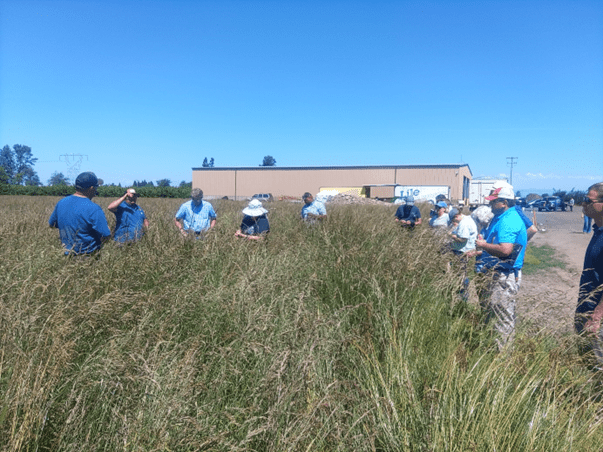
Everywhere we went in the valley we saw a strong crop in the field. The earliest fields of ryegrass were being swathed, but tall fescue harvest had not started yet. As June ended, seed growers were swathing tall fescue fields. These swaths will dry about 2 weeks, at which time the combines will run. Based on early results we expect an adequate supply of seed this year for all varieties, and it should be of very good quality.
After combining, the seed will enter the cleaning process. A seed cleaner is a series of agitating sieves that remove large and very small contaminates. Blowers are also used to separate lighter from denser material. Eventually purified seed from a single field will be assigned a lot number and will then go on to final packaging.
Before shipment to distributors, the seed will be carefully sampled, and samples will be submitted to a lab to determine purity and germination. A sample of seed is carefully evaluated to identify how many weed and other crop seeds it contains, and to make sure that it is viable and germinates normally. All seed marketed must undergo that testing with consideration of restrictions of the state(s) our country where it will be marketed.
In addition to the standard germination and purity testing, Novel Endophyte Tall Fescue seed will be tested for total endophyte infection level (at least 70%) and the presence of toxic off-types (i.e. KY31; less than 5%). This is a voluntary test implemented by the Alliance for Grassland Renewal to insure you receive seed with viable endophyte. If the seed passes these tests then it is designated for packaging and shipping. As a final check, the seeds are also planted and grown out for about 3 weeks for confirmation that the seed lot contains at least 70% viable endophyte. Only seed that passes all these quality control standards receives the Alliance for Grassland Renewal seal of approval. Look for that seal when you buy your seed.
This year promises a good seed crop, so get your order in for your preferred variety. Varieties on the market that are eligible to receive the Alliance seal this year will include Martin2 Protek, Tower Protek from DLF, Lacefield MaxQ2, Jesup MaxQ2 and Texoma MaxQ2 from Pennington, BarOptima plus E34 from Barenbrug USA, and Estancia with ArkShield from Mountain View Seeds. These products have subtle differences so you are encouraged to go here: https://content.ces.ncsu.edu/comparison-of-commercially-available-novel-endophyte-tall-fescue-forage-varieties to learn more. The 2024 crop of each of these products is in the pipeline, and can be expected to reach you by early September if you order early.
It was very helpful to the Alliance Board to visit Oregon and see the seed supply chain first hand. The effort put into this process will provide you with the highest quality seed possible, and will improve your chances for a successful renovation. Farmers often complain about the cost of high quality seed, but a careful look at the process makes it easy to understand how costs add up. The attention to detail we observed in Oregon at all steps of production and testing makes it clear why good seed costs so much.
~ Matt Poore for the Alliance for Grassland Renewal
The Alliance for Grassland Renewal is a national organization focused on enhancing the appropriate adoption of novel endophyte tall fescue technology through education, incentives, self-regulation and promotion. For more resources or to learn more about the Alliance for Grassland Renewal, go to www.grasslandrenewal.org
 The Alliance for Grassland Renewal