On most of the pastureland in our region rainfall is a required resource. At Virgilina, VA we expect 45 inches of annual rainfall, which is about average for the Piedmont of the Eastern US. This rain is supposed to come about 3 to 5 inches a month, with the driest months being January and February, and the wettest being June and July. That works out great if your rainfall follows the long-term average.
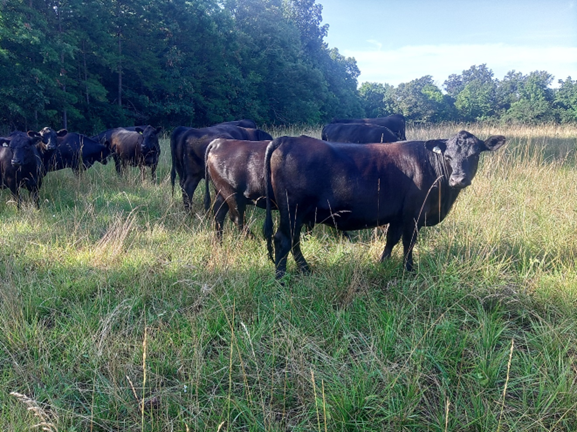
Unfortunately, when June is dry like it was this year forage growth is dramatically reduced as the heat and wind take their toll on surface soil moisture. It is very common in our area to experience dry spells and short-term droughts like we find ourselves in at the current time. With scattered rains starting to come across the region there is some renewed hope, but many field crops are already badly damaged and many livestock producers are feeding hay on overgrazed pastures.
At times like this it is critical to implement a drought management plan. Make sure to take time do a Rain Dance in the face of a promising cloud (you are encouraged to do that to keep your spirits up), but taking careful action to reduce the long-term effect of the drought on your farm is critical for long-term success.
Today it is critical to assess your current situation in terms of moisture. One concept that is very useful is to keep track of your daily and cumulative rainfall so you know where you stand. Some folks are lucky (or unlucky), so measuring rainfall on your location is important. If you keep track of a running rainfall total, it will help you understand just how dry you are. In other words, how damaging that June drought is depends a lot on how much rain you had in May and earlier in the year.
At home in recent years we have tracked our cumulative rainfall so we know more about our deep moisture reserves. This year we had a normal winter for moisture, and then had a wet March (6.9 inches). That was followed by a dry April (only 0.7 inches!) and then a very wet May (11.5 inches). That put us at a surplus of 6.8 inches going into June, which helped us continue to grow grass despite the dry surface. We did get a few lucky rain events in June, totaling 2.35 inches, so we started July with an annual surplus of 4.8 inches. I know that we are dry, but it is nice to temper it with the fact that we are still in much better shape than we were last fall. I know many of you were not blessed with so much water in May, so again this demonstrates the importance of keeping track of your own situation.
In addition to thinking about this rainfall history, we also need to look at the forecast. Don’t get obsessed with it, but weather forecasting is much better than it used to be. Long-term outlooks are available and may be helpful, while the short-term forecast can keep you hoping. Today as I write this on July 7 it is raining at home, and next week is expected to be wet from the remnants of Hurricane Beryl . There is also an expectation of increased activity in the tropics as we move into late summer, and that moisture usually works it’s way into our region. We don’t need a direct hit from a big storm, but we will gladly take the moisture.
The next critical thing to think about today is the total feed inventory for your farm. This will be critical in determining how short you may be on feed so that you can take action before a regional feed shortage is upon you. Start by counting up your hay supply, and while you are at it take forage samples so you can plan on how to best use that hay. Make sure you weigh some bales so you can determine how many cow days of hay you have on hand (remember we measure the feed needed for a cow in lbs not bales).
Next, assess your pasture supply. This is easier for rotational grazing systems than for continuous systems because you can easily figure how many acres you have ahead of you and how much available dry matter is there. Once you graze around to the point that the next best pasture is not ready to graze, then it is time to enter a sacrifice pasture and start feeding hay. Hay feeding will need to continue until about 2 weeks after a good rain that stimulates pasture growth.
If you have a continuous grazing system it is much more difficult. Keep a close eye on the animals to make sure they have adequate forage available. Be aware that in a drought large areas of continuously grazed pasture will quickly become overgrazed and baked dry, and then will remain unproductive for the rest of the grazing season. As a result, a high level of hay feeding or culling will be required if the drought continues.
Once you have an estimate of how many days of feed you have ahead of you and how much hay you have on hand you can calculate when you might run out of feed. This will help you plan well ahead of time for additional hay or alternative feed purchase. If rains return you can adjust your expected grazing days ahead of you, and the work you did evaluating your feed inventory will continue to be very useful.
At Triple Creek we have been running two groups of cattle for the last two months. The main cow herd (which is composed of all the cows that have calved and their 9 month-old calves) continues on our main rotation in the back of the farm. We still have 45 days of grazing ahead of them if it doesn’t rain. This area has not been grazed yet this year and it is heavy with red clover and summer grasses, so if it does rain we will be in great shape.
The other group is composed of our bred heifers and finishers which have higher nutritional requirements than the cows. This group had been on ryegrass since early March. They finished up the last of the ryegrass with a little crabgrass coming up through it the end of June, but after that we had no high quality pasture to move them to. The novel endophyte tall fescue this group grazed earlier has some available forage, but because these new stands are already challenged with the dry, hot weather we will not be grazing those again for about 6 more weeks when they will be set up to stockpile.
The group of heifers and finishers was split up into two groups by Brandon and Tina while I was out of town on vacation for the 4th. One group is the 20 bred heifers which are now grazing 5 acres of a new stand of Bar Optima plus E34 that has not been grazed or clipped all spring. After they clean up that field they will move on to our established 10 acre stand of Novel Endophyte Tall Fescue (mixed varieties).
The 32 20-month old finishers (steers and heifers) were put in a sacrifice field and started on high-quality novel endophyte tall fescue hay and some feed. This will continue until the 15 acres of crabgrass/johsongrass gets enough rain to accumulate good growth. We put 30 lbs per acre of nitrogen on that area, in anticipation of some rain, and that is starting to respond to the small amount of rain we have had.
In the next month we will refine our feed inventory, and make final hay purchases. Right now there is a lot of hay in the area and still some at reasonable prices. There also is a lot of corn that will be cut for silage and other crop residues (corn hay or stover) that may be baled, so know how short of feed you are and make plans now if you need more feed.
Early in a drought it is also critical to reassess your stocking rate. If you are out of pasture forage now, then this drought is telling you that you have too many cows (or sheep, goats or horses) for your system to support. You should be able to go through a month of drought without much worry about running out of feed. At Triple Creek we culled down our cow numbers some last fall because we had been feeding more hay than we like in recent years. This year it is obvious that we have a better balance between the cattle and how much forage we can produce. Cattle prices are very high at the current time, so if you are overstocked and out of feed consider culling some of your less productive animals.
My final word on drought management is to keep it in your mind all the time. The time to manage for drought is when it is raining and things are good. Resist adding animals when you have surplus forage. Resist the temptation to relax your grazing management. The deep roots and high biomass you create will make a big difference on rainfall infiltration in hard summer events, and will also help plants get to deeper moisture.
Perennial pastures are a critical part of dry-land agriculture because they are very resilient to drought. Row crops like corn and soybeans need a lot of rain at the right time, and that is becoming more and more difficult to count on. Well-managed perennial pastures continue to grow after the rains stop, and after it starts to rain again they respond and grow quickly. Managing to maintain a lot of forage biomass and deep roots will continue to be the best way to get through a drought.
Matt Poore for the Alliance for Grassland Renewal
The Alliance for Grassland Renewal is a national organization focused on enhancing the appropriate adoption of novel endophyte tall fescue technology through education, incentives, self-regulation and promotion. For more resources or to learn more about the Alliance for Grassland Renewal, go to www.grasslandrenewal.org
 The Alliance for Grassland Renewal