We have had another eventful month at Triple Creek! A hot and dry June turned into a very wet July, and we have had a very wet start to August. Now, Tropical Storm Debby will be sitting on top of us for the next several days with another 4 to 8 inches expected! It is hard to imagine that just 6 weeks ago we were in drought, and to our north the severe drought centered in West Virginia has grown worse.
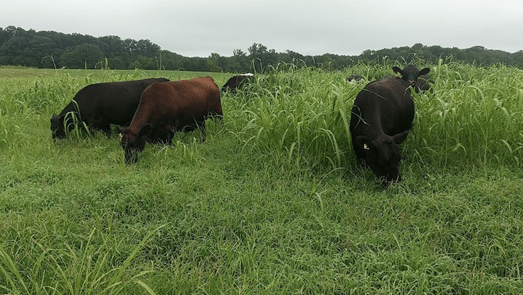
The biggest impact of the rain has been an explosion of growth on all our warm-season forages. All across the farm we have significant stands of purple top, dallisgrass, crabgrass and Johnsongrass. These grasses are now growing rapidly and of high quality.
Christina, Brandon and I discussed the Johnsongrass “problem” because while it is great now, after a few weeks it will be much less nutritious and it will shade out the lower growing species. We decided to move the cattle quickly across a large section of the farm that we had just finished grazing the end of June. This “flash graze” is occurring much sooner than we would normally return to these areas, but the logic is that by selectively grazing the Johnsongrass (which the cattle prefer over everything else) we can help the other species that will stockpile more effectively..
This also will allow us to continue to put high quality forage into the calves which still have not been weaned. We are weaning next week, and once we get that done the cows will go onto a “Summer Stockpile” fescue pasture adjacent to the weaning pasture. We have fenceline-weaned at an age of 10 months now for 4 years with good results. We are looking forward to getting those calves separated where we can start preparing them for breeding or finishing.
Our bred heifers have been grazing across several fields of novel endophyte tall fescue, where they are at a low stock density so they can selectively graze crabgrass and Johnsongrass. They are in exceptional condition and starting to spring. Our finishing cattle at the home farm have been grazing a mix of crabgrass and Johnsongrass we manage to be our summer component following ryegrass in the cool season.
The NC Choices Carolina Meat Conference was last week in Boone, NC and we really enjoyed that. I spoke once but mostly spent time at the Amazing Grazing booth visiting with participants. Christina, Brandon and Laney enjoyed learning more about various aspects of the local meat business and it was great seeing them getting engaged in this community. This is the 7th time the event has been held, and the first time since the pandemic. The sellout crowd with nearly 600 participants from broad perspectives and from all across the country enjoyed a great program including Key Notes from Temple Grandin who talked about Humane Animal Handling and my personal favorite weather man, Greg Fishel, who discussed Climate Change.
The final session of the conference featured Dr. Michael McGraw from the Carbon Cowboy’s film “Roots so Deep (you can see the devil down there)”. Following Dr. McGraw, Johnny Rogers from the Amazing Grazing Program at NC State closed out the conference. The idea of the session was to use the results from the Roots So Deep movie along with all the great education that came earlier during the conference to motivate the crowd to go home and upgrade their grazing management programs.
To prepare for the event Johnny and I watched the film, which is 4 hours long (in 4 parts) and which can be accessed through their website, http://www.rootssodeep.org. I ended up binge watching the whole 4 hours, and I would highly recommend it to anyone that either manages pasture, or that is interested in supporting pasture-based farmers. The film compares matched farms practicing either adaptive grazing or conventional grazing management, and explores many aspects including soil carbon, animal welfare, insect and bird populations, as well as overall greenhouse gas balance. Dr. McGraw was the bird ecologist on the project and gave a great summary to the conference attendees.
The producer and overall project leader, Peter Byck, has now produced several important films, and does a great job pulling together the broad project. The time devoted to the personal stories of the farmers really increases the entertainment value, and also helps you understand some of the cultural challenges that keep folks from adopting better grazing management. I don’t want to give you any spoilers on this because it is well worth your time to watch it. In the end we finished the conference on a high note with words of wisdom from Johnny that were very encouraging.
This does bring me to the point of my story; what to call the kind of grazing system we have at Triple Creek? We have been working out our system for the last 30 years, and the response of the land is really amazing. We now produce a very high yield of diverse species with minimal strategic use of fertilizers, herbicides or other pasture inputs. We use a wide variety of grazing practices including frontal grazing, sweep grazing, creep grazing, flash grazing, stockpiling, and there are many others. We usually move groups daily, especially for the main herd, but we also have some smaller groups (such our bulls) that are set stocked.
In the film the adaptive grazing system is called Adaptive Multi-Paddock or “AMP” Grazing. There are generally principles stated for AMP grazing including long rest periods, minimal or no use of inputs like fertilizer and herbicide, and high stock density. Essentially it is the same as the many other names used including regenerative grazing and mob-grazing. There may be slight variation in practices, but the principles are the same.
When we started evolving our system at Triple Creek about 25 years ago when my family all attended educational events including a grazing school, participated in demonstrations, and decided to go to a rotational grazing system. Folks like Jim Green and Paul Mueller convinced us to adopt temporary
fence, learn fencing skills, and evaluate pasture condition. At this point in my life I really do feel like I am part of that system and it keeps me wanting my feet on the ground out there every day.
After some discussion with our Amazing Grazing Team after the meat conference, we will continue to teach “Adaptive Grazing Management”. If you like to call it Regenerative Grazing or AMP Grazing, feel free just understand it is basically the same thing. The key word is “Adaptive”. Any system that is not adaptive will eventually fail. Building your skills and making those daily decisions that steer your system is the long-term key to making these systems work.
Our focus at Amazing Grazing will remain on helping farmers improve their temporary fencing skills, learning to identify their plants, and to build their interest in the ecology of their pastures. The long-term goal is to produce healthy and high quality livestock and livestock products on a farm that is a net carbon sink, and that improves local water quality and wildlife habitat. At home we will continue to fine tune our adaptive grazing skills, and work with a system of old highly evolved pastures, and newly renovated highly productive novel endophyte tall fescue pastures.
~ Matt Poore, NC State and Chair of the Alliance for Grassland Renewal
The Alliance for Grassland Renewal is a national organization focused on enhancing the appropriate adoption of novel endophyte tall fescue technology through education, incentives, self-regulation and promotion. For more resources or to learn more about the Alliance for Grassland Renewal, go to www.grasslandrenewal.org
 The Alliance for Grassland Renewal