This is a preview of an article written for the Carolina Cattle Connection which will appear in the October edition.
Dallisgrass (Paspalum dilatatum) is a high quality summer forage that is naturalized across the Southern and Mid-Atlantic region of the USA. It is becoming more widespread across the region because of it’s broad adaptation, it’s ability to withstand short grazing, and it’s ability to compete with other forages during summer.
Few people have planted Dallisgrass, but it is a prolific seeder and has primarily spread naturally. It mixes well with tall fescue and clovers resulting in pastures that give both cool and warm season grazing. Producers blessed with natural stands of Dallisgrass have learned to favor it on some fields by fertilizing with nitrogen in early summer, and to favor growth of fescue on other fields by fertilizing in the fall and/or early spring. It is probably also important to let Dallisgrass make a seed crop every several years to maintain stands long-term.
Dallisgrass has a unique role in many forage systems. Its most important attributes are that it produces a lot of high quality summer grazing, and dilutes the cow’s intake of our endophyte infected fescue. It is adapted to a wide range of soils, and is especially well adapted to heavy soils. The one disadvantage is that in late summer it can cause a condition called “Dallisgrass Poisoning” or “Dallisgrass Staggers”. It is common for farmers to “hate” Dallisgrass due to the potential for this problem. However, managers with Dallisgrass can learn to prevent this problem and still use this very productive grass as a beneficial part of their forage system.
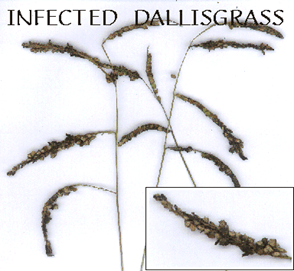
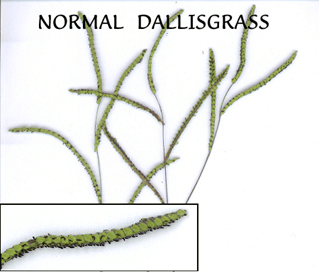
Dallisgrass Staggers occurs several days after cattle ingest a significant amount of dallisgrass seedheads infected with an “ergot‑like” fungus called Claviceps paspali. The seedheads typically are infected with the fungus in late summer and early fall, as the seedheads age. Rather than flat ear drop shaped seeds on the heads, the infected heads have gray to black swellings that have a sticky sap material on them.. Some observers say it looks like little popcorn (see photos of normal and infected seedheads). Sometimes the heads may be orange or red colored. Usually, not all the herd is affected, and it appears that it occurs when some animals develop a preference for the tips of the seedheads. This problem can also occur in horses, and presumably any other mammal that might consume the infected seedheads.
The infected seedheads contain three primary alkaloid toxins, paspalinine, and paspalitrem A and B, which are alkaloids that cause muscle tremors (tremorgens). The affected animals show neurological symptoms, including trembling of the major muscles and jerky uncoordinated movements. Affected animals maybe spooky and sometimes (rarely) aggressive. The animals will startle and run, and often will fall in unusual positions. In severe cases the animals will go down, and may stay down for several days. The symptoms are somewhat like grass tetany, but cattle don’t show the sudden death characteristic of grass tetany, and don’t immediately respond to treatment for grass tetany.
There is no treatment for Dallisgrass Staggers, except to get the cattle off the affected grass, and provide them with high quality forage. If possible, they should be put in a field with no ponds, steep slopes, creeks, etc. as they commonly stumble around and may end up injuring or drowning themselves. Usually cattle completely recover from the poisoning.
In late summer and early fall we often have reports of Dallisgrass Staggers, and it seems to be getting more common now because there is more Dallisgrass in pastures in North Carolina. Toxicity usually is reported on farms with rank, aged Dallisgrass seedheads and the fungus visibly present. In many cases producers had stayed off the pastures hoping to let the grass get a little more growth on it, and as a result the seedheads got old. In other cases, there are only a few cattle in large pastures, so the Dallisgrass grew faster than the cattle could consume it, and eventually they started eating seedheads. Rarely do we get a report of a case where there were deaths of the affected cattle.
If you have Dallisgrass on your farm, you should learn to identify the fungus infected seedheads and then scout your pastures for them starting in midsummer. This is especially important when moving into a new field, or when fields are lightly stocked. Early in the infection process the seedheads develop “honeydew” that will be apparent on your pants when you walk through the stand. After the honeydew stage, the fungal bodies will develop over the next several weeks in place of normal seeds.
If the seedheads do become infected, clip them off at about 12″ before grazing. This generally eliminates the problem. Hay with high amounts of seedheads can also be a problem, so feeding Dallisgrass hay along with other hay is advised, especially if infected seedheads are present.
For more information concerning Dallisgrass Staggers contact your extension agent or veterinarian.
~ Matt Poore, NC State and Chair of the Alliance for Grassland Renewal
The Alliance for Grassland Renewal is a national organization focused on enhancing the appropriate adoption of novel endophyte tall fescue technology through education, incentives, self-regulation and promotion. For more resources or to learn more about the Alliance for Grassland Renewal, go to www.grasslandrenewal.org
 The Alliance for Grassland Renewal