October 2024
It has been another eventful month at Triple Creek Ranch. As usual our calves started coming about 10 days before the due date. We have been managing the cows to gain condition since we weaned the calves in August. Most of the cows are in a high 5 or 6 body condition, and they look to be milking pretty well. The mature cows were due starting September 30 and over half have already calved as of October 10. The first calf heifers were synchronized and bred AI to calving ease bulls selected for moderate mature size, moderate milk, and high carcass merit.
Tina and Brandon are getting better at tagging calves and banding the bulls shortly after birth. Many farmers have difficulty doing this safely, leading to the use of cages to make it safer or just not tagging calves at all. We use a very low stress approach where we quietly approach the sleeping calf and sit down on it, quickly tagging and then looking to see if it is a bull. If so, we slip on a band. About ½ the time the calf never gets up and just goes back to sleep. Most of the cows show no concern because they know us so well. If the cow is a little too protective of the calf we leave them be and tag later, but that only happens with one or two calves a year.
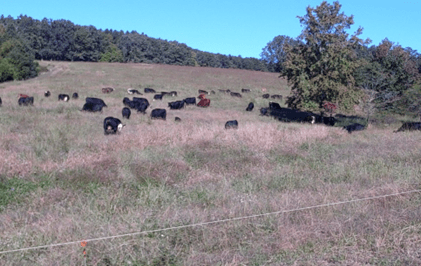
We had over 10 inches of rain in September which stimulated a lot of late growth of warm-season grasses. We have dramatically reduced fertilization of our pastures over the last 5 years, and the result is the toxic tall fescue has been in decline relative to legumes and warm season perennials and annuals. This has helped us with our fescue toxicosis problems, but has reduced our ability to stockpile for winter grazing, increasing our hay feeding days. In the photo cows are grazing a crabgrass, Johnsongrass, tall fescue mix.
Our new stands of Novel Endpohyte Tall Fescue look fantastic. These fields (total of 35 acres) were planted last fall in very poor planting conditions. Even the field we planted into dust November 15 has a good stand as of today. It gives us even more confidence that our conversions are paying off! Unlike our old-stand pastures, these new stands are growing very rapidly given the good moisture we have had. We put 50 lbs/acre nitrogen on in mid-September and these pastures are ready to graze now. These pastures are reserved for the growing yearlings, and the first-calf heifers.
We have had great luck calving our first-calf heifers, with 15 of 18 bred on the first cycle already calving, now the day before their due date! We have not had to assist one yet, but we continue to check them closely. We are feeding them some concentrate and hay at night and turning back on grazed pasture during the day which has resulted in most of the calves coming during the daylight hours. This s a very successful strategy that was proven by research many years ago.
Once these heifers finish calving we will put them on the Novel Endophyte pastures which should support them very well. These heifers are a 6+ in body condition and have been managed since weaning on non-toxic forages. This has really paid off as they have developed very nicely without energy or protein supplementation. Synchronizing them and breeding one time has allowed us to really focus on them for a few weeks and have the job done. This year we decided to breed a few nice ones that came back into heat again, and unfortunately we have 1 that will calve 21 days after the first 18. I don’t think we will make that mistake again this year. I hate to see a nice heifer come up open, but now that our finished beef program has expanded we actually need these heifers to come up open to have enough to fill our commitment.
We are in the process of planting 50 more acres of Novel this year. We are using the spray-wait-spray technique on 12 acres on the main ranch. We grazed this off with the cow herd in late August and were then supposed to spray this with glyphosate September 1 and then plant September 21 following the second spray with Glyphosate. On September 1 it was actually quite dry and there was little regrowth after our grazing, so we decided to wait to spray until after a rain. Unfortunately, once it started raining it rained pretty much every day during the rest of September, and by the time we were able to spray there was enough forage mass that I was worried about having too much residue. We postponed spraying and pulled in our yearling group and grazed this off during the last week of September, and then finally sprayed October 3. We will spray this again and plant October 24. After our experience last year I am not worried about this timing being late, and I will let you know next year how that turned out.
The remainder of the land we are planting is traditional cropland that is being planted primarily for hay. Two fields are being planted in a mix of Tower Protek and Orchardgrass. We are planting one field to the new Triumphant Protek from DLF, one to BarOptima plus E34 and another to Lacefield MaxQ2. Finally, two fields will be planted to a mix of Estancia plus ArkShield and Martin 2 Protek. This land off the main ranch will be used for our hay needs until we get a chance to fence it and develop water.
After seeing the benefits of Novel Endophyte Tall Fescue across our production system we can’t wait to convert additional land next year! What are you planning to improve your farm?
~ Matt Poore, NC State and Chair of the Alliance for Grassland Renewal
The Alliance for Grassland Renewal is a national organization focused on enhancing the appropriate adoption of novel endophyte tall fescue technology through education, incentives, self-regulation and promotion. For more resources or to learn more about the Alliance for Grassland Renewal, go to www.grasslandrenewal.org
 The Alliance for Grassland Renewal