Triple Creek Journal: November, 2024.
This has been a strange year for many of us. We have experienced both record wet and record dry conditions at some point throughout the region. At Virgilina we had record wet months in July and September, with very little rain in June and August, and none in October. Since Hurricane Helene passed in late September we have not had any measurable rainfall. It was the first 0” total for October I ever remember.

As a result of the good rain in September we did accumulate quite a bit of growth on the pastures. It is especially encouraging to see the amount of total forage production so far on our new stands of novel endophyte tall fescue! We planted 35 acres of novel last fall, and despite very dry conditions then, the stands are excellent on 26 acres. One of the 9-acre pieces has a stand that varies from good in some areas to fair in others, with a lot of crabgrass coming on in late summer. We grazed this pasture hard in October to remove as much of the crabgrass as possible and drilled In a mix of Novel Endophyte Tall Fescue and orchardgrass to thicken up that stand. The other fields we are now grazing and leaving 6 inches of residual with the hope of regrowth if we do get rain.
We have fewer acres of annuals this year as we add more perennials back to our system. It is clear that there is a great advantage to the perennials when the weather turns dry. We usually plant a mix of spring oats and ryegrass, and this year that is up, but it is very small and there is no hope of significant feed from that this fall. The novel endophyte tall fescue that is side by side has stockpiled well and is providing valuable grazing for our first calf heifers (see the photo).
We finished up calving the heifers, and we ended up pulling 4 of 19, but all successfully. All of these calves resulted from our AI program and they are really nice. This is a really nice looking set of heifers, and they are now grazing a field of Estancia with ArkShield that really looks good. We have enough Novel Fescue ahead of these heifers to graze them until January even if it does not rain. This group is in excellent body condition, and seeing them milk and performing so well on this fescue with no supplementation will really make a believer out of you.
We finished planting our Novel Endophyte Tall Fescue fields for the year. Despite 6 weeks without rain there is still a little moisture coming up from deep reserves, so some of these fields have germinated. I would feel a lot better if we could get even a little bit of rain on these small seedlings, but it is comforting to know that the small plants are reaching roots down into those soil reserves. Last year there were no such deep reserves, which limited seedling survival in the one field I mentioned with a thin stand.
This year we planted Novel on most of Tina and Brandon’s fields that will be used for hay. These fields are old cropland that they are in the process of converting to perennial grass, and eventually to pasture. We will purchase this hay to use at Triple Creek which will allow us to avoid importing toxic fescue seed and other unwanted weed seeds into our pastures. We planted a variety of the Novel Endophyte products available including three we have not tried before; Triumphant Protek, Tower Protek, and Lacefield MaxQII. Because of our favorable results last year we also planted more Estancia with ArkShield, Martin 2 Protek, and BarOptima plus E34. At this point, all of these products look really good, giving a lot of options to farmers planting pasture.
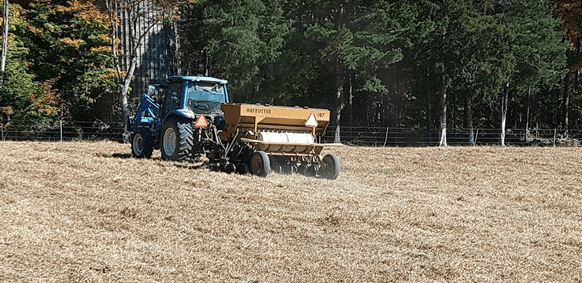
In our old pastures, the KY31 Tall Fescue did pretty well in September, but is looking dry at this point. Summer grasses that now make up a high percentage of these fields we have a pretty good stockpile that will hold up well until we do start getting rain. The crabgrass is completely dead now, but the cows still eat it well when they are moved daily. We have been feeding hay to the mature cow herd for the last 3 weeks to give the pastures additional time to stockpile. The field we are bale-grazing has mostly warm season grasses now, especially Johnsongrass and Dallisgrass. Once we are done with hay feeding next week we will drill ryegrass and crimson clover over this field to compliment all the warm season grasses and to take advantage of the manure nutrients deposited.
As we move through another annual cycle it is exciting to get to cool weather, the birth of the calf crop and shipping out our finishers. There is always a lot to do, but many opportunities along the way to stop and appreciate the ecological system we are wrapped up in. Everyone that manages pasture has that same opportunity at their tips, so take time to observe the many interesting parts of the ecosystem and give thanks for our opportunity to participate.
~ Matt Poore, NC State and Chair of the Alliance for Grassland Renewal
The Alliance for Grassland Renewal is a national organization focused on enhancing the appropriate adoption of novel endophyte tall fescue technology through education, incentives, self-regulation and promotion. For more resources or to learn more about the Alliance for Grassland Renewal, go to www.grasslandrenewal.org
 The Alliance for Grassland Renewal