I love the way the seasons roll in our part of the country. We have every season, and just when you are tiring of heat or cold it starts to change. We continue to have an unusual winter with alternative cold and warm spells, and fairly dry conditions. It has been several years since we have been able to get to most places on the farm without doing much if any damage this late in the winter. We are looking at a big rain event over the next week with several inches expected, so that may change soon.
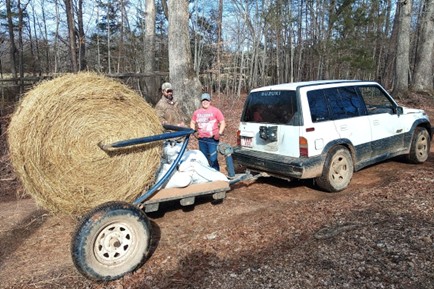
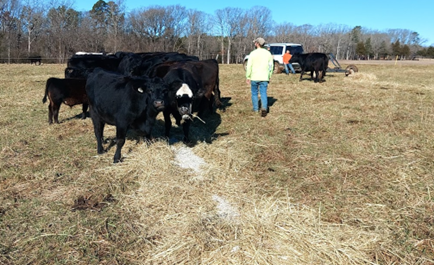
Most of the winter we have been bale grazing as our hay feeding strategy, but we continue to unroll a bale of hay to feed cottonseed on for our mature cow herd along with the free access to round bales in rings. We have been using cottonseed as our main winter supplement for brood cows now for decades, and it is something that really works for us. With 23% protein and 96% TDN it makes a great supplement to provide both extra protein and energy, balancing a wide variety of marginal quality forages. Cottonseed is especially good at stimulating milk production in cattle, and you can really tell the difference in the calves in the main herd since we started feeding cottonseed about 6 weeks ago.
Given the relatively dry weather we have done very little damage to sod this winter, and we have placed most of our bale grazing sites in areas that needed fertility, but that were too wet to access in winter to unroll hay. One such area was bale grazed during October and was then drilled with ryegrass and crimson clover which has come up and is starting to grow. Other areas were heavily impacted to try to knock out broom straw and stimulate the soil biology and the beneficial species that are there. These most heavily impacted areas will get some supplemental crabgrass seed added.
We continue to manage our farm as a system of pastures with different forage types. The back half of our farm is in old stand pastures with a lot of KY31 tall fescue, but also with a lot of red and white clover, dallisgrass, purpletop, Johnsongrass and many other minor warm season annual and perennial species. We use no fertilizer on this part of the farm. These pastures are not as productive as they once were, but they don’t have as much toxic fescue and provide a lot of high quality grazing during mid and late summer.
We have reserved the stockpiled grass in one of these old stand pastures for late winter when it finally does get wet. We will start on this field this week given that it is supposed to rain a lot. We actually need to get on across this field so we can open up the stand for the first big germination event that will come about mid-March. This is an exciting event for me and it makes me realize just how big and diverse the seedbank is when you use regenerative grazing techniques.
We will see a second germination event in early May, and that batch of plants will be warm seasons and will have the less desirable foxtails and vassygrass along with more desirable species like dallisgrass and crabgrass. We really want to create bare ground for the first germination event, but limit bareground in most pastures for the second germination event.
The front half of the farm is where we are making an effort to get rid of most of the toxic fescue and replace it with novel endophyte tall fescue, annuals, and other non-toxic forages. Our plan is to use a high level of management with these pastures to make them as productive as possible during the times of year the old stand pastures are not as productive. We will put nitrogen on the novel endophyte tall fescue next week to get it out early, and we will fertilize it again in late summer to stimulate winter stockpile. Our second year stands should be really strong and will provide is a much higher yield than they did last year. Our first year stands look better every time we look at them.
We will also move ahead with a plan for a pine silvopasture with native warm season grasses. We have 32 acres of a 15 year old pine stand that needs to be thinned, and our plan is to thin it pretty aggressively so we can have a lot of light for the grass. Our goal is really a shady, non-toxic pasture rather than a tree production system so that will push us to remove about 80% of the trees and maybe leave them in patches, rather than isolated individual trees. This may reduce our problem with windfall of these very tall, skinny trees. Silvopasture development his is an area where need additional experience and research.
Finally we will be considering putting novel endophyte tall fescue over our field that is rotated between ryegrass and oats during the cool season and crabgrass/johnsongrass during the warm season. We have problems with this system if we don’t get good late summer rains to establish the cool season component. It seems that if we can get tall fescue established as part of this mix and keep it grazed during summer so the warm seasons don’t kill the fescue it might be an advantage for us.
~ Matt Poore, NC State and the Alliance for Grassland Renewal
The Alliance for Grassland Renewal is a national organization focused on enhancing the appropriate adoption of novel endophyte tall fescue technology through education, incentives, self-regulation and promotion. For more resources or to learn more about the Alliance for Grassland Renewal, go to www.grasslandrenewal.org
 The Alliance for Grassland Renewal