
This article was originally published in The Carolina Cattle Connection, February, 2025.
There are few practices or products that I would recommend for almost all producers. One of these rarities is crabgrass. There are actually many species of crabgrass, and many “ecotypes” within those species. As a result, there are mixed opinions and a lot of misinformation out there about crabgrass. Some cattlemen still consider it a weed while many others have discovered it to be their favorite forage. If you will give it a chance, improved forage type crabgrass can find a niche on almost any farm.
Is Crabgrass a Weed? The weedy reputation of crabgrass comes in part from the problems it causes in lawns. Just one seed can turn into a plant that can creep out and cover a lot of ground, and it is coarse and not the same color as the turf grass, so it is clearly not something you want in your lawn. It is also a headache on driveways and other areas you don’t want a stubborn grass growing.
Likewise, on many farms crabgrass invades tall fescue-based or other cool-season pastures that get damaged in the winter. If there is bare ground, then there will usually be crabgrass. It does provide nutrition to the cattle during summer and early autumn and competes with broadleaf weeds, but it freezes out and does not grow and stockpile like tall fescue in the fall. Over time it will compete more and more with the desirable perennial forage, reducing overall pasture productivity. This is especially true of the lower producing “common” crabgrasses.
In bermudagrass systems, crabgrass is sometimes undesirable because it is a visible contaminant in hay. It typically turns a gray brown color as it cures. In situations where the bermudagrass field is in a waste management plan, too much crabgrass may catch the eye of an inspector resulting in a notice of violation.
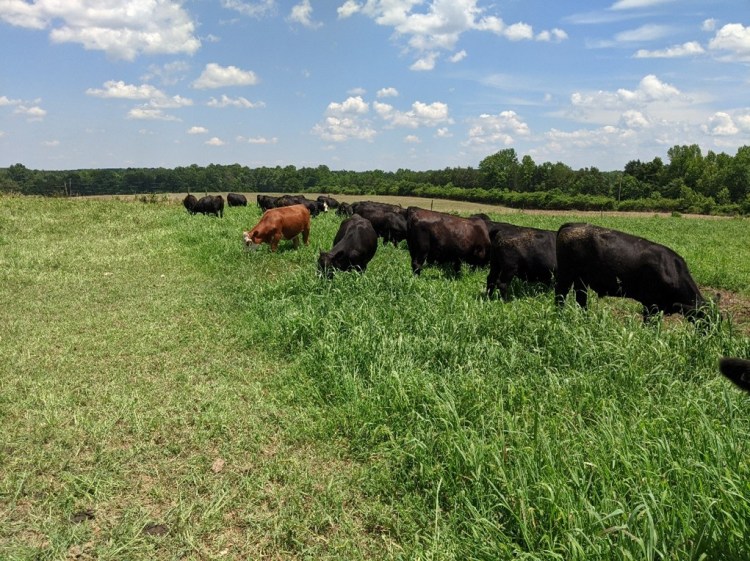
Positive Characteristics of Crabgrass. The positive attributes of crabgrass that need to be pointed out include it’s high nutritive value, and it’s ability to quickly establish and produce a large amount of forage. It is much better in quality than most warm season grasses, and can support season long average daily gains for stocker cattle of 1.5 lbs/day or more. It is very drought tolerant. Even in very dry weather it can be observed to be green and growing in the early part of the day, making use of dew to keep going until it gets rain.
If you do any winter feeding and have areas that are bare at the end of winter then crabgrass is the ideal crop to make something out of those areas. Likewise, if you are trying to implement a system that includes high quality winter annuals like ryegrass, then crabgrass might be the most efficient summer annual to use in your rotation. The low cost of crabgrass seed compared to other summer annuals, and the fact that it can eventually start to reseed itself is critical in reducing the seed cost of an annual system.
Not All Crabgrass is Created Equal. Where I grew up our local type of crabgrass is a smooth crabgrass type that doesn’t yield much and has a very fine texture. In the old days the older farmers I knew called it “hay grass” as it reliably volunteered on land following the harvest of row crops. They took that late summer/early fall growth as a hay cutting. We have this type of crabgrass still in many areas of our farm, but it is not very productive, and when it starts to head and gets leaf diseases in late summer the cattle really don’t like to graze it.
When I first came to work at NC State in 1990, the Noble Foundation released “Red River Crabgrass” and the developer, R.L. Dalrymple, made several trips to North Carolina to help us with educational events. We started working with farmers that wanted to plant it on winter feeding areas, and also for a planned summer forage rotation.
This first true forage crabgrass was a breakthrough. In the early development, R.L. and his colleagues collected hundreds of selections across the world. They found that annual yield ranged from 1000 to over 12,000 lbs per acre. Through selection, Red River was developed to be a high yielding, runner type of crabgrass. There have been several new varieties released by R.L. after he retired from Noble, including “Dal’s Big River” (a selection from Red River), Quick-N-Big, Quick-N-Big Spreader, and Quick-N-Big Spreader 19”.
Currently there a number of sources of Red River, some of which are likely contaminated with common crabgrasses. Impact (another Noble Foundation release) is available as MoJo Crabgrass from Barenbrug USA seed, while the Dal’s Big River and the Quick-N-Big family are available from Dalrymple Farms. Each can also be obtained through a variety of seed dealers.
There is little research comparing all these varieties of crabgrass, but there are critical differences to note.
Red River, Dal’s Big River and Impact (MoJo) are runner type crabgrasses that have stolons that run across the surface of the soil. Quick-N-Big is an upright plant that does not spread by runners. It germinates and grows very quickly, giving you some great early yields. Quick-N-Big Spreader and Spreader 19” are like Quick-N-Big, but they were selected to fall over and root where they fall, making them behave more like a runner type if they need to. Impact (in MoJo) is a late variety that makes much of it’s growth later in the season, while Quick-N-Big germinates quickly and results in high yields just 5-6 weeks after planting if rainfall is abundant.
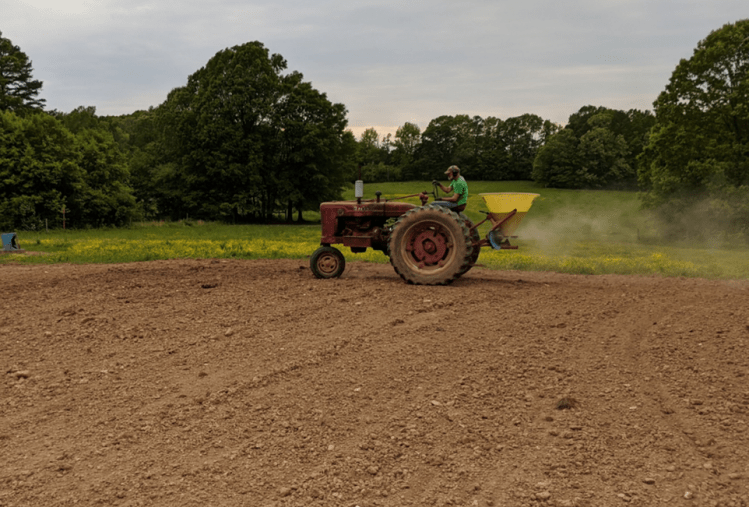
We generally recommend planting using broadcasting with a carrier of fertilizer or pelletized lime, rather than using a drill. Because of hair on the seed, Red River (uncoated) and Dal’s Big River will not flow well in a drill. Coated Red River, MoJo, and the Quick-N-Big types will be compatible with running through a drill. Remember though, crabgrass does not come up well if planted deeper than ¼”, and it is really better for it to be on the surface of the soil, so drilling is discouraged. If you drill consider lowering the drill only until the coulters just scratch the surface, dropping the seed on the slightly disturbed surface followed by the packing wheels.

My Experience Planting Crabgrass. We tried planting crabgrass on our farm starting about 1993, and have been really happy with it. In those early plantings we would broadcast about 5 lb of seed per acre (mixed with pelletized lime as a carrier) after running a chain drag over a winter feeding area. After several years of this we quit putting out seed and found that we had good reseeding on all those areas. To this day we reliably get volunteer stands in these areas and see the “big type”s of crabgrass in the adjacent fields! For this reason I tell folks you really “release” these good crabgrass varieties on your farm.
More recently, we have about 25 acres in 3 different pastures where crabgrass is our targeted summer annual. We graze this short in the late summer (or cut hay) and then drill in ryegrass (and sometimes oats) for the winter annual phase. After grazing the winter annual out in late spring the crabgrass naturally comes in to replace it.
Our plan for this year. This spring we will put out more crabgrass in several situations. We will be planting 5 lbs/acre of an equal mix of Dal’s Big River and Quick-N-Big Spreader 19”. First, about March 15 we will start cleaning up and smoothing the feeding areas using a cultivator where necessary. We then will run a chain harrow and then immediately broadcast the seed and run a cultipacker.
We also have several pastures like the one I mentioned above that have ryegrass on them now that we will seed. These pastures have crabgrass that comes naturally, but we are trying to shift that to the more productive types. On these pastures we will broadcast the seed following the cattle in March as we graze the first cycle, and let them work it in as they graze again in April.
One thing that is important when broadcasting is to remember that the seed does not fly as far as the carrier, so narrow up your path to about ½ of what you would with fertilizer. Calibration is also difficult so do your best, but just make sure you don’t put out too much the first time across. When I broadcast I set the rate pretty low, and then I adjust the rate and go back over it a second time.
Crabgrass is very responsive to supplemental nitrogen, so on the winter feeding areas where most soil nutrients are high, adding about 50 lbs of nitrogen per acre can result in some very large and economical yields. If soil nutrients are low in general, then a complete fertilizer would be recommended.
Finally, be aware that on the winter feeding areas you will have broadleaf weeds, so be prepared to spray them. Typically we seed about April 15, we scout for broadleaves for the next several weeks, and when weeds are present we wait until the crabgrass is about 4 inches tall and tillering, and then spray it with an appropriate herbicide. This really works and helps the grass make better use of the nutrients in these areas.
Part of the joy of agriculture is trying new things like crabgrass. Now that we have good commercial varieties available, take note of this very important grass as you contemplate how you might improve your forage system.
~ Matt Poore, NC State and the Alliance for Grassland Renewal
The Alliance for Grassland Renewal is a national organization focused on enhancing the appropriate adoption of novel endophyte tall fescue technology through education, incentives, self-regulation and promotion. For more resources or to learn more about the Alliance for Grassland Renewal, go to www.grasslandrenewal.org
 The Alliance for Grassland Renewal