
It has been a manageable winter season for us, but as always this time of year I am impatient for spring. We did a lot more hay feeding than we like again this winter, but with our second year stands of tall fescue coming in strong we expect an increase in forage production this year. This is especially helped by the fact that we can use more fertilizer to stimulate yields in these stands without fear of increasing toxin levels. Fertilizer went out on the Novel Endophyte Tall Fescue stands last week, and with a rain that followed, and then a week of 70 degree weather ahead we should see the grass wake up.
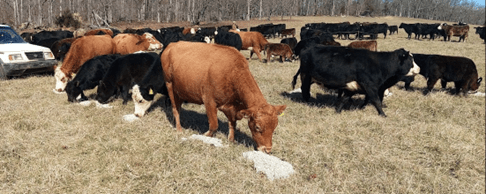
We spent the last two weeks grazing the last of our stockpile with the mature cow herd. We had reserved this grass for use when we needed it most, and after bale grazing for about two months we started stripping that out for the cows as we continued to feed whole cottonseed off the clean sod. It is nice to take a break from the hay feeding, but we will be back to it later this week for another 3 weeks or so.
We were excited to ship the last of our finishers last week! We started shipping these cattle in October, and ended up with a total of 64 finished for the year. We started finishing a few cattle each year about 25 years ago, and we have gradually reduced our cow numbers and increased our finishing numbers. This has allowed us to have a reliable business model that is buffered from volatile changes in the calf markets. I have started to think of our annual cycle ending with the shipping of that last set of finishers.
Now that our 2022 born finishers are gone, we will focus on getting the 2023 crop finished a little earlier than we did this year. We have these cattle in two groups, with 30 at our other farm in North Carolina still grazing on stockpiled tall fescue (photo). This farm is managed to have enough stockpile to last through the winter, and this time of year the cattle really pick up when the green tips start to push up through the old stockpile. This gives an increase in the quality of the diet, and makes for a smoother transition to the spring grass when things do turn on in a month or so. The other finishers are still on the Virgilina farm being fed hay, and they will be combined with the AI heifer group as soon as we have ryegrass available.

It was a challenging tall fescue establishment year for us in 2024 with very dry conditions during the planting season. This resulted in delayed planting dates, so plants were very small going into the winter. In January we had some extremely cold weather for several weeks, and the small plants were severely damaged. This has made it very slow to come out, but there still seems to be an adequate population of plants in most cases.

We had several fields that were tilled prior to establishment, primarily to smooth rough areas, but also to incorporate lime and fertilizer. These areas seem to have better stands than the no-till established fields. This seems to be due to plant residue in the no-till plantings due to the lack of rainfall during the fall and winter.
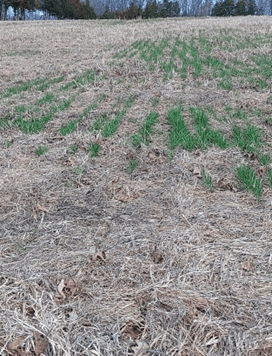
The worst stand on our new plantings to date is on a field where we used the spray-wait-spray system. This was complicated by the weather that delayed us some. We eventually did spray twice with 6 weeks between and planted November 2. Most of this field was grazed pretty close prior to spraying and there are good stands in those areas. In other places in the field there were substantial stands of nimblewill. These areas were not grazed well, so they have substantial matted residue, and these places have very poor stands. At this point it is unclear if there will be some plants in these areas because you can find a few fescue seedlings in the drill rows that have just germinated. In retrospect we might have been able
to burn the parts of this field with all the residue, but I question whether that would have been a good idea in the very dry conditions we were experiencing. As this stand develops I will write more about how we work with it to get to a productive stand.
It is interesting how variable things are year to year. Last year on this date we had a lot of ryegrass and tall fescue ready to graze. This year, we are way behind, with only one small field of oats and ryegrass with growth nearly ready to graze. We decided to start limit grazing this while keeping on feeding hay to our AI heifer group. We are allowing them 2 hours a day, and plan to graze each block 2 to 3 days, buying us about a week or so until the growth picks up. You can’t rush the grass, so we have to try to be patient and not turn out too early which can impact growth through the entire season.
~ Matt Poore, NC State and Chair of the Alliance for Grassland Renewal
The Alliance for Grassland Renewal is a national organization focused on enhancing the appropriate adoption of novel endophyte tall fescue technology through education, incentives, self-regulation and promotion. For more resources or to learn more about the Alliance for Grassland Renewal, go to www.grasslandrenewal.org
 The Alliance for Grassland Renewal