
April 2025
The start of spring is an exciting time, and April is my favorite month. It is always easy to get impatient for spring during March in our country, because despite the spells of warm weather we may have, until the ground warms up you can expect pastures to be slow to come out. Extending the grazing season is a common goal among pasture-based livestock producers, but you can push it only so far until you are overgrazing and setting your pastures back.
I think about my Paw Paw often as I go about my farm chores. My paternal grandfather (Paw Paw to me) was a carpenter by trade, but was also a small farmer in the mountains of southwest Virginia throughout his life. He farmed “by the signs”, and he had all kinds of things he was watching to help guide him on his daily tasks. I hate that I didn’t take time to learn more of the signs he looked for.
“Planting Time” is something he did by the signs of the moon, with tricks like “don’t plant your potatoes when the crescent moon points down or they will grow too deep to dig”. He also taught me other interesting signs like “if it rains with the sun shining it will rain again tomorrow”. I am sure he learned these things from his parents, and by paying attention to little details in his environment. This kind of thinking was a really common approach back when there were no such thing as maps with expected last frost dates or good weather forecasts. You might consider those old approaches as bogus and I am sure some were, but they helped our ancestors survive.
Much of that old knowledge has been lost to many of us, but I realize that I make those same kind of observations which can really help me make better decisions around the farm. Back to the subject of when to start the grazing season. If you have tall fescue-based pastures, it takes a certain soil temperature before they will really take off. If you wait too long to turn out you will never catch up with the grass and it will get over mature. If you are too early, the animals might graze it too short, reducing your production throughout the season. If you get it just right, you can move around the first rotation quickly and the cows will eat mostly tall fescue, removing the boot stage seed heads as they start to elevate. As a result, you will grow fewer seed heads and the quality of the pasture including the amount of vegetative grass and legumes will be much better throughout the season.
I have noticed over my life that tall fescue never comes out in an enduring way before the red buds bloom. When I was young I used to think we were in for a really early start when the fescue greened up in early March. After several times turning out too early and having to pull back in for more hay feeding I realized that until the red buds on the roadsides bloomed there was no reason for me to get excited. I assume this is due to the cumulative effect of warm days on soil temperature, and the red bud bloom indicates that soil temperature has reached the point where tall fescue will really turn on. If you think about it, it is like having thousands of soil temperature monitors in various environments all around you and all you have to do is to notice the flowers as opposed to following a complex graph on a computer screen. This year it was March 22 when the flowers opened, while last year it was 2 weeks earlier.
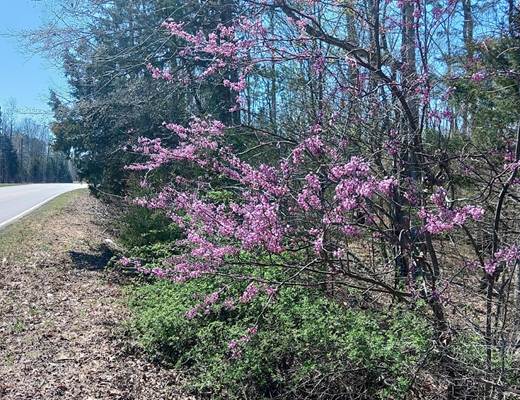
We now get to start on our grazing season before the red buds bloom by planting ryegrass to get the growing cattle and young cows grazing about 3 weeks before tall fescue is ready. I think every farm should plant some ryegrass for this purpose as it is really rewarding to get that very early flush of such high-quality forage and the cows really appreciate it. Also, putting some nitrogen early on tall fescue will help push out some early growth that we can graze after the first time across the ryegrass. If you have toxic fescue, it is probably not a good idea to put much nitrogen on it in the spring and you may need to wait for the dogwoods before turning out. With novel endphyte tall fescue you can push the growth a week or two earlier without increasing the toxicity of the forage allowing you to turn out about the time the red buds bloom.
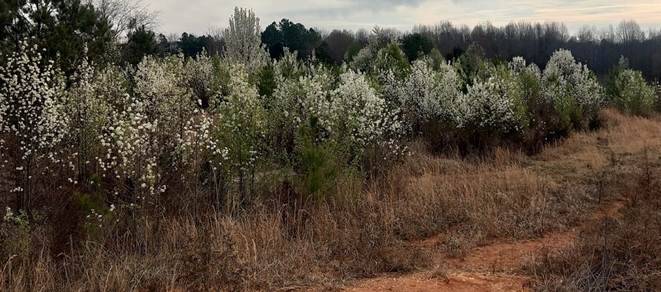
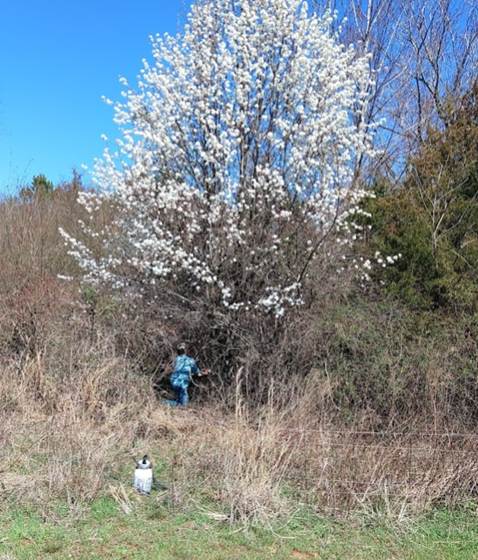
Another activity we accomplished since last month was to cut down many wild type Callery Pears in our riparian zones. Most of these have escaped from ornamental plantings of Bradford Pears (a variety of Callery Pear) or other fruit bearing pears that were grafted on to wild type Callery rootstock. We don’t have a lot of these trees across the farm, but as many know they can become a really big problem if you let them get well established. We have neighbors, especially closer to town, that have thickets of these thorny invasive plants (see the photo). Each year in early March these trees bloom with their beautiful but putrid smelling flowers, so it is easy to see them. We went around and cut as many of them down as we could and flagged any we could not get to for future cutting.
We have very limited use of herbicides on our farm, but this is one case where we make sure we use this powerful tool. We used a 70% diesel, 30% Remedy mix, and sprayed each stump covering the cambium layer (the layer immediately below the bark) and the bark down to the soil level. This will help control sprouting which will happen very quickly if you don’t spray the stumps. We also cut some very thorny honey locust saplings that are continually trying to invade our pastures and gave them the same herbicide treatment.
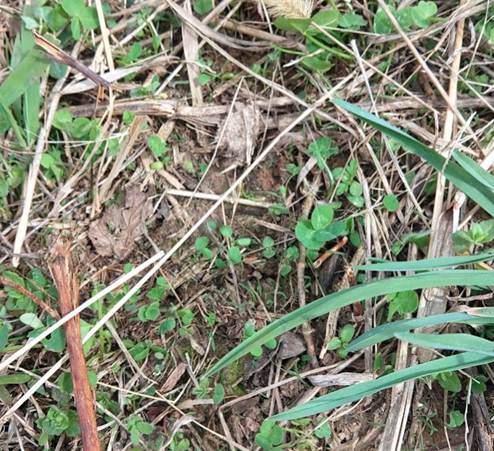
Elsewhere on the farm we finally got the right combination of moisture and warm days to stimulate what I refer to as “the big germ” when our clover seed sprouts to keep our legume stands strong. We have an intermediate red clover on our place that is a great reseeder, and while there are a few “live over” plants, most of the stand we will enjoy later this summer will come from these new plants. To manage to get good stands we will first graze over these pastures once quickly this spring to remove as many fescue seedheads as possible. We will then come back across in June to graze off the grass and vegetative growth of these clovers, and then on our third rotation there will be a lot of warm season grasses and many mature flowers (with seeds) on the clover plants, completing the cycle. Allowing legumes to reseed is a key to keeping a stand, and it is a good idea to allow this to happen at least every few years.
Finally, we put crabgrass seed on the winter feeding areas. We drag these pastures with a chain harrow and then broadcast the seed with a carrier of either pelletized lime or fertilizer. We planted a mix of Quick-N-Big and Dal’s Big River crabgrass at the rate of 5 lbs of pure live seed per acre. Over the next few weeks these seeds will germinate and start the development of some good summer grazing.
Once things start growing well in April it is one of the most joyous times of the year! The cattle don’t feel bad from the combined effects of the hot weather and fescue toxins that are coming in May, and the warm sun really does your attitude a world of good. Make sure you get out there and control where your animals graze and at what intensity, as it is a critical time to set up pastures for the remainder of the year.
~ Matt Poore, NC State and the Alliance for Grassland Renewal
The Alliance for Grassland Renewal is a national organization focused on enhancing the appropriate adoption of novel endophyte tall fescue technology through education, incentives, self-regulation and promotion. For more resources or to learn more about the Alliance for Grassland Renewal, go to www.grasslandrenewal.org
 The Alliance for Grassland Renewal