
As you walk your fields and evaluate pasture conditions, identify areas that might need renovation or a boost in soil fertility. A good first step is to run a soil test. This simple tool gives you valuable insight into two key things: the nutrients in your soil and the soil pH, both of which directly impact forage productivity.
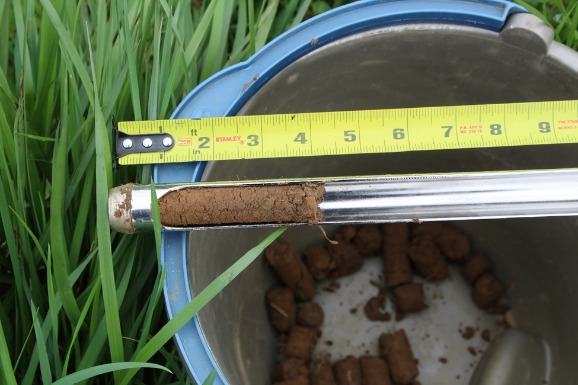
Soil pH is especially important. It tells you how acidic or alkaline your soil is, which affects how available nutrients are to your plants. In pastures, soil tests often come back with pH levels between 4.7 and 5.3. That’s too acidic for most forages to perform their best. Ideally, we want the pH between 6.0 and 7.0 for grasses like tall fescue, orchardgrass, crabgrass, and sudangrass. If you’re growing legumes like alfalfa or clovers, aim even higher, at least 6.5, to help with root development and nitrogen fixation.
Keep in mind that changing soil pH doesn’t happen overnight. Agricultural lime needs rainfall and three months to a year to fully react in the soil. So, if your soil test shows a low pH, don’t wait; apply lime as soon as possible. If you’re planning to seed new pastures in the fall (especially cool-season grasses like tall fescue and orchardgrass), liming as soon as possible during the growing season gives the soil time to adjust before planting. By September, the pH should be in a better place for seedling establishment and early root growth.
When reviewing your soil test, pay close attention to the lime recommendation. At the University of Tennessee’s Soil, Plant, and Pest Center, those recommendations are based on lime with a 65% Relative Neutralizing Value (RNV), also called Effective Calcium Carbonate (ECC). But not all lime is equal. Some lime sources may have an RNV as low as 50%, meaning you’d need to apply more to get the same effect. For example, if your soil test recommends 2 tons per acre at 65% RNV, but you’re using lime with 50% RNV, you’ll need to apply 2.6 tons per acre to get the job done (2 × 0.65 ÷ 0.50 = 2.6). Always ask your supplier for the RNV and adjust your application rate accordingly.
Also, be cautious with liquid calcium products. Some are marketed as “liquid lime” or quick fixes for low pH, but research from the University of Kentucky shows they do not actually raise soil pH. Agricultural lime remains the only proven and effective solution for raising and maintaining proper soil pH.
Bottom line? Stick to the basics: test your soil, apply the right type and amount of lime, and give your pastures a solid foundation. Managing soil pH properly sets up your forages for stronger growth, better nutrient use, and long-term productivity.
~ Dr. Bruno Pedreira, Forage Specialist & Director of the UT Beef and Forage Center, Department of Plant Sciences, University of Tennessee.
The Alliance for Grassland Renewal is a national organization focused on enhancing the appropriate adoption of novel endophyte tall fescue technology through education, incentives, self-regulation and promotion. For more resources or to learn more about the Alliance for Grassland Renewal, go to www.grasslandrenewal.org
 The Alliance for Grassland Renewal