
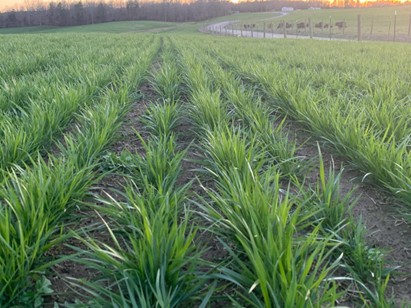
First year management of newly established novel endophyte tall fescue is a hot topic of discussion at many of the Alliance’s in-person workshops and online trainings. Ideally, new fall-planted fields are well established and the rows are covered with a full canopy of leaves. We are well into spring now and about to enter summer so new pastures have likely been grazed lightly once or twice or hay has been cut and baled. I’ll break this article into a three parts for management of newly established novel endophyte fields; 1) grazing management for summer, 2) summer weed management considerations and 3) planning for fall management.
Summer grazing management:
Many of the articles that Alliance members have written address the need to conservatively manage grazing and hay production during the establishment year. We typically recommend a residual grazing height of 4” and a hay harvest height of 6”. These heights are important as cool season grasses store much of their energy reserves in the lower portion of the crown. This energy is used not only to fuel leaf regrowth after defoliation but also is used for plant respiration to maintain the plants. Respiration increases markedly during high temperatures (during the day and even with high night temperatures). These newly established plants also have roots that are not completely developed making the plants more susceptible to injury from heavy defoliation and/or summer droughts. Protection of the lower crown is important in maintaining a healthy, vigorous stand of tall fescue that is primed to rapidly grow once temperature and moisture becomes favorable in late summer and fall. So summer management is critical not only for maintaining thick stands, but also for efficient fall nitrogen responses and rapid growth (and subsequent regrowth) with fall grazing.
If pastures are grazed in summer months (remember that minimum 4” residual height!), longer rest periods can also be beneficial in restoring and maintaining the crown energy reserves. Typical rest periods for cool season grasses are in the 25-28 day range, but these should be increased in summer months. Because of the wide variation in temperature and rainfall across the region it’s difficult to say what the proper rest period should be, but with good conditions and active summer growth 35 days is not unreasonable. Rest periods exceeding 60 days during drought or high temperatures may be warranted.
Summer weed management:
Most spring weeds have come and gone by now but warm season plants are taking their place. Evaluate stands closely to determine if steps should be taken to remove problematic species like dogfennel or horsenettle. If clover is to be established in the fall, select herbicides carefully to avoid residual activity on clover seedlings. Clover planting may need to be deferred an additional year if weeds like horsenettle are present and must be controlled with picloram or aminopyralid. Other weeds may respond to 2,4-D, dicamba or triclopyr which have much shorter residual activity so that clovers can be drilled this fall or frost-seeded next spring.
Planning for fall management:
The herbicide information above affirms that summer decisions influence what can be implemented and accomplished in fall and winter months. It may be wise to soil test the pasture again to determine the pH response received from lime applications made last year. It may also still be necessary to add additional P or K to the pasture. Depending on the fertility needs it may be advantageous to source poultry litter instead of applying commercial fertilizer. Lime P, or K (or a combination of these) may be required if clovers are to be added to the stand. Guessing can be expensive either from excess nutrient application or in decreased stand establishment or forage production, so pay for that soil test and get definitive results and instructions for success.
It is also important to research what clover(s) are to be added to the stand and to research and source the best varieties for your climate and management style. White and red clover species are commonly added to tall fescue stands and are widely adapted across the tall fescue belt; however, there are varieties within each species that have disease tolerance and growth patterns more suitable to northern/southern or humid/dry climates. Consult with your local county agent to determine which varieties best fit your area and management style.
If clovers aren’t going to be fall drilled into a grazed stand, it may be appropriate to stockpile the novel stand for the first fall production season and frost seed clover. Stockpiling also gives the plant every advantage to fully develop a root system. Ideally, from a pure toxicity standpoint, it is most advantageous to graze novel endophyte fields first in the late summer and early fall because that is when the toxins will be highest in those old fields of Kentucky 31. So, if you feel that the novel stands are well established and developed, by all means graze them first in the fall and defer KY31 to cooler weather when the ergot alkaloid levels drop. If for some reason the novel stand seems weaker and in need of a rest following the summer, stockpile it until later in the winter and broadcast clovers into it at the end of grazing.
Hopefully these tips have been helpful in determining summer management and fall planning of newly established novel tall fescue. Once these stands are well established they are resilient and provide high quality nontoxic grazing for years to come.
~ John Andrae, Clemson University and the Alliance for Grassland Renewal
 The Alliance for Grassland Renewal