Triple Creek Journal June 2025.
We have been suffering from drought now for about 4 years. Very dry falls coupled with long dry spells during the spring and summer have made it pretty tough. I remember a few times in my life when we had favorable moisture throughout the growing season, and remember having more grass than we knew what to do with. The last time I saw that was a long time ago.
For the last year we have been worried about our managing our stocking rate. We started as a purebred Hereford farm for about 20 years, and then transitioned into a commercial cow/calf farm for four decades. We backgrounded calves for 60 to 100 days, and raised replacement heifers. In 2015 we started finishing more and more cattle. Now 70% of the calves are finished to 24 to 30 months of age and 15% are replacement heifers. We have adjusted our cow numbers down by 1/3 (150 cows down to 100 cows) and that should balance the forage budget on an annual basis. However, our highest forage demand now is during the fall and early winter.
Before, our peak number of pounds of cattle on the land was in June and July just before we sold the calves. Now it is in October when we have the cows calving and in early lactation, all the finishers, and all the yearlings. This high demand, coupled with the dry fall weather has made it difficult for us to keep everything fed, and we have fed hay for many more days than we like for the last several years. We also suffer from the impact of fescue toxicosis, which really hurts our ability to finish those cattle off early.
Superimposed over that are problems the weather is creating with growing the amount of grass we are used to on an annual basis. We also used less fertilizer because it is much more expensive than it used to be, and that clearly has reduced our yields. The bottom line is we have been really worried about being overstocked. Even though our new plantings of tall fescue will really hit a gear this year, and we are bringing in new land we are not expanding our cow numbers any at this time.
The last month has been pretty amazing. The weather was very cool all through May with abundant rainfall. Most days it either rained, or it was in the 70s with low dew points. Cool season forages really responded and their rapid growth stretched on into June. Today we are still grazing ryegrass that is desperately trying to head out, but that has retained a lot of quality. We grazed all around the farm one time early which we had to do because of our dry April, so our seed head control was great with few fescue heads left standing. These pastures have really come out with a strong stand of clover and now the warm season species are picking up.

Our warm season forages finally got a kick this week when the thermometer started reaching the mid 80s and the moisture was plentiful. We have a lot of dallisgrass, purpletop, and bermudagrass that start to make a strong part of the stand as we move into summer. We also have more and more native legumes coming in, especially beggar tick trefoil (desmodium species). I have taken a keen interest in the various plants and how we might better incorporate them to reduce our costs and the fight the toxic fescue that is in most pastures.
As we stand today we really have a lot of good quality forage ahead of us. We are holding with our decision not to increase numbers, but hopefully we will be enjoying a lot less feeding days this winter!
Our renovation of pastures and cropland with Novel Endophyte Tall Fescue continues to be a major emphasis for us. We cut the cropland areas for hay and really got some high quality feed off those. The pastures, most of which have been in now two years, are very strong and giving us a lot of production, especially in between the supply of annual forages.
We are planting two small pieces of cropland (7 acres) that belongs to Brandon’s uncle and 12 acres of pasture on Triple Creek. The cropland we are planting has been in oats and millet for two years, and will be planted in Novel Endophyte Tall Fescue this fall. We really struggled with pearl millet on that land last year, so we decided this year we would use browntop millet and plan for only one hay cutting and an early planting date for the tall fescue.
One of the pastures we are renovating was planted in Ray’s Crazy Mix for the last two seasons, both summer and fall. We stockpiled the fall mix and didn’t graze it until early May. This was heavily vetch, wheat and ryegrass. The cows ate the vetch and ryegrass, and the wheat heads, but they stomped down most of the straw. This has created a great situation to drill into. Tina planted the sudangrass 5 days ago, and we were excited today to see it jumping out of the ground!
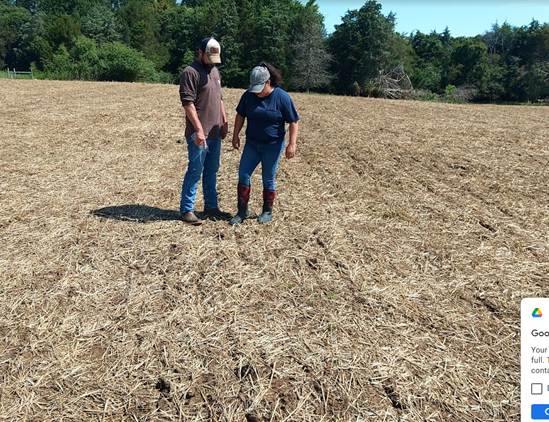
The other pasture we are converting is still in KY31 tall fescue along with Johnsongrass and other species. We grazed it early and then clipped it before tall fescue could make any mature seed. We were going to spray it with glyphosate in late May but it had grown back so much that we decided to graze it again first, worrying about all the plant residue there would have been there if we had gone ahead. As of today we have not grazed that yet, but still plan to do that in the next few weeks followed by the sudangrass, which we will only be able to graze one time.
We also have two 2-acre areas in our middle field that were planted last year using the Spray-Wait-Spray method. These we are planning on replanting. The lack of rain and excessive plant residue last fall is to blame for this, and it is our first sure enough failure. We decided we would let one area go (just to see if the fescue might continue to come in) and the other we sprayed down with glyphosate and planted sudangrass. The one we didn’t spray came with a strong stand of buckhorn plantain, and red and white clover, and we will be grazing finishers on that. While I say this was a failure, our real intent was to kill toxic tall fescue, so we have been successful with that part. The nice new tall fescue stands will be welcomed when they are finally established.
Every situation is different, so as you contemplate actions to improve your pastures consider completely redoing some areas and upgrading your grazing management on the rest of your farm. It is very rewarding and can help you really impact the performance of your animals. Once you start to take action in small bites the benefits become apparent and this will encourage you to continually work to improve your system.
~ Matt Poore, NC State and the Alliance for Grassland Renewal
The Alliance for Grassland Renewal is a national organization focused on enhancing the appropriate adoption of novel endophyte tall fescue technology through education, incentives, self-regulation and promotion. For more resources or to learn more about the Alliance for Grassland Renewal, go to www.grasslandrenewal.org
 The Alliance for Grassland Renewal