
It has been a good summer grazing season as we continue to get ample rain. A really mild May turned into a blazing hot June, but rain is a great healer. We have high populations of dung beetles working the pastures now, and our native warm season grasses and legumes continue to build as part of our diverse pastures. I realize that utilizing short duration grazing and long rest periods will really help these plants to compete with tall fescue because they can build a seedbank.
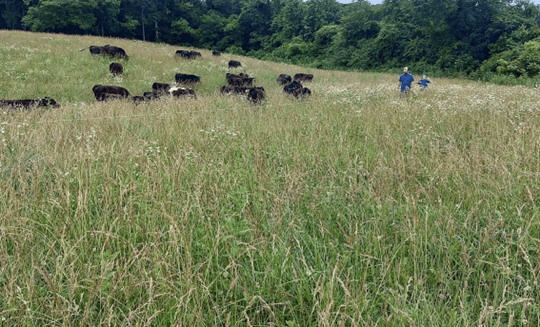
Folks that use very long rest periods will appreciate how a much of a seedbank develops. Once most plants are allowed to make seed, those seeds will wait for an opportunity to sprout and cover the ground. This of course could be viewed as undesirable as many “weed” species will be allowed to make seed. However, to keep a long-term stand of clovers and the natives, you need to allow the seed bank to develop, and these undesirable species will always be with us.
We have never used many herbicides in our program, mostly because I am more of a cattleman than a farmer. We have areas on the farm that have never seen an herbicide in the 48 years we have owned the ranch. Over the first 40 years we regularly mowed those areas in the late summer before stockpiling tall fescue. As we got better and better control of the blackberries and other brushy species, we got a little more complacent about our late summer mowing, and more likely would mow in the early summer to knock off the seedheads.
Plants like purpletop (a native warm-season grass) and tick trefoil (a native legume) which bloom in late summer started making good seed crops. As a result we find we have more and more of those species every year. We manage the back half our farm that way, and it turns out to be much better than when those pastures were predominantly KY31 tall fescue.
On the other half of the farm we are renovating the pastures to warm-season grasses and novel endophyte tall fescue. These areas are critical for our growing and finishing cattle, and our replacement heifers. We do use glyphosate in our conversion plan, and also might use a broadleaf herbicide to control undesirable species like Horsenettle and Spiny Amaranth (pigweed). Our goal is to deplete the seedbank of those species, and then later build a new seedbank of clovers and more desirable forbs.
As we were grazing around our new tall fescue pastures in June, I realized there was a tremendous amount of fescue seed production. I have generally recommended clipping tall fescue pastures rather than letting them make seed. This is partly to improve the forage quality by removing the lower value seedheads and encouraging vegetative growth, but also to prevent fescue toxicosis.
I realized that all this tall fescue seed was creating a very heavy seedbank. Then I realized that if a stray toxic tall fescue seed fell from the sky, it would not have a chance against those many millions of novel seeds! Thin spots will inevitably develop in our pastures due to some kind of heavy use, or possibly as a result of poor drilling that leaves gaps in the initial stand. I have been a bit worried about those places in our new fields, but during this second grazing year we stomped in a whole lot of the kind of seed we really want! If we allow a novel endophyte tall fescue seedbank to develop, then it will fill in those niches that could be filled by toxic tall fescue or other undesirable species that fly in on the wind.

We weaned calves today, and our fenceline weaning system has really improved the experience for both man and beast. I still have a little knot in my gut on the day before weaning because of the many problems we have had over the years. After 5 years experience, weaning across an electric fence is strongly recommended. To give the calves good grazing we encourage a stand of crabgrass and bermudagrass on our 5-acre weaning pasture, and in an adjacent 5 acre pasture we “summer stockpile” KY31 tall fescue.
Summer stockpiling of tall fescue is an idea that was developed at Virginia Tech that involves leaving all the growth until late summer when it is grazed off using controlled grazing. We have found that this kind of stockpiled grass is great for the cows right after we wean the calves, so we frontal graze this field during the week of weaning.
While this pasture for the cows is predominantly KY-31 Tall Fescue, there is also a lot of Johnsongrass, Dallisgrass and many other species present. It is very adequate nutrition for drying off the cows, and it is something we know we can count on every year. This area is scheduled for renovation to Novel Endophyte Tall Fescue next year, so we will have to modify our weaning program a bit, but I believe that creating a summer stockpile from Novel Endophyte Tall Fescue will work even better in this system once that is established.
After the week on crabgrass, this year’s calf group will graze dwarf Sudangrass we are using as our smother crop prior to planting novel endophyte tall fescue. Then they will go on to a second year tall fescue stand which has really grown out well due to all the rain we have had. Assuming adequate rainfall they will then be able to graze Novel Endophyte Tall Fescue well into the winter
Tall fescue really is an amazing forage once you take the toxins out of it. While we formally classify tall fescue as a cool-season perennial, it is really one of those grasses that can be grazed throughout the year. It does slow down in summer and winter, but it’s ability to retain it’s nutritive value over time means you can graze it all year long if you plan things right. As you get to the southernmost areas of tall fescue adaptation you need to be more careful about grazing it in the summer, but across most of the tall fescue belt a lot of cows eat tall fescue from April through February. Compare that to warm-season forages that don’t have nearly that long a grazing season, nor the ability to hold onto nutritional quality.
What is your forage system and how might you tweak it to extend your grazing season and to get better performance from the forage you grow? There are many ways you can improve your pastures, and building a desirable seedbank may be one of the most important things you can do. Decide what you want your pastures to look like, go to the effort to renovate if it is called for, and once you get the species you want build a seedbank to allow the system to rejuvenate itself.
~ Matt Poore, NC State and the Alliance for Grassland Renewal
The Alliance for Grassland Renewal is a national organization focused on enhancing the appropriate adoption of novel endophyte tall fescue technology through education, incentives, self-regulation and promotion. For more resources or to learn more about the Alliance for Grassland Renewal, go to www.grasslandrenewal.org
 The Alliance for Grassland Renewal