September, 2025
It has been another busy month for us getting pastures clipped and getting cows ready for calving. We had a very wet spell in July and early August, but that quickly changed with less than an inch of rain here in the last 3 weeks. The dry weather is expected to continue for the next several weeks at least, so we are starting to adapt our plans and planting schedule. Dry weather in Autumn has become the norm for us, and it really makes establishing cool season forages and stockpiling for winter grazing difficult.
With the high amount of rain we had in July and early August came abundant growth of warm-season forages. We have had a lot of dallisgrass for many years, and in recent years crabgrass and Johnsongrass have really expanded. These are all good for summer production and help with fescue toxicosis, but once you get to late summer their quality really falls and they hold back the cool season species.
When there is an excessive amount of summer rain it can turn this situation into a big problem. We are still trying to graze off pastures with a lot of Johnsongrass and crabgrass that we bale grazed on last winter. There is a huge mass of forage there. All the pastures we have grazed across have been clipped to knock down the warm seasons so fescue and clover can get more light. It is not super dry yet, so if we can just get a few rains we will be in better shape with stockpile than we have been in recent years.
At Pleasant Hills Farm, 6 miles down in North Carolina, we have 30 finishing steers that are weighing about 1250 lbs and nearing finish. We will start delivering them to our aggregator in October. These cattle grazed through a diverse mix of mostly native species during June and July, and then went to pastures with a lot of dallisgrass. By mid-August much of this dallisgrass had headed out and was developing ergot infection. I kept walking ahead of the cattle scouting for bad heads, and when the sticky honeydew started being obvious on my pants I realized we had to clip it.
Ergot infection of dallisgrass is caused by a fungus similar to the ergot that infects small grains and other grasses. This organism is called Claviceps paspali and the toxins it produces cause tremors and staggers once cattle consume enough of it. It is a very scary thing to see, and we have had it several times in the past so I really don’t want that in these finishers.
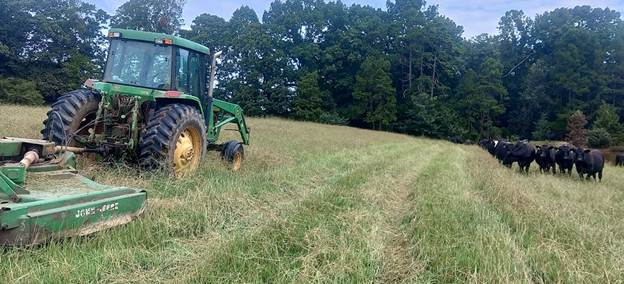
I normally don’t clip pastures “high” because fescue seedhead stubble can be really sharp, causing eye injury and interfering with grazing. In the case of this dallisgrass there was so much mass that if I had clipped it short (6 inches) it would have left enough mass to smother the stand, and besides I needed the forage for grazing. Dallisgrass doesn’t get the sharp seedhead stubble like fescue, so that also doesn’t seem to be a big problem.
We feed these finishers a mix of soyhulls and corn gluten feed to balance the diet to give us gains high enough to achieve a medium choice quality grade. These are the quality goals set by our buyer, so it is important that we work hard to have the cattle fat enough by the scheduled delivery dates, and the feed helps us to accomplish that. We are feeding 8 lbs of feed to these cattle right now along with a daily allowance of grass which is about twice what they need, allowing them to be a little selective in what they graze. Right now they prefer the dallisgrass and other warm season species, and don’t graze the tall fescue as hard.
One thing we have been working on is getting more animals in our herd that carry the slick hair gene. This trait is a mutation that worked it’s way into the genome of many cattle in the Caribbean and Central and South America. It was brought to the US primarily in Senepol cattle. Senepol is a composite breed created in the Virgin Islands and made up of Red Poll, a british breed, and N’Dama, an African breed. Additionally, there apparently were local feral cattle that carried the slick hair gene in the mix as the slick hair trait is not found in either breed. Many purebred Senpols have two copies of the slick hair gene (they are homozygous).
We have done research at NC State that showed this gene imparts a high level of tolerance to tall fescue. We have bought some slick hair cows over the years, and also used a bull we borrowed from a breeder one year. Cattle that have the gene are obvious and show much less fescue toxicosis compared to our mostly Angus cows. The few cows we have with the trait have produced some pretty good individuals, and we have several bulls we have saved that carry the gene. We are expecting at least 35% of the calves born this year to carry the slick hair gene, and based on the calves we have raised the last few years we are excited to see how this turns out.

We are in the process of grazing off the remaining sudangrass on the land we will plant to Novel Endophyte Tall Fescue this fall. We expect this seeding to be in early October and we are hopeful we will get some rain by then. Our stands planted the last few years look good, but we had a lot of competition from crabgrass and Johnsongrass this year. We are still trying to get all that grazed off, and so far the fescue stands behind the cattle are looking strong.
It is an exciting time for us with calving coming on, and by the time I write next month we should have a lot of calves on the ground. The cows are gaining condition on the forage we have for them now, and we plan on bale grazing for a month as the first wave of calves starts coming. I hope we all get rain and have healthy calves!
~ Matt Poore, NC State and the Alliance for Grassland Renewal
The Alliance for Grassland Renewal is a national organization focused on enhancing the appropriate adoption of novel endophyte tall fescue technology through education, incentives, self-regulation and promotion. For more resources or to learn more about the Alliance for Grassland Renewal, go to www.grasslandrenewal.org
 The Alliance for Grassland Renewal