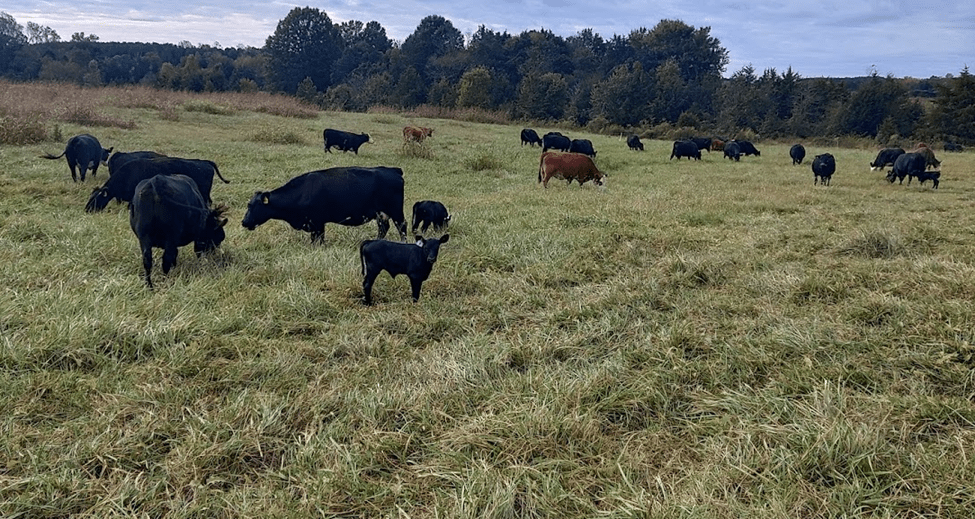
October brings our first wave of calves, and we are well into it now. It has been a rough start for us this year. We will be calving right at 100 cows, with 18 of those first-calf heifers. Our usual success rate with calving is about 95%, with somewhere between 3 and 10 dead calves by the time we are done. As of today we have 27 alive and 7 dead, and it has been the worst start we have had in over 10 years.
We have been calving in the fall for the last 20 years. Before that we calved in winter, starting about January 15. In most years we got along great with winter calving, but we had 3 snow and ice events during peak calving that pushed us to change to fall. Our final winter disaster was a record breaking snowfall in January 2000, with 28 inches of snow in just 24 hours. Unfortunately it was during the first cycle of calving and in those days we had 150 cows. We lost about 20 calves to that event, and afterward decided we had to make a change.
Our first step was to breed to calve for February 15 calves as all our big weather events had all been before mid-February. This meant turning in bulls May 10. I was well aware that with our toxic tall fescue base we were risking a low breeding rate if the temperatures hit the 90s during the next month. As my luck would have it we saw the hottest May ever and the cows really suffered. The bulls were miserable too, and lay down in the mud under cedar trees instead of working checking cows. We ended up with a 70% pregnancy rate when we checked them in the late summer. We kept all the open cows and bred them to have fall calves the following year, and then saved all the rest over for fall calves the year after that. By 2002 the whole herd was calving starting October 1. This change cost us a lot (2/3 of a year of revenue) and it took us a long time to recover from that financially, but looking back it was the best move we could have made as it has made calving a lot less risky and more enjoyable..
While fall calving has kept us from dealing with the ice and snow, we started seeing other problems related to tall fescue. Some years we had very small weak calves and every year we had late term abortions in August and September. We also had an occasional calf that seemed to be totally normal in every way that was just dead at birth. In our worst year there was a very wet spring but no summer rain, so we had very little warm-season grasses like we usually do. Cows spent the summer eating old growth of tall fescue. We grazed a summer stockpile of tall fescue in September, and while that seemed like a good idea we ended up with 5 cases of agalactia (no milk), and lost calves for several other odd reasons. It is hard to prove, but it seemed likely these problems are all fescue related.
This year we have had three cows to abort a month or so before they should have calved. We have also had two stillborns that seemed very normal other than being dead beside their mothers. Most of the losses have been in the mature herd which have been grazing a stand of summer stockpiled KY-31 tall fescue that had a lot of weeds and Johnsongrass in it. One of the stillborns was in the 2nd calf cows, and they have also been grazing on some late summer growth of KY-31. Neither of these groups has had much toxic fescue this summer, the main herd being primarily on warm season grasses, and the young cows on novel endophyte tall fescue since the time they were weaned calves.
We are working with a new veterinarian, and she has been out to check the cows that lost calves, taking blood samples and trying to make a diagnosis. She was concerned that one of the cows that aborted had a low antibody level to BVD. Other than that it is hard to point to a cause other than some bad luck. She suggested we might want to test the whole herd for BVD as we could be looking at a persistently infected animal that could be infecting the whole herd.
As I contemplated this, I started thinking back and then I realized that the thing we all were missing; wee were grazing both groups with calf losses on toxic KY31 tall fescue. Late-term abortions and stillborns are problems we see with fall calving herds on toxic tall fescue, and again it is so easy for us to just dismiss that as a possible underlying cause of this kind of problem. It is too early to tell what is going on for sure and we have additional blood tests that will come back soon on more problem cows. It is another case that is all too common; we just look past the obvious limitations of this toxic forage.
While this has been a little discouraging it does make us even more determined to convert more of our land to novel endophyte tall fescue and other non-toxic forages. With calf prices as strong as they are it is the right time to take control of the forage system and make it one where cows with good genetics can express their potential. Our first-calf heifers are starting to calve and they all have a lot of milk and the calves are normal size, vigorous and thriving. These young cows have been cleaning up summer growth of novel endophyte tall fescue and are now finishing up on crabgrass. There are obvious advantages to these non-toxic forages!
~ Matt Poore, NC State and the Alliance for Grassland Renewal
The Alliance for Grassland Renewal is a national organization focused on enhancing the appropriate adoption of novel endophyte tall fescue technology through education, incentives, self-regulation and promotion. For more resources or to learn more about the Alliance for Grassland Renewal, go to www.grasslandrenewal.org
 The Alliance for Grassland Renewal