
Regenerative Agriculture and more specifically Regenerative Grazing are important topics for discussion these days, and many will say there is a Regenerative Agriculture movement building. The idea is that if you focus on building soil health, over time the productivity of your land will increase, and you will improve the general health and well-being of the livestock and the complex pasture ecosystem they are a part of.
One of the things you hear a lot in Regenerative Grazing circles is that you should never use herbicides, never use chemical fertilizers, never use vaccines or other pharmaceutical products, or never use supplemental feed. You might also hear; always allow very long rest periods for pasture or always leave a lot of residue covering the ground when you move.
One of the mantras of the Amazing Grazing program at NC State has become; “Never Say Never and Never Say Always”. It is often true that things like herbicides, chemical fertilizers, feed and other outside inputs might hurt the overall ecosystem if used in excess. However they are very valuable tools that are too effective to simply discard without any thought. This month I will focus on herbicides, and throughout the rest of the series I will discuss how we use some of these other inputs.
There are many herbicides available for use in pasture-based agriculture, and they have been tested and shown to be safe and effective when used according to label directions. There are generics of many of the formulas too so it is easy to get confused about when and how you might want to use them. Many farmers new to pasture-based agriculture have a general fear about these products, and this is probably a good thing as if misused they could cause problems. However, most of the products you can purchase without a pesticide applicators license are relatively safe as long as you take precautions like wearing gloves and safety glasses when mixing. Read the entire label to make sure you understand the product in some detail.
Most of our land has never had an herbicide applied on it for at least the last 5 decades. I didn’t do any spraying growing up, and never even heard of anyone spraying pasture in our area, so it was just something I didn’t think you needed to do. As I visited hundreds of farmers and met dozens of chemical company reps through the early part of my career, I started to see some pretty interesting potential for some of these products to help our program.
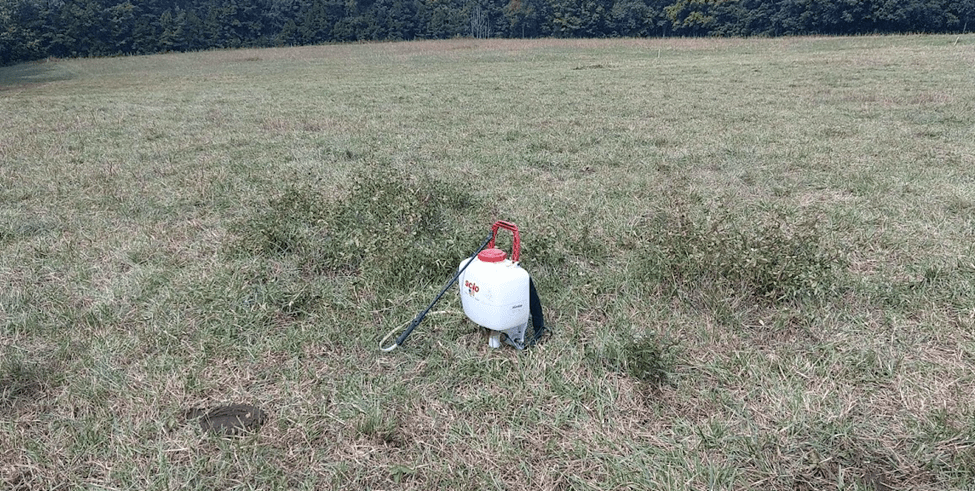
Dad always thought we had too many weeds, so we decided to buy a sprayer and start experimenting a little with it. Sometimes our strategy worked, but in many cases we also learned that it was very easy to wipe out your clover. I also learned I was not a very good sprayer, as I always seemed to miss streaks. Eventually we upgraded to a more modern sprayer with a foam marker and a 500 gallon capacity to improve our capabilities. I also learned to do some spot spraying on fencerows and for invasive troublesome weeds.
We have three situations now on the farm where we might use an herbicide. Perhaps the most important is spraying to keep fencelines clean. The second is when we are doing pasture renovation, and the third is when we have highly undesirable plants. The herbicides we sometimes use include 2-4 D, dicamba, aminopyralid, tryclopyr, and glyphosate. There are various trade names for these compounds as all are older products with generics available. I will use the trade names here for clarity, but don’t intend to recommend them over other products that might give similar effects. I will also not mention the concentration of the mixes as to get those you need to read the label for yourself.
Good fences are a critical aspect of pasture-based livestock production. In North Carolina the most common fence type is high tensile electric, usually with 4 or 5 strands on perimeter. We also have our share of 4 strand barbwire which is the standard in many other parts of the country. Either type of fence will eventually be badly damaged by letting vegetation grow up on them unchecked.
Barbwire is damaged by vegetation as it holds moisture around the wires and dramatically shortens the life of the fence. When we purchased our farm most of the fence was barbwire, and the previous owner had planted multiflora rose along all the fencerows with the idea that this would eventually create a natural fence after the wire rusted out. Those of you with multiflora rose will know that was a bad idea! Now multiflora is all over the farm. By the time we bought the farm most of the wire had rusted out and while the rose fence rows would not stop a cow, they certainly could stop a human!
We started rebuilding the fences from high tensile electric. In most cases we put the new fences away from the original fencerows which now make great shade lines. It was great having these new fences, but it soon became clear that they would rapidly grow up in vegetation including multiflora, polk berry, honeysuckle, goldenrod, cedar trees, etc. When this vegetation is wet it saps a lot of power from your fence making it difficult to contain the livestock. Excessive vegetation will also eventually drag the wires down.
If you take a stand to never use herbicides, then it is critical that you regularly get out and mechanically control weeds on the fencerows. This means mowing on both sides of the fence as close as you can and then using a weed eater and chain saw to cut whatever is right under the fence. This would have to be done once or twice a year. The alternative is to use an herbicide that will be effective on the target vegetation. If you have a very small farm then mechanical control is very feasible as long as you keep at it regularly.
At our farm we have about 15 miles of fence. As a result, mechanical control is not feasible so we use the herbicide approach. I spray fencerows using a 40 gallon tank sprayer that sits in the back of my pickup or 4×4. On flat ground we spray with glyphosate (Roundup) once a year, making every effort to keep the spray on the bottom wire or lower. Glyphosate will cause corrosion of the wire, so be aware of that whenever you use it. Also, glyphosate may not be very effective on some weed species such as woody perennials, so there will still be some additional mechanical or spot spraying needed.

On sloping ground we will use a mix of triclopyr (Remedy) and Duracor. Triclopyr is effective on woody perennials like the multiflora rose, while Duracor is good for a wide variety of annual and perennial herbaceous weeds. Grasses are not effected and we want them to stay on sloping ground to prevent creation of a gully under the fence.
Pasture renovation is an important part of our current activities as we strive to get toxic KY31 tall fescue off our land. We could use tillage to kill the existing grass stands, but this would lead to a lot of erosion. Instead we use glyphosate to kill the existing sod, and then plant no-till into that. After the new stand of grass is developing we scout the fields for weeds. This often includes horsenettle which is a very persistent and difficult to control weed. It is pretty tolerant of glyphosate, so it really shows itself during early stages of renovation.

Horsenettle is very tough and excellent control is only seen with products that contain aminopyralid like Grazeon Next, and Duracor. This effectiveness is in part due to the fact that aminopyralid has soil residual activity. Unfortunately it will also control clover for potentially years after it is used, so it should only be used strategically to improve grass stands.
Finally I sometimes will strategically spot spray certain plants before they can take a foothold on our farm. This starts in the early spring with Callery Pear. When these invasive trees bloom we flag them and then later cut them at the ground and spray the stump with a mix of Remedy and diesel fuel.

We will also have multiflora rose and blackberry plants crop up across the pastures. We generally clip pastures once a year to keep these shrubby plants from taking over, but in some areas they really persist. At one time we had a lot of multiflora plants taking hold, so my mom took on the chore of using a strong pelleted herbicide you sprinkle around the base of the plant to spot treat these.
In places mom got a little carried away with the rate of those toxic little pellets, and you could see where the chemical had moved downslope and killed a streak of the pasture. This gave me an appreciation for how some of these strong chemicals could cause unintended collateral damage. However, I am really glad today that mom was proactive in helping me get rid of those roses which are not a major problem for us with the current management.

We do have blackberry that keeps coming back. These often develop into little patches that are easy for me to spot spray. A fall application of Remedy and Duracor (same as we use for fencerows) will be very effective if you leave the dying plants until the next summer so the roots are completely killed.
Herbicides are a tool. We could get along without them, but when used sparingly and strategically they are really powerful to improve your pastures. Overuse of them will mean you have no clover or other plant diversity, and that you will eventually hurt overall soil health. My feeling is that with judicious use they can have a very important role in the development of a regenerative grazing system.
~ Matt Poore, NC State and the Alliance for Grassland Renewal.
This article first appeared in the Carolina Cattle Connection and is reprinted in Novel Notes with permission.
The Alliance for Grassland Renewal is a national organization focused on enhancing the appropriate adoption of novel endophyte tall fescue technology through education, incentives, self-regulation and promotion. For more resources or to learn more about the Alliance for Grassland Renewal, go to www.grasslandrenewal.org
 The Alliance for Grassland Renewal