It was a really busy month for us at Triple Creek with a lot more trouble than we are used to. We have had health problems with the cows, and more trouble with calving than usual. We generally have one or zero sets of twins born each year. This year we have had 4 sets out of 85 births so far! We have 15 cows to go, and we are hoping we will have no more twins. Usually we are glad to have one set, even if the cow will not take both because we can graft the extra calf on a cow that loses a calf. The one set of twins from last year weaned off weighing nearly as much as the singles, and that cow produced nearly $4000 worth of calves!
This year things didn’t go as we would hope and we lost both calves on three of the four sets. The cow with the one set that did survive didn’t take one of the calves, and we successfully grafted that one onto a young cow that had a stillborn, so that was a bright point. A lot of our friends and neighbors have had more twins than usual this year too, so we are not alone. Why this happens is not understood, but it could be the weather or perhaps the quality of the forage.
We also had two cows to have late-term abortions, and two full-term still borns. Additionally, one cow started to show problems walking in her hind end, and eventually went down and died before the calving season started. We also had two cows that rapidly lost body condition and ended up dying. This seemed to be too much for just bad luck, so we had our veterinarian out several times to look at these cows, do some blood tests, and help us figure out what was going on. We have a virus called BLV (Bovine Leucosis Virus) that we have had in the herd for a long time, and it is common for it to be in beef herds all across the country.
Bovine Leucosis Virus is a slow virus, and the only problem it causes is lymphoma in a small percentage of the cows infected. In the past we have lost on average of about one cow per year that we could pin on BLV. Symptoms are usually either partial paralysis in the hind end, cows that just go off feed and wither away, or sudden death. These symptoms are the result of tumors along the spinal cord, in the digestive tract, or somewhere else in the lymph system. It is heart breaking to see this, and all the cows in question this year tested positive for BLV.
The mature cow group where we had all the problems had been grazing a stand of summer stockpiled KY31 tall fescue leading up to calving, and it is certainly reasonable to assume that fescue toxicosis played a role in all the problems.

We also had one of our finishers in a group not on Novel Endophyte Tall Fescue quit eating and drinking completely. Blood tests on this heifer showed that she had severe liver and kidney damage consistent with Acorn Poisoning. Talk about bad luck! We have had this problem rarely and sporadically over the years, but it has been a long time since we lost an animal to it. After a particularly bad outbreak about 30 years ago we fenced out all our woods to try to reduce the opportunity for the cattle to eat acorns, which dramatically reduced our problem.
This particular group of finishers was moved into a pasture that had a lane through the woods to give them access to a pond for water. I had not noticed that there were several oak trees in that lane, but I would not expect an animal to eat a lot of acorns when they were on very high quality grass and getting 8 lbs of feed a day. Apparently this particular heifer just got a taste for those acorns and ate too many. The other 34 head in the group are fine. Thank goodness we have a good vet that worked with us to make sure that all these problems are not something that is going to sweep through the whole herd.
All this happened in mid-October, and by the time we got into November things had turned around and calves started coming just as you would like. A bright point is our first-calf heifers. We have been synchronizing and breeding the heifers by AI (artificial insemination) for the last 6 years. This allows us to choose calving ease bulls, and also to get them all calving at the same time. We have in several years only bred these one time so the calves were all due on the same day. This year we had our AI technician rebreed three heifers that came back into heat 21 days after the initial breeding. The results were that 15 of 25 heifers settled on the first breeding (60%) and all three that we rebred settled, giving an overall success rate of 72%. We were very happy with this, but of course were still diligent in our management to get as many live calves as possible.
We use a technique proven many years ago to make the heifers calve during the daylight hours so we can be there to help them if they needed assistance. This involves feeding the heifers in the evening and only giving them access to hay overnight. During the day they are on dormant bermudagrass pasture. This has worked great for us over the years with very few calves born at night. This year we had a few calves come early before we started the PM Feeding program, but after we started all the heifers calved during the day. Today the last calf from the second cycle heifers was born unassisted, just 22 days after the initial due date for the group. For the first time ever we didn’t assist a single heifer, with a 100% live calf outcome!
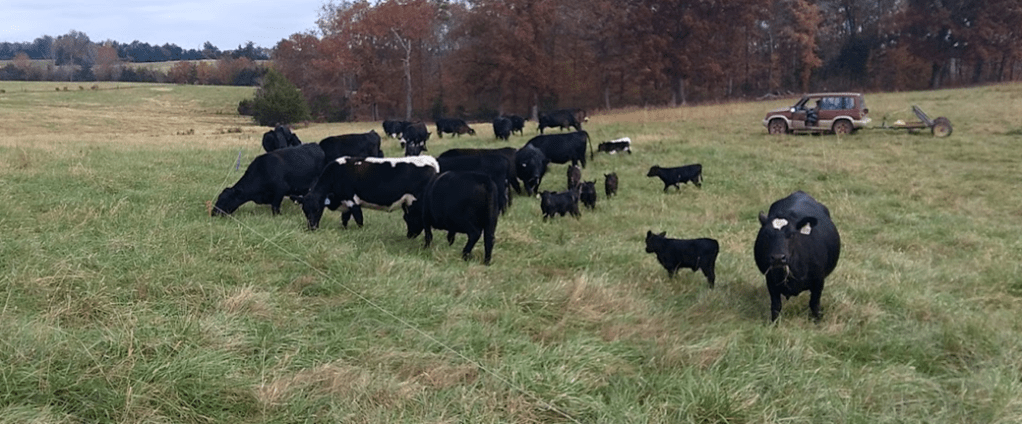
Another thing we do to make calving easier is to pull the mature cows into a pasture near the working pens where we feed hay during the first month of calving. We have been using a modified bale grazing technique where we put out hay at the far end of the pasture to start with and then each time we put out fresh hay we move it closer to the pens. Generally when we do bale grazing we put out a month or so of hay and ration it out using polywire. When we are calving it makes more sense for us to put out hay as we go (since we go out everyday anyway) and to not start the cows in a really tight area. This gives the cows room to get away from the herd when they are calving, and allows the calves more room to spread out, reducing scours and other health problems. I mentioned at the start the problems we had with this group, and the positive note is that we were easily able to get these cows to the pen to deal with the problems.
After a very dry August, September and October we finally had a good 3 inch rain that came slow on the 28th, 29th, and 30th of October! All our new Novel Endophyte Tall Fescue plantings were in the ground by that time and as of today they are really coming up strong. Also, our hay field plantings from last year jumped out and we are planning on starting hay cutting next week. The tall fescue all across the farm is growing strong, and we plan on moving the mature herd on to grass in two weeks.
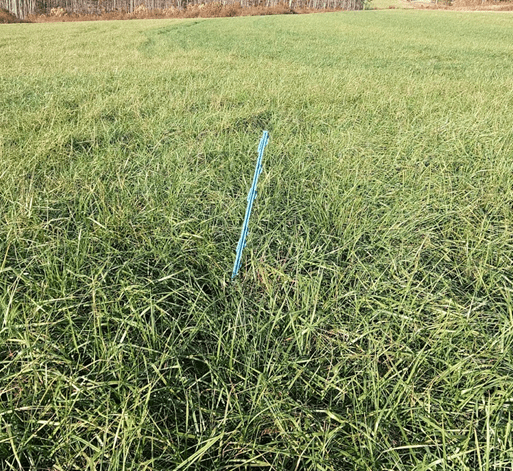
We do have one group of cows (our three year olds) that we are grazing on some stockpiled fescue/crabgrass that accumulated mostly in September. We are moving these every day and are really happy about the quality of these young cows and their calves that are out of one of our Slick Hair bulls we raised. We have a lot of warm-season forages invading this pasture, so our plan is to renovate it to Novel Endophyte Tall Fescue starting next year.
As we move into the holiday season it is important to remember to give thanks for all we have, and our ability to work in agriculture. Each morning when we go out to check on the cattle we know that we could find serious problems like we have faced this month. The dedicated cattleman understands that we are dealing with both life and death, and we take the responsibility for doing everything we can to look after the welfare of our cattle. Each day we go out and find healthy newborns to tag, cows in good body condition eating good feed, and see the new grass we have planted coming up we realize why we do this. It is a thankless job that rarely yields much profit, but it is good for the soul to know that our efforts will pay off even when there are bumps in the road we have to deal with along the way.
~ Matt Poore, NC State and the Alliance for Grassland Renewal
The Alliance for Grassland Renewal is a national organization focused on enhancing the appropriate adoption of novel endophyte tall fescue technology through education, incentives, self-regulation and promotion. For more resources or to learn more about the Alliance for Grassland Renewal, go to www.grasslandrenewal.org
 The Alliance for Grassland Renewal