Originally written for the Carolina Cattle Connection
Regenerative grazing is based on the premise that most of our agricultural land is in a degraded state and requires inputs to be productive. Managing to improve soil health will move the agricultural ecosystem in a direction that will be more productive with less inputs. With careful management the ecosystem will eventually become so healthy that little or no inputs like fertility amendments or herbicides will be needed for optimal productivity.
While this is a really great goal, and one which really is possible for many of us, it is not as easy to get there as is sometimes promoted. When I started farming 55 years ago most of our land was pretty productive, but we cut a lot of hay and used a lot of fertilizer to stimulate yields. The standard practice was to use a complete fertilizer, 10-10-10 or 17-17-17 in pretty high doses twice a year. Fertilizer was pretty inexpensive in those days so this didn’t seem to be a great concern.
We generally cut hay off about half the pasture area each spring and then continuously grazed the land until all the forage was gone, usually about Thanksgiving. At that point the cows started to get thin, and eventually we started hay feeding in the same convenient location near or in the barn. The result of this program was that most of the nutrients in the applied fertilizer were either removed in the hay, or moved to the shade areas where the cows spent most of every day loafing. During hay feeding the soil nutrients in hay were deposited near the feeding area. While this system maintained good production for the most part (especially in the spring), without the fertilizer there was little potential for growth.

After I grew up and went to college I took a soils class and learned that the soil had the potential to hold on to nutrients in the form of soil organic matter. Also, some elements like phosphorus (P) were said to bind to the soil particles to be released later when needed. I also learned that if soil pH was in the neutral range (6.0 to 7.0) the phosphorus could easily be released from the soil to the plants when needed.
After returning to the farm I realized that we need to do soil testing to really see what our status was to guide the fertilizer applications. What we found was that on the areas where we put a lot of the complete fertilizer we actually had a good level of phosphorus and potassium (K), but that the pH was low, with the report calling for several tons of lime to the acre. Once we added that lime we noticed that our clover stands really came on and the whole pasture looked much healthier.
On the parts of the farm that were only grazed we used little if any fertilizer and the main plant species were broomstraw (broomsedge), blackberries and KY31 tall fescue. The phosphorus and potassium levels were very low, and the pH was around 5.0. This was about half our farm, and when we penciled out the 2 tons of lime per acre and over 100 lbs of P and K that was called for it was really expensive to get things corrected. Because we had a big land payment we just could not afford what was recommended.
We eventually decided that this part of the farm really needed help, so we bit the bullet and applied the recommended levels of lime and fertilizer. The result was nothing short of amazing. The tall fescue rapidly came out and grew aggressively. We would mow several times per year, and the blackberries and broomstraw started to disappear. Soil tests revealed that we now had medium P and K levels, and pH had recovered to 6.0.
Following that we frost-seeded Will Ladino clover and within a few years there was a really nice mix of fescue and clover. However, we still were more or less continuously grazing, so the behavior of the cows meant we still moved many of the fertilizer nutrients into the loafing areas where the cattle concentrated. We continued to add fertilizer each year to keep that good grass coming. One year we had a really strong growth response after a spring application, and when we turned cows out they pretty much went to pieces due to tall fescue toxicosis. This continued to happen in subsequent years.
After dealing with a lot of fescue toxicosis we decided to only fertilize in the late summer to stimulate fall growth for stockpiling for winter grazing. This was also the time we really got serious about controlled grazing management, with the cows spreading their manure more evenly across the land. Subsequent soil testing showed that the P and K levels were staying up and pH remained about 5.8 to 6.0. Clovers really dominated in the spring, we had few fescue toxicosis problems, and we still grew a good stockpile for winter grazing.
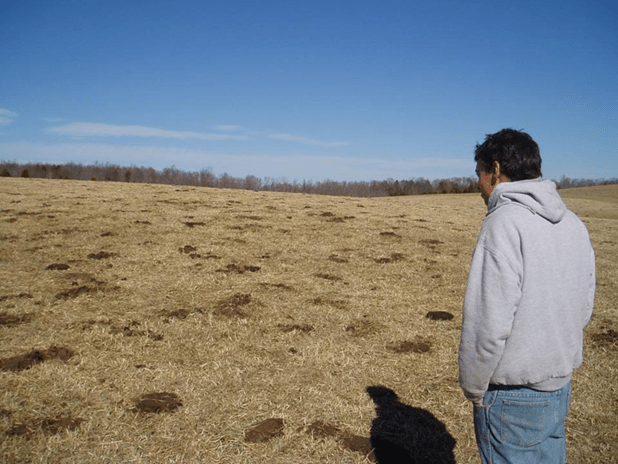
Gradually, we started losing our tall fescue stand which was replaced by summer grasses like dallisgrass, purpletop, and crabgrass, and red clover. We were excited about the summer grazing we were getting, but it became more and more apparent each year that we could not stockpile for winter grazing the way we did in the old days when the pastures were nearly 100% tall fescue.
At that point I first learned about the concepts of Soil Health. Plant diversity was improving on this land and we were still getting pretty good production, so everything seemed to be in order. On the parts of the farm where we had been using fertilizer for many years we still had good tall fescue stands, and we were still getting a good response to applying nitrogen in the fall.
The next stage in this story came with the really high fertilizer prices that occurred starting about 2007. We went ahead and put out the fertilizer in the fall, but the weather turned very dry and we got no appreciable growth. After that point we entered a phase where we were reconsidering the economics of applying fertilizer at all.
Then into the picture came my friend Dr. Alan Franzluebbers. Alan is a soil ecologist who specializes in nutrient cycling. We worked together on an on-farm study to test the response of tall fescue to late summer-applied nitrogen (N) fertilizer. We replicated N fertility rates on plots on a large number of farms. That first year we found some new stands of fescue that really responded to the N applications, but surprisingly there were farms with older pastures where we saw no response, with a very high yield on the zero nitrogen treatments. Where we didn’t see much response to added N there were high levels of soil organic matter and soil test biological activity. I was interested in these results to be sure, but I told Alan that I knew we still needed to apply that 50 to 100 lbs of N in late summer on my farm to get a good stockpile.
After many discussions about this, Alan convinced me to put a set of N plots on our farm. To my great surprise the soil test biological activity was high, and there was little response to the applied nitrogen! I still fought against the idea that I didn’t need to be adding all that N. I had been doing it for decades and figured out I had spent about $250,000 on that activity over 20 years! I was slow to admit that I might have wasted some of those funds!
After that I became more of a student of soil health, and came to realize that we really could grow grass without much fertility addition. The areas on the back of the farm where we had changed things so much continued to evolve into a diverse mix of plants, with red and white clover being very dominant in spring, with warm season grasses coming on in the summer. We have not applied fertilizer or lime to these areas for 12 years, and soil tests still reveal medium levels of P and K with a pH about 5.8.
This was great for our system during the grazing season, but we began feeding more and more hay in the winter as the tall fescue declined. We unrolled hay across most of the pastures, which helped keep the manure and urine in a place where it could grow grass in the future. This manure and urine contained about 95% of the N, P and K that was in that hay, much of which came from someone elses farm (in purchased hay), or from our hay fields where we regularly applied fertilizer.
In more recent years because of the general decline of our tall fescue we made the decision to renovate the better pastures to Novel Endophyte Tall Fescue. Based on my experiences I realized that if we wanted this to stay in tall fescue we would have to feed it nutrients when it needed it. Currently we are putting a moderate level of nitrogen on this in spring and late summer, and are back to having good winter stockpile. Phosphorus and K remain in adequate levels, again because of the manure nutrient recycling we get from our improved grazing management.
As part of our forage system we also have pastures that rotate between crabgrass and Johnsongrass in the summer, and ryegrass and oats in fall, winter and spring. After managing this for several years I observed that in early spring the grass grew very slowly with a yellowish color. There were spots of deep green grass that marked the location of fecal and urine spots that were releasing a lot of N, but they were a very small part of the total area.
I called Alan one day and told him I was convinced I needed to put some nitrogen on that ryegrass/oats to get it growing. He convinced me to wait, predicting that I would see the nutrient cycling turn on when the soil warmed up. Sure enough about April 1 we had a week of warm weather and when I went out to look at those pastures the color had turned dark green and all the grass started to grow. The soil biology came to life and the nutrients were starting to cycle.
What I learned from that experience was that I could strategically apply a small amount of N (30 lbs per acre) in February and have a lot of grass by early March. We don’t apply this to all the ryegrass/oats, only enough to give us a month of grazing with our young stock that graze this area. Compared to other feed options, that early start to spring grazing is very economical even with the current fairly high N prices.
So what does all this have to do with regenerative grazing? First, doing a good job of grazing management and hay feeding management will keep N, P and K well distributed on the pasture where it can do you good. Second, applying lime, P and K to depleted soils will get you to a condition where organic matter starts to build up, improving soil health and resulting in the active cycling of these critical soil nutrients. Third, while nutrient cycling can take care of many of your fertility needs, there are still opportunities to stimulate economical growth with strategic application of N.
You will hear it said that if you apply commercial fertilizer you will poison your soil as the organisms are not used to chemical form of these nutrients. If you are talking about very high levels, then that might be true. But, low level, strategic application when there is demand for the nutrients appears to me to be beneficial to the overall system.
The first take home message is that you need to build fertility before you can benefit from the phenomenon of nutrient cycling. This can be done with commercial fertilizer or organic amendments like poultry litter, or by unrolling or bale-grazing hay.
The second message is that if you really understand the nutrient needs of your plants you can maintain your stands and get very economical responses to low level application of fertility. There is no simple “never” or “always” rule that can guide this. You know your land, and through making observations similar to what I have described you can build a system that is very productive with very little application of either N, P and K or lime.
~ Matt Poore, NC State and the Alliance for Grassland Renewal, originally for the Carolina Cattle Connection.
The Alliance for Grassland Renewal is a national organization focused on enhancing the appropriate adoption of novel endophyte tall fescue technology through education, incentives, self-regulation and promotion. For more resources or to learn more about the Alliance for Grassland Renewal, go to www.grasslandrenewal.org
 The Alliance for Grassland Renewal