
The last four late summers and falls in KY (2022-2025) have had extended dry periods following by late fall rains. This has made fall forage establishment and fall stockpiling difficult since dependable rains have come very late. These long dry periods have also caused considerable stress on cool season forages. In many parts of the state Kentucky bluegrass has gone completely dormant and many orchardgrass stands have thinned. On the other hand, KY-31 plants have only shown very slow growth with leaf curling (a drought survival response) since the endophyte enhanced the survival of these plants. When the fall rain finally came, fescue predominant pastures were the first ones to green up.
Unfortunately, the new growth after these periods of drought stress have had abnormally high levels of ergovaline, the toxic alkaloid in KY-31. Normally the highest levels of ergovaline are in May and June when seedheads are present and lower in the fall when the plants are in a vegetative stage, but it seems that these higher levels are some type of drought response in the plant. These high fall ergovaline levels have extended into early winter since hard freezes (<25 degrees) seem to be coming later the last few years.
You might ask “Why should I care.” We normally aren’t concerned about toxicity in tall fescue during the fall and this is part of the reason that fall calving has been encouraged. The lower ergovaline in the fall allows good milk production for fall calves and less rebreeding issues than with spring calving herds. These cows are being bred during the very toxic late spring period. Although we have not conducted systematic research, below are several anecdotal reports from KY farms.
The following observation are from UK’s Dr. Les Anderson. Last fall (2024) he had several questions regarding fescue toxicosis from grazing fescue regrowth after Helene. One producer was breeding late October/early November and had zero conception rate on cows with a long history of great conception. He also had 30% of his herd get tender feet during this period and he treated for foot rot even though it did not appear to be foot rot. Another producer called and had a few abortions during this period on his January calving cows. His cow’s feet were also tender. Tender feet or lameness can be an issue with toxic fescue since vasoconstriction limits normal blood flow to the extremities.
Dr. Chris Teutsch shared the following observations from when he worked in Virginia (2000-2017). One year we had a major drought, 18” behind at one point in time. About mid-August it started to rain and we got the most beautiful stockpile that I can remember. Later that fall we had a laundry list of fescue related issues including little or no milk and thickened placentas. The issues were the worst on farms that were practicing good grazing management and had good soil fertility. Apparently, they were creating an environment in which fescue thrived. I think we just had a perfect storm for the production of ergovaline and I suspect that may be what happened last year (2024) on some KY farms.
Below are observations from a retired county agent in KY concerning fall breeding success last fall (2024). One farm had less than 15% success with embryo transfer on a herd of over 20 cows. Bulls did get better conception on the next cycle, but there still some that will be late. Another local producer has a herd of 35 cows which were A.I.ed with timed insemination. He had 8 out of the 35 conceive. The clean-up bull did get pregnancies, but still disappointing results. Two other herds that do a lot of embryo work reported very poor results. On the other hand, a herd on Novel endophyte fescue had 3 out of 3 embryo recipients conceive and carry the pregnancy, and 8 out of 11 conceive on a timed A.I.
What can you do? If you are seeing issues or have in past few years, you can take cows off predominant tall fescue pastures in the fall (wait until a couple of hard freeze periods before putting them back on these pastures). This is part of the reason that we recommend not grazing stockpiled tall fescue until after two or more hard freeze periods. Note: A field that showed high ergovaline one year is much more likely to show high levels another year. We know legumes, especially red clover, can help alleviate fescue toxicity. An option is to feed hay containing red clover. Another option is feeding soybeans (2 lbs per day) or soyhulls (5 lbs per day). You can also test for ergovaline levels by submitting tall fescue samples from your pasture to the UK Vet Diagnostic Lab (VDL) or a similar lab at the University of Missouri or in your state. Then you can better determine which fields are the safest for grazing during the fall. Here’s the link for the sampling guidelines including how to harvest the fescue plants and how to submit samples to UK VDL. https://forages.mgcafe.uky.edu/files/tall_fescue_sampling_guidelines_for_ergovaline_analyses.pdf
Figure 1. The bottom line shows the normal ergovaline during a typical year and the upper line shows what happened in 2022. We saw similar results in 2023 and 2024. With cattle it’s best if they are not consuming more than 500ppb ergovaline in their diet. Note: in mixed pastures make sure to take into account the dilution factor. If fescue is 1000ppb but it’s only half of their diet, then the cattle are only consuming 500ppb.
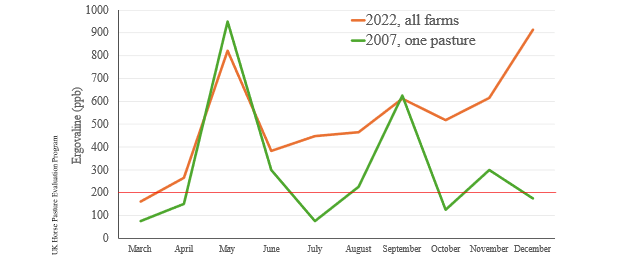
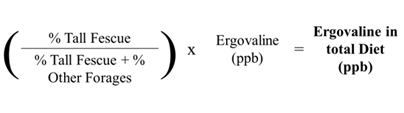
Figure 2. The UK Forage Group has been monitoring ergovaline levels on four different farms in Central KY and two pastures per farm. Shown are the results over the last year. One farm had extremely high ergovaline readings, but other farms still had concerning levels. Again, remember that it’s not the ergovaline level that matters but what percentage of tall fescue with high ergovaline that they are consuming (see calculation in figure 4).
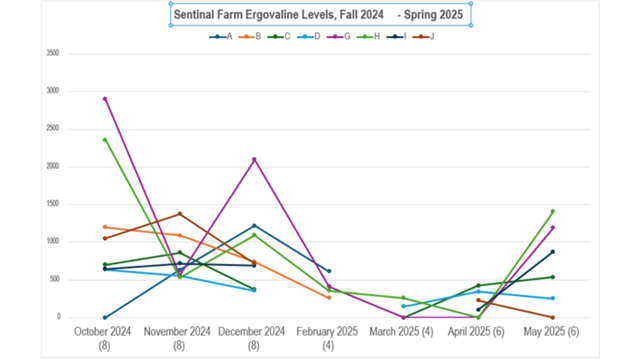
Figure 3. The level of ergovaline in the total diet indicates the potential risk for livestock. We assume that most animals readily consume tall fescue and other forages like bluegrass, orchardgrass and clover, but are less likely to consume weeds. For example, late term pregnant mares should not have over 200ppb ergovaline in their total diet. For cattle, the numbers are less precise, but generally fescue toxicity issues may be observed when ergovaline levels in the diet are consistently over 500ppb. See below for examples of ergovaline in the total diet based on the amount of tall fescue, other forages, and undesired plants/bare soil.

Figure 4. Simple formula to calculate ergovaline in total diet.
~ Ray Smith and Krista Lea, University of Kentucky and the Alliance for Grassland Renewal.
The Alliance for Grassland Renewal is a national organization focused on enhancing the appropriate adoption of novel endophyte tall fescue technology through education, incentives, self-regulation and promotion. For more resources or to learn more about the Alliance for Grassland Renewal, go to www.grasslandrenewal.org
 The Alliance for Grassland Renewal