
After a month of hay feeding through the early part of the calving season we finally have the cows back on grass. While we are glad to be back grazing we have a limited quantity, so we expect to be back on hay about February 1. This turned out to be a very dry fall again, with little to no rain from the middle of August through the end of October. This has been a recurring theme for us, with dry falls in 5 of the last 6 years.
I was asking an retired friend and colleague what his experience has been over his career with desirable weather for fall stockpiling. He indicated that over the decades about 3 out of 5 years have been really good stockpiling years. That has also been my experience, so I am hoping that this last half decade turns out to be an anomaly. The folks that I work with (Brandon and Tina Gayle) are starting to wonder if I am telling them the truth about how much grass we can go into winter with when it rains in the fall. Essentially they have been working with us for 3 years now and have never seen a good fall stockpile yet.
I am thankful that this year was better than last for establishment of tall fescue. We planted 7 acres to Lacefield MaxQ2 Tall Fescue on the main farm, and 8 acres to a mix of Triumphant Protek Tall Fescue and Endurance Orchardgrass on some land belonging to the extended Gayle family. We will be grazing the Lacefield, while the Tall Fescue/Orchardgrass will be cut for hay. We used this hay mix on some land last year and were very pleased at the yield and quality of the hay. We know in our area that the Orchardgrass will start to thin in just a few years, but the idea is that when it does the tall fescue will take over and fill in. We got all that planted by mid-October and put on 30 lbs per acre of nitrogen (67 lbs of urea). After a really good rain the last few days of the month we had rapid germination and the stands look really strong today.
We were late cutting our fall hay because we were waiting for rain to improve the yields some. While that late October rain did stimulate some additional growth the yield was well below what we would hope. We feel fortunate that nearly all the fields we planted last year turned out some really nice hay. Although the yield was about ½ of what we normally would expect we were happy to get anything. After cutting these stands started regrowing rapidly, and we are excited to see how healthy the grass is.
We also have our 3rd year plantings of Novel Endophyte Tall Fescue (various products) that have developed into very strong stands. These pastures have been exclusively grazed, and after grazing in early September we put out fertilizer and have allowed them to stockpile. We had been expecting a good rain which stimulated me to make the move and get the fertilizer out. Unfortunately the rain never materialized and we only had 0.1”. We had a couple more small rain over the next few weeks, but then there was no rain until the end of October. We will be grazing these pastures with our first calf heifers, but expect to start on hay a lot earlier than we have in previous years.
We love to use temporary electric fence to improve forage utilization and improve manure nutrient distribution. Despite the great results we have had over the decades from this system, most of our neighbors use continuous grazing and put very little effort into getting more from their pastures.
As we were setting up a strip of grass for the main herd last week I had the realization that while it is an easy and quick technique for us, we do take time to pay attention to detail. I took interest in this management approach years ago and over time have learned many tricks to help with success. I have been the victim of many breakouts over the years, but have carefully evaluated why it happened each time and learned how to prevent it.

Things that I have learned that help make this successful is to make sure you have plenty of power on the fence, make sure that you are using good quality posts and polywire (or polybraid), making sure you allocate sufficient forage so that the cows are not hungry, making sure the temporary posts are not too far apart, and making sure the polywire height is consistent and that the fence section is straight and tight.
Some farmers I work with prefer to give multiple day strips while grazing stockpile, but I have found that doing it daily gives a kind of rhythm that the cows like. It also keeps you regularly watching the forage ahead, residual forage behind, and daily changes in animal behavior. This is a personal preference, but if you plan on checking the cows every day you might as well be in the habit of giving them a fresh strip of grass.
We set up the next strip each time we take one down and this turns out to be one of the best things you can do to avoid trouble. No matter how careful you are with the polywire height and tension, occasionally a deer or the calves will hit the wire and knock it off a post. If cows are well trained they will not cross a wire on the ground unless they are hungry. If the tear down is longer than just one post then some cows may cross the wire, but will stay in the next strip where they find plenty of fresh grass.
This week we had the first substantial snow of the year. I am always a little worried about the first snow when we are grazing stockpile because that is when our first breakout is likely to occur. For two days before the snow we worked hard to make sure we had a lot of power on the wire, and to be extra careful with the setup. We also made the strips about 10% larger than we had been allowing for a higher intake and increased waste that comes with cold, wet weather.
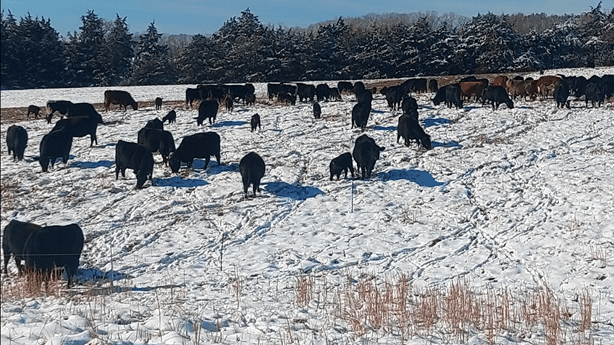
As it turned out we had 3 inches of snow overnight and the cows behaved and stayed put. I was really glad that we had paid attention to all those details; it is a great feeling when you realize your efforts paid off.
I hope the holidays turn out joyous for you all. If you have good grass to graze that is wonderful! If you didn’t get around to stockpiling and strip-grazing this year maybe it would be a good time to ask Santa Claus for some loaded reels and step-in posts so you can start the journey to Amazing Grazing in the new year.
~ Matt Poore, NC State and the Alliance for Grassland Renewal
The Alliance for Grassland Renewal is a national organization focused on enhancing the appropriate adoption of novel endophyte tall fescue technology through education, incentives, self-regulation and promotion. For more resources or to learn more about the Alliance for Grassland Renewal, go to www.grasslandrenewal.org
 The Alliance for Grassland Renewal