The rolling hills of central Virginia made the perfect backdrop for a recent pasture walk hosted at the family farm of Ronnie Nuckols, a longtime cattle producer who has been steadily renovating his pastures with one of the novel endophyte-infected tall fescue lines. The evening offered a great opportunity for local producers to see firsthand how these improved fescues perform under real farm conditions—and to talk directly with someone who’s made the transition from old KY-31 fields to the next generation of fescue. During the evening, we followed the full journey of pasture renovation—from the ideas behind it to the practical steps of execution and long-term use.
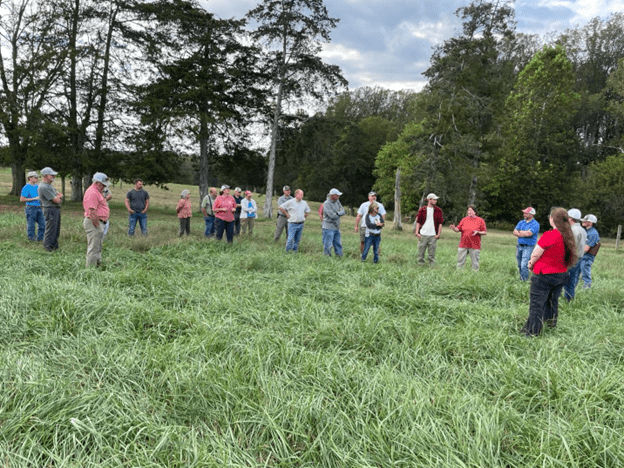
Thanks to arriving a little early, our group had the chance to tour several of Ronnie’s pastures before the formal walk began. Since starting his renovation efforts in 2021, Ronnie has taken on one field at a time, methodically replacing his older KY-31 stands with a novel endophyte variety that provides the same vigor and persistence but without the livestock toxicity issues that have long challenged producers across the Fescue Belt. Each pasture we visited was lush and green, reflecting both the favorable growing season and Ronnie’s careful management.
The event, organized by J.B. Daniel (NRCS) and Matt Booher (NRCS), drew about twenty people from across the region. Out in the field, Ronnie shared what led him to take the plunge into pasture renovation. After attending several educational meetings, he was convinced by data showing improved average daily gains and reproductive performance in cattle grazing the novel endophyte fescues. “The cows just do better,” he said plainly—and the thriving stand behind him provided the proof.
As the group moved through the pasture, Ronnie walked us through his renovation strategy: from killing out the old KY-31, to preparing the seedbed, to establishing the new stand. He discussed what worked well, what he’d do differently next time, and how he now manages his grazing rotation to protect the young plants. As a cow-calf operator, he emphasized the importance of balancing forage quality and persistence, noting that integrating a dependable cool-season grass like tall fescue has given him more flexibility during stressful grazing periods.
Throughout the evening, there was plenty of conversation—not just about pasture management, but about the endophyte itself. The novel endophyte in these improved fescue lines forms the same natural partnership with the grass as the wild type, helping the plant thrive, but it does not produce the compounds that cause fescue toxicosis in livestock. Seed distributors were also on hand to answer questions about availability, establishment timing, and variety options.

Our team (myself and Bryna Haile, my graduate student) joined the walk to share some of the science behind these improved forages. We brought along a microscope and fresh plant samples from Ronnie’s fields so participants could see the endophyte inside the grass for themselves—an invisible but vital part of the story.
It was a lovely evening of learning, shared experience, and good company—complete with excellent sandwiches. Events like this show how much can be gained when farmers, researchers, NRCS and extension specialists come together in the field to see innovation in action.
~ Carolyn Young, Department of Entomology and Plant Pathology, NC State University and the Alliance for Grassland Renewal
The Alliance for Grassland Renewal is a national organization focused on enhancing the appropriate adoption of novel endophyte tall fescue technology through education, incentives, self-regulation and promotion. For more resources or to learn more about the Alliance for Grassland Renewal, go to www.grasslandrenewal.org
 The Alliance for Grassland Renewal