This article is reprinted with permission from the Carolina Cattle Connection Amazing Grazing column.
Over the last decade there has been an explosion of interest in “Regenerative Farming”. I know many farmers that have had great success giving up many of their traditional inputs and building a system that produces with much lower inputs than they used in the past. Many farmers have realized that while they have productive farms, the cost of production often is high relative to their income. When they hear someone talk about the benefits of Regenerative Farming where you can give up all your inputs and see a big improvement in the bottom line, they are likely to listen.
On my farm we have used rotational grazing and holostic management practices for a long time. With the introduction of the Regenerative Agriculture concept I realize that most of what we have done has improved soil health across our farm, but that we have a long way to go restoring a productive ecosystem.
As we ponder which inputs we could give up, veterinary care supplies, or pharmaceuticals come to mind. We have had a good relationship with a veterinarian throughout our year’s ranching and with my job at the University we fully adopted the recommended vaccination programs back in the early 90s. Twenty years ago we vaccinated all calves twice for Black Leg (7-way), IBR, PI3, BVD, BRSV, and Pasteurella (pneumonia). All our cows received a modified-live viral vaccine pre-breeding along with Leptospirosis vaccine twice a year. In short we gave a whole lot of shots.
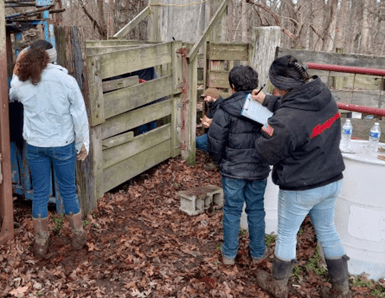
Back at that same time we regularly dewormed cattle including the mature cows, and usually used pour-on ivermectin. This was done for all cattle mid-summer and again in the late fall before the breeding season. These two ivermectin treatments perhaps helped with worm control, but also gave us some horn fly control in summer and lice control during winter.
Finally, we use to have a pretty bad problem with Pink Eye so we have used a lot of tetracycline (LA-200) over the years as well. Foot rot (lameness) is also a common problem for us, and long acting tetracycline was our choice for treating that as well.
One thing I once heard a well known Regenerative Rancher say in a talk was that “we should just quit giving all these vaccines, dewormers and antibiotics and go totally natural”. As I reviewed in my mind the very many shots we routinely gave and the increasing cost, I started to question our program. Once I had asked a veterinarian friend of mine why we only have to vaccinate in childhood for many human diseases, but it seems like we have to vaccinate annually for all the major cattle diseases. In this discussion he revealed that many cattle vets believe that if a heifer is double vaccinated for the major viral diseases before she is bred the first time she probably has adequate protection for her whole life. This discussion came back to my mind.
Another key thing that happened for us is we started raising local beef, so that most of our animals never left the farm as feeder cattle. When we were marketing feeder cattle we needed to give all those vaccines so the cattle had some level of protection at their new locations, and so that we qualified for special sales. Without the exposure to the common diseases at the stockyard or feedlot it was clear our cattle didn’t need as aggressive a program.
As I became more of a student of pastureland ecology I also became concerned about the impact of residual insecticides like ivermectin on the environment. I realized that the ivermectin we were putting on in mid-summer was killing horn fly larvae in the cow pies, but that it was also interrupting the breeding cycles of dung beetles and other beneficial soil organisms. I had been aware for many years that the mature cows didn’t have very high worm levels anyway, so most of the benefit of the ivermectin on them was the reduction in horn fly and lice populations.
Today our program is very slimmed down compared to where we were 20 years ago. The mature cows no longer receive vaccinations. The calves get vaccinated for Blackleg (7-way) at about 4 months of age and again at weaning. At weaning all calves get one shot of a modified-live viral vaccine, and the heifers get a version of the same vaccine with leptospirosis. Six weeks later the heifers get another shot of the viral vaccine with leptospirosis as we prepare them for breeding.
While we have a mostly closed herd, we occasionally purchase bulls, and we can’t rule out that someone’s cattle might break in with ours. The level of vaccination we now use seems to be consistent with this low chance of exposure, and so far we are getting along well.
We have also dramatically reduced our use of dewormers in recent years. Mature cows are no longer dewormed and we now use periodic (but infrequent) spraying to control horn flies. We use dust or spray to prevent a lice outbreak in late winter. We generally use a “white” liquid dewormer on the calves at 4 months of age and again at weaning. Replacement heifers and finishers are dewormed if there is indication that they need it, which rarely ever happens. By switching to the white dewormer and avoiding deworming in mid-summer when dung beetle activity is at it’s highest we have seen dramatic increases in dung beetle populations.
Finally, we do still occasionally use an antibiotic. One constraint on this is the removal of antibiotics as over the counter drugs, but we continue to work to maintain a good relationship with our veterinarian. We know that a very quick response to treating pinkeye and foot rot will really make a big difference in preventing a major outbreak or long-term damage to the animal. I will say we rarely have to use an antibiotic, but when it is called for it is a tool I want in the cabinet.
One thing we have done is to start breeding heifers using Artificial Insemination, so we now use the products needed to synchronize them which we did not do 20 years ago. The use of AI has dramatically reduced our incidence of calving trouble with heifers, and has brought high quality genetics into our population. These products we now have added to our program contribute greatly to our long-term goals and the regeneration of our farming system.
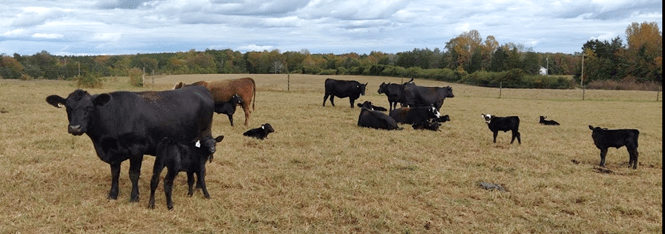
As you consider your own farm considering adopting the regenerative philosophy, and specifically consider what you might do to reduce inputs. Most of us can improve management or change our system in some way to allow good production with the removal of some of the inputs we have depended on in the past. Just beware of the idea that abruptly giving up everything is the answer. Many of the animal health products I have talked about are useful and can help us as long as we use them to address specific problems in the short-term. Along the way we should make system changes to reduce the incidence of problems in the future.
~ Matt Poore, NC State and the Alliance for Grassland Renewal
The Alliance for Grassland Renewal is a national organization focused on enhancing the appropriate adoption of novel endophyte tall fescue technology through education, incentives, self-regulation and promotion. For more resources or to learn more about the Alliance for Grassland Renewal, go to www.grasslandrenewal.org
 The Alliance for Grassland Renewal