
These are interesting times in the beef industry. Cattle prices are higher than ever yet there is scant evidence of herd expansion in the macroeconomic data. However, I see enormous asking prices for bred heifers marketed online, so this month I want to share data that I’ve seen in the literature that could aid in making decisions as you buy bred heifers this fall
Older, earlier calving heifers have an advantage over the long run
There was a paper published in the Journal of Animal Science in 2013 (doi: 10.2527/jas.2013-6465) that I will use as the basis for this argument. I’m happy to share copies of it if you send an email. It is truly impactful science. There were two datasets evaluated in this manuscript. Production records from the U.S. Meat Animal Research Center and the South Dakota Integrated Resource Management Groups were evaluated. From the SD dataset (n=2,195 heifers), first calf heifers that calved in the first 21 days of the calving season were one year older (5 years old) when diagnosed open compared to heifers that calved (4 years old) after the first 21 days of the calving season. Imagine getting an extra calf out of a cow just because she calved early the first time.
Furthermore, at U.S. MARC, heifers that calved early as first calf heifers weaned a heavier calf not just the first year, but all the way out through the sixth calf compared to heifers that calved after the first 21 days. The difference was approximately 50 pounds in the first year and 15 pounds in the sixth calf. My estimate based on looking at their data is that the earlier calving heifer produced an additional 150 pounds of weaned calf over a six-year period. At today’s prices, there is a substantial economic advantage to buying an earlier calving heifer.
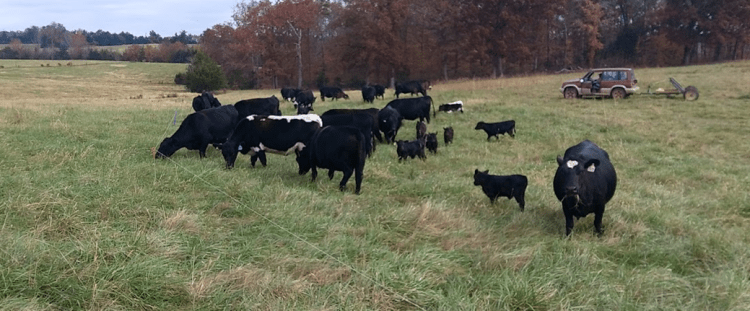
Why does this occur and how do we take advantage of this? A beef cow is pregnant for approximately 285 days. When a farm imposes defined calving seasons, cows that have long postpartum intervals between calving and breeding calve later each year until slipping outside of the breeding season. It is rare for a cow to calve earlier next year than she did this year. Postpartum interval is generally a minimum of six weeks and the estrous cycle in beef cattle is 21 days. To calve on the same date each year, a beef cow must become pregnant within ~85 of calving. If her postpartum interval is 42 days, then she roughly has two estrous cycles to achieve pregnancy. Body condition score at calving has proven to be a strong predictor of the length of the postpartum interval. At calving, beef cows need to be a minimum of 5 on a 1-9 scale and heifers need to be a 6.
Regarding the weaning weight advantage, age is the strongest predictor of weaning weight for beef calves. Having a lot of cows get pregnant early in the breeding season will do wonders for the weaning weight of your calf crop. Reproductive management tools like estrus synchronization and artificial insemination can help get a bunch of cows and heifers pregnant early in the breeding season. Having them in adequate body condition and gaining weight are also important to have cows ready to breed early.
How would I use the information from this research article to make bred heifer buying decisions this fall?
I favor heifers that are bred to artificial insemination based upon that data. I’ll have a tight estimate of calving date and the ability to select heifers bred to calve early in my calving season. I would even consider heifers bred to calves 30 days earlier than my mature cow breeding season to give first calf heifers an additional chance in their second breeding season. I’m willing to pay more for this certainty. How much more is debatable. From the U.S. MARC dataset, it appears that the early calving heifer produced ~150 lb additional weaned calf over heifers that calve later. Right now, the market value of gain (NOT sale price) says that the value of gain in the 400-600 lb range is ~$3.00 per lb. Of course, that’s just a snapshot of the current market. We should certainly factor in that market dynamics could and will change dramatically in the next six years, which is what we would be projecting out. I use a concept called “net present value” to make this decision. The net present value of $450 delivered over the next six years at an 8% discount rate is $346.72. Now, I also want a profit for my management, so personally, I would be willing to pay an additional $200-$300 for a heifer bred to artificial insemination over one bred via natural service using today’s market prices.
The sticker shock of bred heifer prices may make it difficult to raise your hand at auctions this fall, but there is data available to help make more informed decisions. Best of luck as you source replacement females for your cowherd.
~ Dr. Eric Bailey, University of Missouri
The Alliance for Grassland Renewal is a national organization focused on enhancing the appropriate adoption of novel endophyte tall fescue technology through education, incentives, self-regulation and promotion. For more resources or to learn more about the Alliance for Grassland Renewal, go to www.grasslandrenewal.org
 The Alliance for Grassland Renewal