This article is reprinted with permission from the Amazing Grazing column in the Carolina Cattle Connection, March, 2026
The regenerative farming movement is focused on improving the efficiency of agriculture through restoring soil health and ecosystem function. Most pasture-based livestock production systems are based on perennial forages, and thus their potential for soil health is inherently high. With just a few key changes in management, pasture-based livestock producers can dramatically impact their system, moving it to a self-sufficient system that can operate without much of the expensive inputs many of us use regularly.
Through this series I have discussed a variety of inputs that may be needed in a cattle farm in order to restore soil function and a high level of animal production in a reasonable amount of time. While it is an admirable goal to do away with all external inputs in a system, most farms will need to use various “tools” to build soil fertility, create a desirable plant population, and achieve a level livestock production performance that meets their targets. If the principles of adaptive grazing management are regularly followed, then system health and productivity are bound to increase, and inputs can be gradually withdrawn.
There is no question that organic matter is key to building soil fertility. To build organic matter levels plant tissue has to be grown in place or imported, perhaps as chicken litter, compost or hay. To grow a lot of forage in place will take some nitrogen fertilizer or a system heavy in legumes. Higher yields are good for soil organic matter because more carbon is returned to the soil, benefiting the soil biology.
Legumes are a key to a highly productive perennial grass-based system. For the Carolinas, red and white clover are the staples, and should be part of nearly everyone’s forage system. In order to grow excellent stands of clover the pH of the soil needs to be at least 6.0. Most pastures in our region will need some application of lime to grow good legumes; our culture has been to substitute nitrogen fertilizer to stimulate grass rather than managing for legumes. If you will apply lime to increase pH and plant clover, the benefit will be seen for a long time.
I am excited about a Regenerative and Adaptive approach to management because I have worked with many farmers over the years that have seen dramatic benefits. At home we have turned very unproductive land into productive pastures. Once you start to manage for soil health and practice adaptive management you will see constant improvements in your system. The key is to keep it up, with the big payoffs coming after a few decades of system evolution. It is important for me to note that at home we have not given up all external inputs. We still use feed, fertilizer and herbicides as surgical tools to get where we need to be. We are using an adaptive approach to make changes in our genetics and our forages to better meet our goal of getting away from expensive feed inputs.
If you are interested in moving your farm in the direction of high ecosystem health then there are several key items you need to consider.
First, rotational grazing is the key to managing soil health in a grazing system. The use of polywire to effectively move cattle around the landscape, giving the desirable level of animal impact is critical. Polynet gives the same opportunity for farmers with small ruminants or poultry. Changing the grazing system is a barrier for many farmers, but it should not be. Once the livestock and the farmer are well trained it opens up many options that can save you a lot of time and money.
In our travels with Amazing Grazing and in our personal lives we have made the general observations that most cattle producers are slightly over stocked. Basically, most folks we know have more cattle than their forage system can reasonably support. Essentially they are exceeding the carrying capacity of their land, leading to a need to purchase a lot of hay and other feeds to balance the forage budget. A key benefit to adopting a rotational grazing system where animals are moved at least once a week will be improved forage utilization. In other words more of the forage you grow will end up “down the throat” of a cow. In this way you can take a slightly overstocked farm and turn it into a slightly understocked farm just by making that one one change in management.
Second, nutrient cycling is key to a healthy ecosystem. Soil nutrients are taken up by the plants, which are eaten by the livestock and other wildlife, and then they are returned to the soil through manure and decaying plant tissue. If soil nutrients are very low to start with, then it will be necessary to put some outside source to help build those levels. Also, nutrient distribution can be very uneven in systems that don’t move cattle very often, so rotational stocking and dispersed hay feeding are key practices to keeping a lot of nutrients cycling. You can amend the fertility using commercial fertilizer (as long as you don’t use too much at once) or you can use imported hay, poultry litter, compost or some other nutrient source. Soil pH is also critical, so early on you should apply lime to get you to a pH of above 6.0.
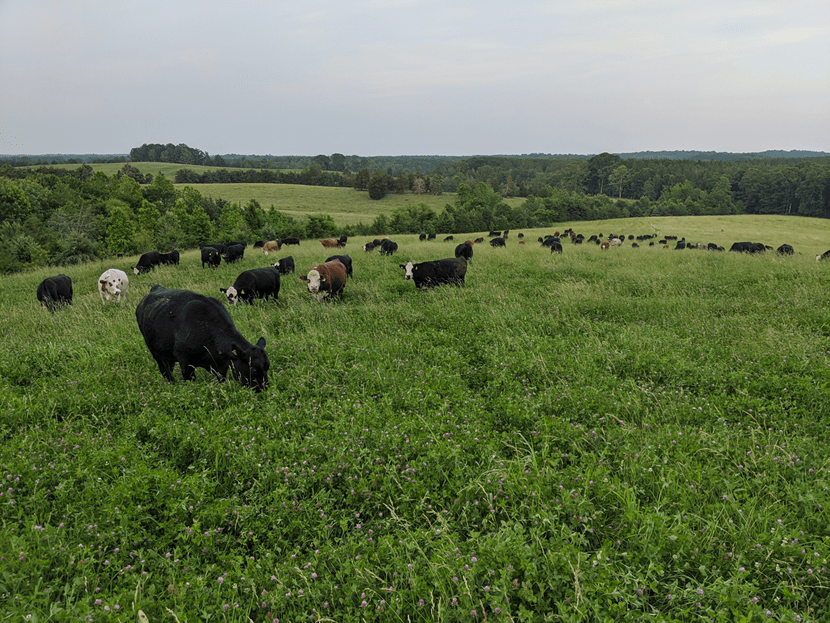
Third, you can’t assume that if you just graze and wait a good stand of something will develop. There actually are places in the country where agriculture is relatively young which still retain a seedbank of native plants just waiting to be released. That is not the case in our region where much of the topsoil was eroded away more than a century ago. Actively planting a desirable mix of grasses, legumes and non-leguminous forbes will give a jump start on the pasture evolution process. Some acreage in native warm season grasses might also fit well in your production system. For some farmers annuals will make sense, especially on 10 to 20% of the land. There are many options to customize to your particular context.
If you are going to actively manage pasture health then you will need to measure that somehow. I like the Pasture Condition Scoring system developed by NRCS. There is a well developed worksheet with documentation that can help you learn about this approach on the NRCS webpages. Scoring all your pastures can help you develop a plan for how to improve things.
Once you walk and score all your pastures and have soil test results you will be ready to make an action plan. Some pastures will need only small inputs to be highly productive. This might mean applying a ton of lime per acre to some fields and frost seeding clover. Other pastures may have a lot of undesirable plants, so they might call for strategic herbicide use. Other pastures in very poor condition should be scheduled for a full renovation. This process involves killing the remnants of the existing pasture with either glyphosate or tillage, correcting fertility, planting a cover crop (for at least one season), and then replanting with a desirable cool or warm season perennial grass or a mix of species.
Infrastructure development is a key item that can’t be ignored. A good watering system not dependent on direct access to surface waters like creeks and ponds has a dramatic beneficial impact on the ecosystem, and also allows you to put water where you need it in the landscape. You can start by using a temporary lane back to a pond or other water access, but eventually you need to get that infrastructure installed. Also, many farmers adopting this management style will start with a lot of temporary fencing, but eventually putting permanent cross fences on major pasture boundaries will make your life a lot easier.
Fortunately there are many advisers out there than can help you with the assessment and to make a good action plan. Contact your extension agent or conservationist to start the conversation. The NRCS has a very good system for helping you develop a conservation and grazing management plan which will guide your infrastructure development and future management. Your state soil and water conservation district or NRCS office is also a good place to start to explore cost-share programs that can help you improve your system.
One new development is that NRCS has a new mandate to put a lot of their EQIP funds into Regenerative Agriculture. For pastures this basically means that to qualify for a contract you will need to implement management practices intended to improve soil health. Basically, you need to adopt adaptive grazing managenment. The soil health on your farm will be documented before the start of the contract and after the five-year contract is completed. This is a new program and somewhat a moving target, but ask your local adviser how to get involved.
Finally, I want to stress that all the good things related to Regenerative Agriculture are dependent on the farmer and their team taking charge of the system. Very frequent trips to the pasture lead to better observations and evaluation of system performance. It comes down to the fact that the most important aspect of a pasture ecosystem is you the farmer. You are the big bottleneck that needs to be overcome. Status Quo will always be so much easier than charging into unknown territory. If you are a new farmer you have a lot to learn, but not much to unlearn. If you have been farming a long time you will need to completely revise a worldview that is based on generations of experience. Either way there are a wide variety of educational opportunities out there to help you along the way.
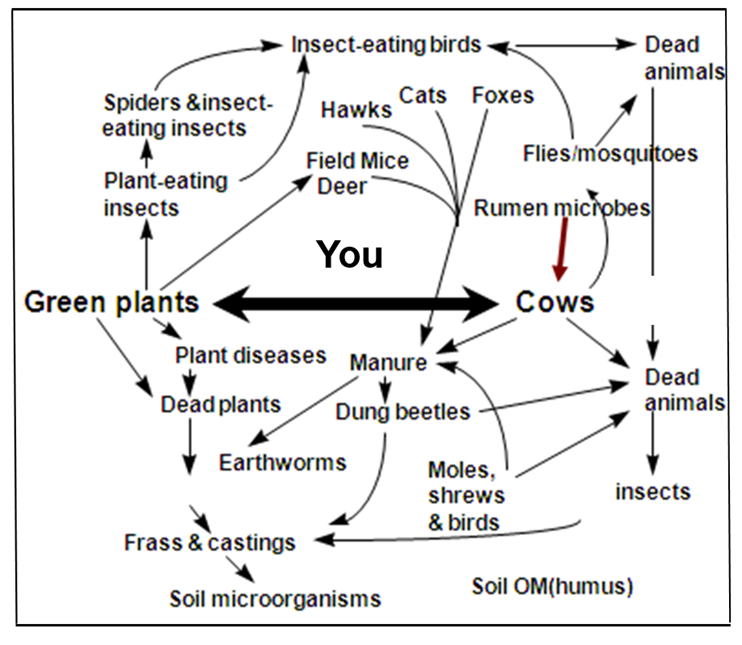
As we move into the future there will be multiple reasons to take a regenerative approach to grazing. This approach promises higher returns for your efforts, improved ecosystem services associated with your farm, and improved mental and physical health for you and your livestock. The main downside to all of this is that it takes some focus and attention to detail from you. If you don’t think it is worth the trouble, then you need to question why you are in the pasture-based livestock industry in the first place.
~ Dr. Matt Poore, NC State and the Alliance for Grassland Renewal. This article is reprinted with permission from the Amazing Grazing column in the Carolina Cattle Connection, March, 2026
The Alliance for Grassland Renewal is a national organization focused on enhancing the appropriate adoption of novel endophyte tall fescue technology through education, incentives, self-regulation and promotion. For more resources or to learn more about the Alliance for Grassland Renewal, go to www.grasslandrenewal.org
 The Alliance for Grassland Renewal