September is a critical time for Tall Fescue Pasture Renovation. If you don’t have your critical dates set, make decisions and put the dates on your calendar. Specific establishment calendars are available for most states on the Alliance website, or from your local extension agent.
For new stands to be planted this fall it is critical that fields are well prepared for planting, and that seed is put in the ground on a timely basis. If you used the Spray-Smother-Spray-Plant strategy, it is time to terminate the summer smother crop. It is important to minimize surface residue, so it may be advisable to remove the crop as hay. If grazed, make sure you graze it pretty hard so that all the material is either consumed by the animals or severely stomped. This will help the new seedlings to emerge and grow. After that final haying or grazing event, wait a few weeks (preferably following some rain) before spraying glyphosate and planting. Crabgrass residue is especially troublesome for tall fescue seedling emergence, so if there is significant crabgrass present graze it hard or hay it, and spray with glyphosate several weeks before planting to allow the residue to decay some. If you are faced with a lot of residue, burning may be something to consider.
If you are using the Spray-Wait-Spray-Plant strategy then you should make your first spray three weeks before your planting date. As with the smother crop system, make sure you have removed as much biomass as possible before allowing the pasture to grow a few weeks before spraying. It may be necessary to wait longer than 3 weeks if the weather is dry to allow for sprouting of any tall fescue seed or other weeds that might be present. If you want to establish Novel Endophyte Tall Fescue without herbicides, till the land thoroughly to kill all existing tall fescue and the summer annual before planting to novel endophyte tall fescue.
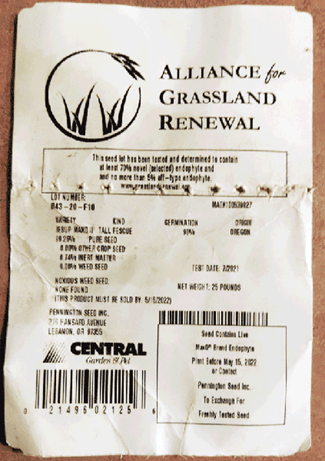
At this point you should have already ordered your seed from a reliable source. Novel endophyte tall fescue seed is now starting to arrive at seed dealers across the fescue belt. If you have not ordered, it is not too late as there is a good seed supply this year. Make sure when you receive your seed you check the label to make sure it is not expired and that it carries the Alliance label.
Products that will carry the Alliance for Grassland Renewal Label this year will include BarOptima plus E34 from Barenbrug USA, Jesup MaxQ2, Lacefield MaxQ2 and Texoma MaxQ2 from Pennington Seed, , Estancia with ArkShield from Mountain View Seeds, and Martin 2 Protek, Tower Protek and Triumphant Protek from DLF/Pickseed. All these will have good seed supply this year and despite minor differences they are all good products. For more information on the varieties go to this link: https://grasslandrenewal.org/resources-and-links/
Make sure that when you put seed in the ground that you calibrate your drill to make sure you have enough seed to cover the land you plan. Make sure that seeding depth is not too deep, targeting ¼ to ½ inch. If you are using tillage make sure your seedbed is firm and then consider cultipacking again after seeding if soil is fluffy.
In recent years we have had more requests regarding advice on planting mixtures containing Novel Endophyte Tall Fescue, clovers and other forbs. The general recommendation has been to start by developing a strong stand of tall fescue and then adding legumes and other species later. This is because starting with a mix may result in a poor stand of grass, leaving the stand more vulnerable to later weed infestations. Mixtures of Orchardgrass and Novel Endophyte Tall Fescue may be desirable, especially for hay fields. In this case a mix of the two at half the rate for a full stand is recommended. In many states this would be 7.5 lbs of Novel Endophyte Tall Fescue and 6 lbs of orchardgrass per acre. Check your state’s recommended seeding rates.
For second year stands, graze or cut hay to remove summer growth of tall fescue and other volunteer summer grasses. Fertilize with nitrogen and allow to stockpile, or graze rotationally once fall growth starts to accumulate. If there were few weeds during the year and the pasture was not sprayed with a residual herbicide, then consider frost-seeding red and white clover during January after grazing stands down for the winter. If you had weeds then delay planting the clovers, and follow through with a weed control program next season.

In 2023 and 2024 the entire tall fescue belt experienced a drought, so there were many fields that were planted late. These late plantings were surprisingly successful, so if you are very dry it is not a bad idea to delay until you have some moisture to plant into. It is getting dry across the region again this year, so watch the weather and hope for a better season than we had last year.
~ Matt Poore, NC State and the Alliance for Grassland Renewal
The Alliance for Grassland Renewal is a national organization focused on enhancing the appropriate adoption of novel endophyte tall fescue technology through education, incentives, self-regulation and promotion. For more resources or to learn more about the Alliance for Grassland Renewal, go to www.grasslandrenewal.org
 The Alliance for Grassland Renewal