As I write this, we are being passed over by yet another good chance of rain that will leave only splash marks in the dust. We ended up with 0.85 inches of rain in April and 0.3 inches so far in May. Overall, we are more than 15 inches behind for the year at this point.
This past week we went into the D3 drought classification at both our VA and NC locations. This is the first time in my life I have seen it like this in the spring. We are just finishing our first grazing cycle with the mature cow herd and will be forced to go back to hay starting the end of this week. The other cattle groups have about a month of grass ahead of them.
We cut our oats and ryegrass for hay and got about ½ a crop. Fortunately, it tested out to be really high quality and without nitrate, which is a concern with much of the small grain hay being cut around us. Our fescue hay fields are trying to head out, but there is very little leaf tissue, so the hay will yield a lot less and be lower in quality that what we would like. We will cut those fields about Memorial Day even if it doesn’t rain. If it does rain soon then that crop could still surprise us.
This week I will be making a trip to the FSA offices in both counties to talk to them about the Livestock Forage Program. This standing disaster program was put in place to help farmers impacted by drought or other disasters that reduce their hay and pasture yields. When you hit D3, a pretty good benefit is triggered.
We will start buying as much hay as we can find. We will also start the process of deciding which cows will be culled when we wean the calves. With our yearlings promised already for the beef program, and most of the calves (now 6 to 7 months old) needed to keep that market the next year and to provide replacement females, we will do most all our culling out of our mature cow herd. We have some older cows, and some that are not as productive as others, that will make their way onto the cull list which we will make when we work the herd this week. We will not sort them off until we wean the calves, but it will make it easier for us to make a good decision if we do it ahead ofif time instead of at the sort gate.
Our pastures are in remarkably good condition considering the growing season so far, so we are hopeful that when it finally rains things will grow out well. We have been grazing them pretty light and leaving about 4 to 6 inches of residue. We have not grazed our first-year stands of novel endophyte tall fescue at all, and that will probably wait until after we get good rain. While there is plenty there to justify a light grazing, we just don’t want to risk damaging the stands.
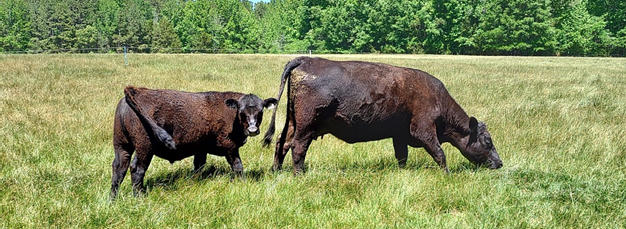
This is a photo of a first calf heifer grazing a third-year stand of BarOptima Plus E34. This stand is very dense with almost no seedheads. There is a lot more forage there than you would think because it is a short-natured plant with a very high tiller density. The condition of this heifer and her calf (with no supplement) is typical and is testimony to the value of Novel Endophyte Tall Fescue in a forage system for the fescue belt!
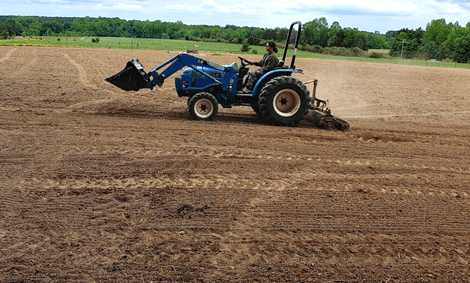
We had ½ inch of rain the fourth week of April, so we decided to go ahead and plant the crabgrass on the sacrifice areas Brandon disced and worked into a good seedbed. We also broadcast seeds onto a field we heavily bale grazed during the winter. We mixed Quick-n-Big Spreader 19 Crabgrass and Dal’s Big River Crabgrass. Quick-n-Big Spreader is an upright crabgrass that will fall over and spread through decumbent stems, with outstanding early yield. Dal’s Big River is a rework on Red River that R.L. Dalrymple released in response to a lot of Red River on the market that is just a mix of common crabgrasses (and not really pure Red River). Dal’s Big River is later than Quick-N-Big and is a runner type crabgrass that will give good yields later in the season. We broadcast 3 lbs of each mixed with 100 lbs of 34-0-0 per acre. Following broadcasting we ran a cultipacker on the tilled ground, and ran our finishers over the bale graze area to stomp in seed.
Over the decades one of the highlights of our spring is attending Merlefest in Wilkesboro, NC which is a large music festival. My spouse Jeannette and I, along with many family members, have been attending now for 35 years! It is always a great chance to get away from the farm for a week and enjoy a break when there is not too much to be done at home .
On Sunday afternoon I was really getting relaxed and getting ready to enjoy the finale by Allison Krause and Union Station when I got a call from Tina. I know she would not call me if it had not been something critical, so I got to where I could hear and called back. “Are the donkey’s halter trained?” “Why?” “They are 3 miles from the farm near the Red Bank Road!” Not really what I wanted to hear!
Here I must admit that having good help is the most important thing in farming. I have had similar calls at Merlefest over the years, but never before have we had employees as dedicated as Tina and Brandon at home to deal with the inevitable problems that come when you least need them. I suggested putting a polywire around them, giving them some hay and water, and to get ready for yet another adventure Monday morning. Tina and Brandon made it so, and when I arrived Monday morning, they had already been to them and found them where they left them Sunday night.
We met to do the cow chores and then went to try to get the donkeys. Brandon had bought a pack of vanilla sandwich cookies and a bag of Cheetos (the donkeys’ favorite treats) to use to bait them along. We got a halter on Ruby Mae, and managed to get her to head toward home, with Jack eagerly following along. She seemed to want to go, so that was a relief, and Jack seemed happy to follow. They had walked the road about 4 miles to get where they were, but we found a direct line through a couple of neighboring farms that cut this down to about 2 miles.
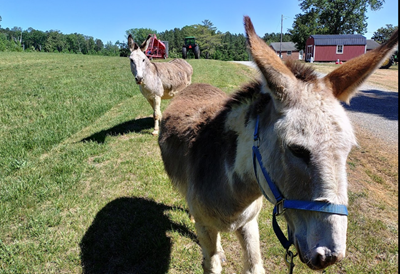
This all progressed nicely with Brandon and me on foot with Tina bringing along the truck. About halfway through this short cut, we came to a creek that Ruby Mae refused to cross. We pulled, pushed and did everything we could, but to no avail. Eventually we got Jack to cross for Cheetos, and finally we literally pushed Ruby off the bank and she had nowhere to go but across. After 2 hours we arrived at the back gate to Triple Creek and got the donkeys back in with the cow herd.
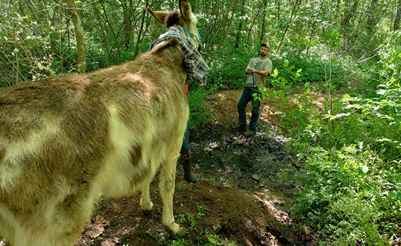
Retelling that story has already made me feel better about the drought! There is nothing more difficult for a farmer than a drought, but it is all part of the big story we are caught up in, isn’t it? After all, if things always went according to plan, what kind of adventure would this life be?
~ Matt Poore, NC State and The Alliance for Grassland for Renewal
The Alliance for Grassland Renewal is a national organization focused on enhancing the appropriate adoption of novel endophyte tall fescue technology through education, incentives, self-regulation and promotion. For more resources or to learn more about the Alliance for Grassland Renewal, go to www.grasslandrenewal.org

