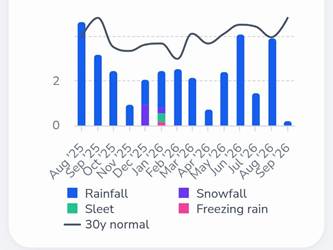
Sometimes it seems that no matter what you do you just can’t win! Our drought continues in earnest, keeping us in D3 for another month. While we did have some rain in early August, we went the rest of the month without and only grew a little bit of grass. We had an inch on the front of the farm August 28, but unfortunately had only 0.4” on most of the back pasture area.
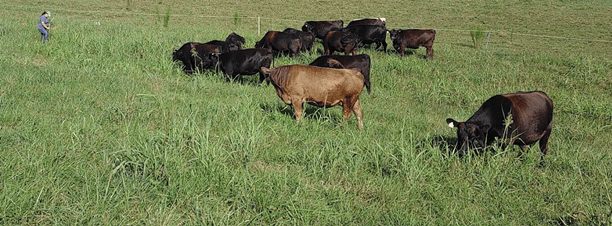
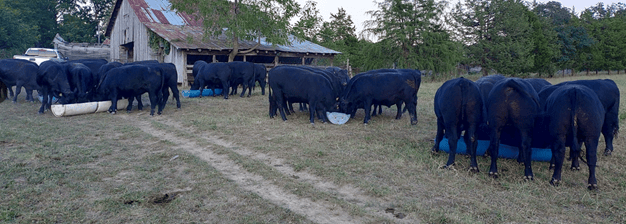
We have now made the second full cycle of the cow pastures, and started back to feeding hay today. We are setting up bale grazing on areas of the farm that are usually too wet, so some good will come from all the hay nutrients. The cows are in really good body condition and ready to start calving in about a month.
It was at mixed emotions that we gave the cows the last piece of grass yesterday. It is pretty amazing how well behaved and easy to work with this herd is. The fact that they have been around for generations on our farm creates a culture of cows and calves that know our system. It is hard to understand this if you are not a long-time cow/calf manager.
We continue to sell animals to try to reduce our feed needs. If we are to feed through next spring we will need to sell another 20 cows to pay for the hay. The old folks say you can’t feed your way out of a drought, and that is true to some extent, but in this case at my age it does not make sense to liquidate the whole herd and try to start over when we have grass. Hay is expensive, but cattle are even more valuable. However it comes out we will reduce stocking rate substantially, and this should help us recover next year and make room for some pasture renovation and other improvements we need to make.
We sold 8 bred heifers and they went quickly to neighbors. We had really good luck this year with our AI program and had 22 pregnant out of 26 bred. We did a DNA test on the group of heifers using the Zoetis Inherit program, and it turned out to be a really valuable thing to do give our need to sell 1/3 of them. All 22 heifers look really good, so the DNA test gave us more to go on than just their phenotype (what they look like). Our main problems in the herd are udders and feet, and it is nice that we now have genetic values for that we can select for.
One thing that has come out of this experience is that I found a really neat rainfall tracking app. There are several of these out there that can give you good rainfall totals calculated from the radar record. I was frustrated about that inch in the gauge when it was obvious that we didn’t get that much on most of the farm. With this app you can set any location on the map, and the app will give you current and historical precipitation for that spot. We have always kept up with rainfall in a rain gauge near our headquarters. It is hard to consistently keep up with this, but we have done pretty well. We have not consistently measured rain at our NC location, so we don’t have good information on that. We also know that with a farm that is 1.5 miles long a thunderstorm doesn’t necessarily hit the whole farm. Now I have rain points set up on each end of the farm. Sometimes technology is of huge value, and this is one example.
The thing that is of most value to me on this app is the ability to quickly see our cumulative rainfall, monthly and monthly totals. There is a small cost to the app if you want the history and more than one location, but being able to track rainfall in several different locations with ease is really valuable.
We have continued to track actual rainfall in the gauge and have found with significant events the actual and the radar estimate match pretty well. In very light rain the app tends to overestimate things a little. It may say we had 0.1 inch, where the rain gauge is dry. We will continue to track that and see how it matches over the long run. For now I will say if you don’t currently follow rainfall on your farm, this could be a very valuable tool for you.
One highlight on the farm now is the finishers at Pleasant Hills Farm, 8 miles south of the main farm on the NC side of the border. With the forage quality being down a little we started feeding these cattle a little earlier and a little more than we have in the past. The company we sell to allows us to use some concentrate supplement (up to 1% body weight), and the trick for us is to adjust that feeding rate early enough to get the cattle where they need to be on delivery day. At this point we have 30 days until we start delivering them, and I think we could easily ship half of them today and meet our mid-choice quality target.
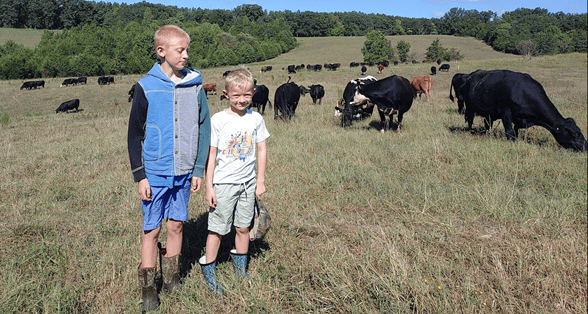
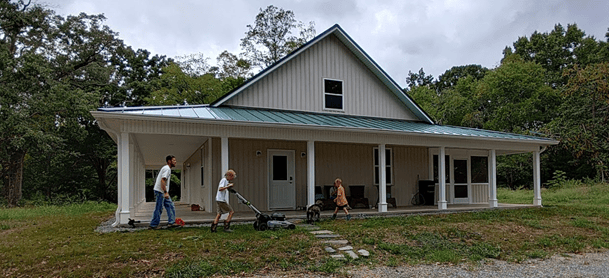
The other exciting thing right now is that the farmhouse is finished, and we had our first official guests for Labor Day. My nephew Mitch Herman grew up in his early years on Triple Creek and is still very engaged with what we do. He and his spouse Julie brought their boys, Blake (10 yrs) and Knox (6 yrs) for Labor Day. Blake is really interested in farm equipment, and Knox is an animal lover. The makings of a great farm crew!
They had a great time helping move cows and do farm chores, and we all had time to work together to clean up around the house, and work to get a lawn established. The lawn is a work in progress given the fact that it was planted mid-summer and had very little rain.
We had to grade around the house and plant grass (the worst time of year) to satisfy the inspector, and that was our last task before getting the Certificate of Occupancy. After that we were able to settle up with the insurance company and start to furnish the place. While we miss the old house and all the memories in it, we now have a place to create a whole new set of memories which started this past weekend!
They say hard things like the situation we are in are good for you as long as they don’t kill you. While I am still longing for that long overdue wet spell, I know in my heart that we will not let this drought stop us. We have a plan and are sticking to it, but it looks like we are in for a really long winter feeding season! There is rain in the forecast again for this weekend, and if it comes this time there is still time to grow a little grass before cold weather. If that happens I will tell you about it next month!
~ Matt Poore, NC State and the Alliance for Grassland Renewal
The Alliance for Grassland Renewal is a national organization focused on enhancing the appropriate adoption of novel endophyte tall fescue technology through education, incentives, self-regulation and promotion. For more resources or to learn more about the Alliance for Grassland Renewal, go to www.grasslandrenewal.org

