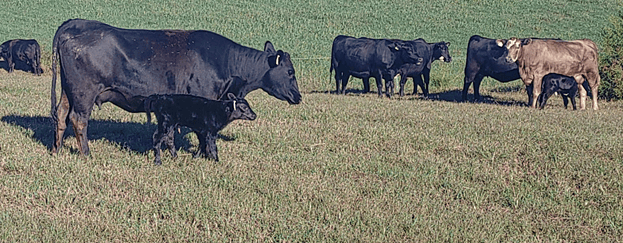
Calving season is my favorite time of year. We calve starting in October, so the days are cooling off, the cattle are feeling better, and the days are still long. Seeing those new calves hit the ground is the start of our annual cycle for the cow herd. So far, we have had good luck, with 36 of 106 on the ground without a problem yet, and they were not due until yesterday! The oldest ones are starting to run and play, and it is always a pleasure to watch.
We have had seven calves out of the AI heifers so far, and these are not due until late next week. Of the 14, 12 will calve in the first cycle and only 2 will be on the second cycle. For a number of years, we only bred the heifers one time AI and put all the open ones in the beef program. After literally eating many very nice heifers we decided to rebreed anything we caught in heat the second cycle, assuming the technician could come breed them. It turned out this year there were 3 of those we caught in heat at the same time, so we bred them and they all settled. In the coming year we are cutting down on numbers due to the drought, so we will only breed 18 heifers and will work hard to get them all bred on two cycles.
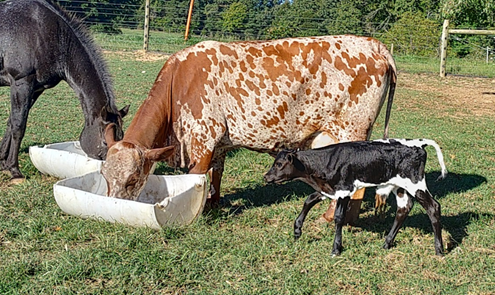
The blind cow calved early this year and had a skunk tail bull, which is a common longhorn cross color pattern. We have 4 cows in the herd that also carry this “pinto” color pattern. The blind cow is out of one of my dad’s old longhorn cows and a Polled Hereford bull. Dad bought a longhorn cow with a heifer calf at side during the 2007 drought and since that time a significant amount of longhorn has crept into our cow herd. The blind cow was born in the front pasture where the longhorns stayed all the time. We didn’t know she was blind until we weaned her and moved her out of this small front pasture. She is now 10 years old, and she has turned out to be a pretty productive cow. As long as she is in that pasture where she knows where everything is she is fine.
We did a DNA test on our bred heifers this year, and that helped us make decisions on which to sell and which to keep. Our plan for the coming year is to test all the heifers that would normally qualify for our AI program based on their phenotype, and then cut down to 18 to breed based on the DNA results. We are using the Zoetis Inherit Select product, and this basically gives us EPDS for our commercial cattle. We have been saving a few bulls each year, and we also plan on using early DNA testing to decide which bulls to keep this year.
This month we entered into the Savory Institute’s “Environmental Outcome Verification Program (EOV)”. The Savory Institute is a global organization working out of South Africa founded by Alan Savory. Savory has franchised “Savory Hubs” around the world that work to extend the mission and programs of the Institute. The EOV Program is the verification system behind the “Land to Market” certified regeneratively produced product label.
The company we raise beef for, Firsthand Foods, is working with other food hubs and aggregators on a project to increase the use of regenerative verification and labeling on food products. Our farm, along with the other beef producers supplying Firsthand Foods will be undergoing the EOV monitoring program. In the current market, many customers are asking, “is it regenerative”? Participating in this program will answer that question.
Our friends Jamie and Amy Ager at Hickory Nut Gap Farms worked several years ago to become a Savory Hub. They are now working with regenerative farmers across the region on implementing the EOV program. It is interesting that Hickory Nut Gap and Firsthand Foods are technically competitors in some markets, but they are working together to improve the market viability for everyone in the local beef business.
I really like the idea of the EOV system because it is based on the actual ecological outcome on the farm, not on the certification that you do or don’t do specific practices. As you have seen me say many times, never say never and never say always to practices. The goal is to apply all the tools you have at hand in a concerted way to build soil health and system productivity. The EOV system uses both short-term and long-term monitoring to establish baseline levels for key indicators of soil health, and then monitors the progress in each indicator.
Each year, 10 locations on the farm will be monitored for key indicators including soil organic matter, soil respiration, plant species, ground cover, available nutrients, and biological activity. Every 5 years, one additional location will be used for long-term monitoring with more detailed measurements. The idea is to develop a baseline and then to document continued improvement in the system.
It is unfortunate that we started this monitoring during the worst drought in history as many of the indicators don’t look too great when you consider that we have not had much water for a year. However, there is a good understanding of how drought and other issues can impact the monitoring, so it is expected and is something that the monitors know they need to work around. I am excited to see these baseline measurements and to learn more about our progress in regenerating a healthy pasture ecosystem.
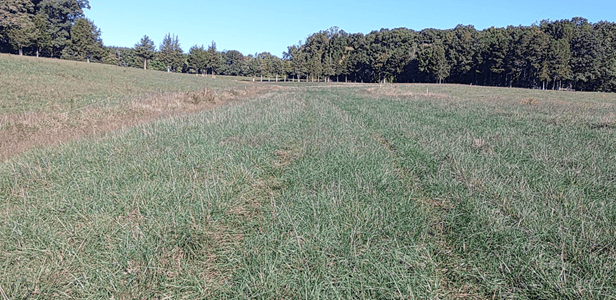
Finally, we continue to be very dry and remain in D3 drought despite continued forecasts for rain. We had a few good rains in mid-September. We put nitrogen on our new stands of fescue pasture and our hay land two weeks ago with the promise of a few more good rain chances on the horizon. The big rains predicted didn’t come, but we did have two rains a week apart totaling 0.85 inch. Those areas have turned green and started to come out, so there is still opportunity to grow some grass if we can continue to get some moisture. In the meantime, we will continue to feed the cow herd hay during this early phase of calving, and the yearlings. We are thankful to have some good grass ahead of the finishers at both farms for another 6 weeks or so. We also have the last of the crabgrass and then plenty of tall fescue for the first-calf heifers. With a little more rain we can expect a few more months of grazing with the mature cow herd after we finish with calving. However you look at it we are in for a long winter hay feeding season, but at this point I think we can get through just about anything with a smile.
~ Matt Poore, NC State and the Alliance for Grassland Renewal
The Alliance for Grassland Renewal is a national organization focused on enhancing the appropriate adoption of novel endophyte tall fescue technology through education, incentives, self-regulation and promotion. For more resources or to learn more about the Alliance for Grassland Renewal, go to www.grasslandrenewal.org

