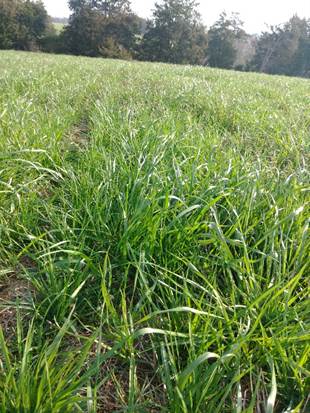
Tall fescue is the most important coolseason grass grown in the “Heart of America”. It is a versatile plant used for animal feed, lawns and turf, and conservation purposes.
Tall fescue is a native of Europe. The exact date of its’ introduction into the United States is not known, but likely came as a contaminant in meadow fescue seed from England prior to 1880 (Table 1). Tall Fescue was an entry in the National Herbarium Collection in 1879 and was grown in plots in Utah, Kentucky and Maryland (USDA) in 1880. In 1916, tall fescue plants were identified in Pullman, Washington with some of these plants taken to Corvallis, Oregon in 1918. Selections out of this initial planting was released in 1945 as the variety Alta.
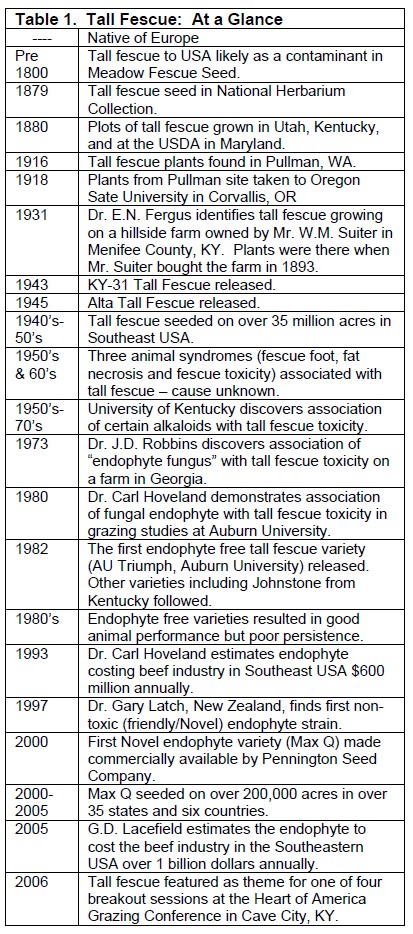
FARM VISIT– The most important farm visit in the history of Kentucky agriculture occurred in 1931 when Dr. E.N. Fergus, an agronomist with the University of Kentucky, was invited to Menifee County to judge a sorghum syrup show. Following the field day, Dr. Fergus visited a hillside farm owned by Mr. W.M. Suiter. Dr. Fergus observed an excellent stand of grass growing on a steep hillside. The grass had been growing in the field for over forty years. Dr. Fergus identified the grass as tall fescue and took a few pounds of seed back to the University for testing. After lengthy testing, it was released in 1943 as the variety “Kentucky 31”. It now occupies over 35 million acres in the Southeastern USA.
FARM VISIT 2 – A second historic development involved cattle herds grazing separate tall fescue pastures on the A.E. Hays farm near Mansfield, Georgia. Only one of the herds exhibited fescue toxicity symptoms. Dr. Joe Robbins and Dr. C.W. Bacon, USDA, Athens, Georgia, began searching for an explanation for this situation in 1973. Finally, in 1976, the toxic pasture was found to be 100% infected with an endophytic fungus, while the non-toxic pasture was less than 10% infected. This implied an association between the endophyte and fescue toxicity.
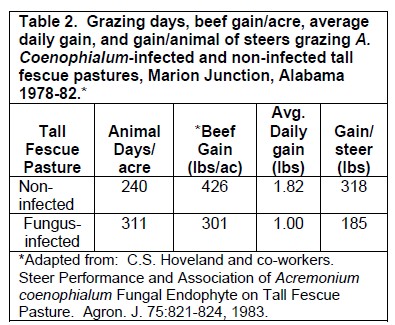
Endophyte Impact Documented – A third development involved a grazing experiment initiated in the mid-1970’s at Auburn University. Dr. Carl S. Hoveland and coworkers noted marked differences in the appearance and gains of steers grazing newly-established paddocks of tall fescue on the Black Belt Substation near Marion Junction, Alabama. Ultimately, it was found that there was no fungus infection in paddocks where performance was good, but a heavy infection in paddocks producing poor gains. Thus, the association of the endophyte with poor performance of cattle was documented in a replicated, controlled grazing experiment (Table 2). It is believed that some paddocks were endophyte-free because they had been established with old seed in which the fungus had died prior to planting.
Endophyte Free Varieties
Once the endophyte had been documented as the “problem”, the obvious solution was to develop a variety without the endophyte (endophyte-free). That process was not difficult or terribly time consuming and by the early 1980’s, Triumph was released from Auburn University, Johnstone from the University of Kentucky, followed by several varieties from both university and private breeding groups.
Endophyte-free varieties were planted on many acres and in several experiments/demonstrations. Experimental results, along with farmer experience, showed excellent animal performance once the endophyte was eliminated; however, it was also learned that the endophtye had provided the tall fescue plant considerable “protection” enabling the old Kentucky 31 endophyte infected to be very persistent and resistant to many environmental, pest, and management stresses including overgrazing. As a result, most endophytefree varieties did not persist well and were not popular among farmers as a “solution.”
Need for a GOOD Endophyte
With full knowledge that the endophyte was the major causative factor in poor animal performance of tall fescue and the fact endophyte-free varieties were not as tough and as persistent as needed, thoughts then turned to a “new solution.” The need for a “good” endophyte – an endophyte that would permit positive animal performance along with stress tolerance of the plant seemed to be an academic “pipe dream” until Dr. Gary Latch in New Zealand identified, isolated, and tested several endophytes and indeed found some that would give that win-win situation. Dr. Latch selected the best endophyte from his program in New Zealand and entered a cooperative research venture with Dr. Joe Bouton, Tall Fescue Breeder at the University of Georgia. The research team inserted the best endophyte into the best tall fescue variety in Dr. Bouton’s program and indeed produced a novel endophyte variety that gave animal performance equal to the same variety without an endophyte and permitted the plant to be more stress tolerant, similar to the same variety with the “toxic” endophyte. Marketing rights to this variety was obtained by Pennington Seed Company and released in 2000 as the variety Max Q Tall Fescue.
Since the release of Max Q Novel Endophtye Tall Fescue in 2000, over 200,000 acres have been seeded in over 35 states in the USA and at least six different countries.
Other varieties are being developed and tested and will be available in the future. In addition, other management strategies are also being investigated.
The endophyte of tall fescue is a very serious problem for the livestock industry. This organism is costing the beef cattle industry over $1 billion dollars annually. Our challenge is to utilize the best research information, management practices and proven products to reduce the economic impact of this “fungus” to our livestock industry.
References
Ball, D.M., C.S. Hoveland, and G.D. Lacefield. 2002. Southern Forages 3rd Edition. PPI and FAR, Norcross, GA.
Ball, D.M., S.P. Schmidt, G.D. Lacefield, C.S. Hoveland, and W.C. Young, III. 2003. Tall Fescue/Endophyte Concepts. Oregon Tall Fescue Commission Special Publication 1-03, Salem, OR.
Lacefield, G.D., J.C. Henning, and T. Phillips. 2003. Tall Fescue. Univ. of Kentucky Coop. Extension Service Pub. AGR-59.
~ Garry D. Lacefield, Extension Forage Specialist, University of Kentucky
The Alliance for Grassland Renewal is a national organization focused on enhancing the appropriate adoption of novel endophyte tall fescue technology through education, incentives, self-regulation and promotion. For more resources or to learn more about the Alliance for Grassland Renewal, go to www.grasslandrenewal.org

