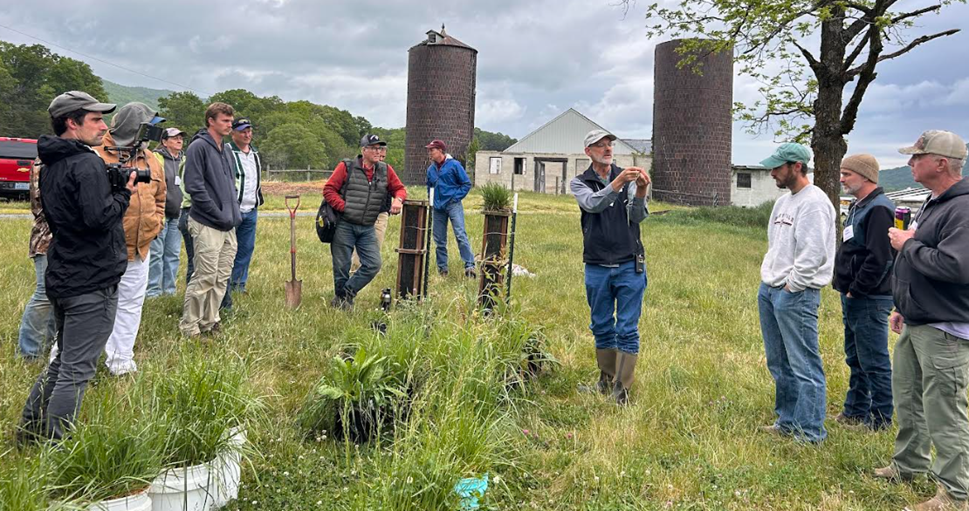
On May 7th, 2026, the Catawba Sustainability Center (CSC) – a 377-acre Virginia Tech research and demonstration farm in Catawba, Virginia – hosted a full-day workshop on nutrition in pasture-based livestock systems, bringing together farmers, extension agents, university faculty, and students.
The morning session opened with presentations by Dr. Matt Poore, farmer, professor & extension specialist in ruminant nutrition at NC State, and Mr. Joel Salatin, farmer, author, and co-owner of Polyface Farm in Swoope, VA. Dr. Poore grounded the group in the science of forage quality, mineral supplementation, and animal performance in pasture-based systems. Relevant research was put into context of his own 650-acre grass-fed beef farm in Halifax County, VA. Mr. Salatin followed with his perspective on animal nutrition but paid special attention to infrastructure, particularly for livestock water – a timely topic given the dry conditions faced by producers across the region.

After an active discussion and shared lunch, our speakers led the group through an exercise in plant identification, including perennial grasses and a range of forbs – some of which are often dismissed as weeds but which can play a meaningful role in forage diversity and livestock nutrition. From there, we moved between the CSC’s native warm-season grass pastures and mature pine silvopasture with cool-season understory to compare forage composition across systems. The afternoon wrapped up with a look at fencing and irrigation infrastructure, rounding out a day that covered far more ground than the original nutrition-focused agenda.
“Despite a long career in farming and ag consulting throughout VA and beyond, this is the first event I’ve helped lead in cooperation with VA [Cooperative] Extension. The CSC is building workshops by and for producers, bringing together a local community to share insights on what works for their operations at a practical level.”
About the CSC’s Grass-Fed Beef Partnership
In partnership with Roanoke County, the Grass-Fed Beef Partnership acts as an economic development program for the region. The CSC purchases calves and yearlings from local producers at five cents above per pound stockyard rates. These producers must fence cattle out of waterways and/or rotationally graze, incentivizing these ecologically beneficial practices. The cattle are then managed through our adaptive grazing program, moving through diverse pastures with cool-season grasses, native warm-season grasses, and silvopasture sites. The cattle are finished on grass and sold through the local community. The CSC supports and uplifts the local agriculture economy by supporting local producers, co-ops, processors, food access partners, and local business.
The Catawba Sustainability Center is committed to continuing our workshops and building a local community around sustainable agriculture. If you are a producer, extension agent, or researcher in the region and want to stay connected for future events, please reach out to Nick Tyre (nicktyre@vt.edu) or Matthew Wagner (matthewwagner@vt.edu).
We are grateful to VA Cooperative Extension and Roanoke County Economic Development for their support in making our work possible.
- Nick Tyre, Ph.D. Student, School of Plant and Environmental Sciences, VA Tech and Matthew Wagner, Farm Manager, Catawba Sustainability Center
~ Joel Salatin and Matt Poore
The Alliance for Grassland Renewal is a national organization focused on enhancing the appropriate adoption of novel endophyte tall fescue technology through education, incentives, self-regulation and promotion. For more resources or to learn more about the Alliance for Grassland Renewal, go to www.grasslandrenewal.org

