
Why Stockpile Forage?
Livestock producers should continually look for ways to reduce costs and improve the feed value of materials used in their operations. With high fuel prices, rising equipment costs, and increased maintenance expenses, making hay can quickly cut into profitability. North Carolina State University enterprise budgets estimate that cutting, tedding, raking, and round baling 4-by-5-foot hay bales cost about $140 per ton in 2022. Since three 4-by-5-foot round bales equal about one ton of hay, the production cost is roughly $46 per bale.
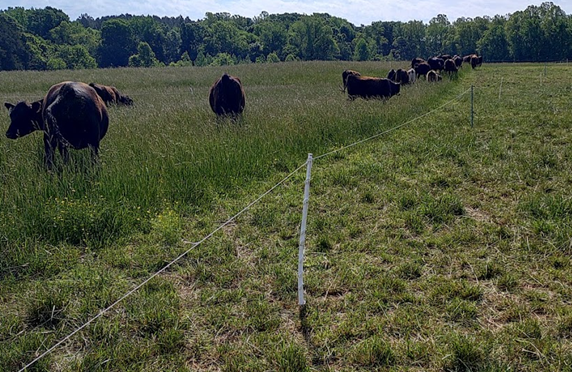
Reducing the number of hay bales needed for cattle can lower costs and improve the operation’s bottom line. Livestock can harvest, process, and use standing forage without the added expense of tractors and hay equipment.
Stockpiling Strategies
Many producers assume hay should be fed only in winter. However, hay may be needed whenever the dominant forage species is not actively growing or cannot keep up with grazing pressure. For example, producers with only cool-season grasses may need to feed hay during hot, dry summer periods. The following strategies can reduce hay demand during the usual feeding season and address summer forage shortages that affect the ability to stockpile for winter.
Strategy 1 (USDA Plant Hardiness Zones 6–8): Use Cool- and Warm-Season Grasses
Depending on your farm or ranch location, consider planting both cool-season and warm-season forages. Avoid mixing them in the same pasture unless the dominant species becomes fully dormant during part of the growing season. Perennial cool-season and warm-season grasses generally should not be planted together.
Allocating part of the acreage to warm-season forages gives producers flexibility to graze livestock during summer while cool-season forages rest during their semi-dormant period. In a typical growing season, cool-season forages begin recovering from summer dormancy while warm-season forages are still growing, allowing the cool-season forages to stockpile for grazing later in the year.
North Carolina State University research shows that overwintered, stockpiled tall fescue in February can contain 12% crude protein, which is higher than most tall fescue hay. Although warm-season bermudagrass loses leaf quality faster than tall fescue, fall stockpiling practices can help maintain crude protein levels between 11% and 14%, according to a Mississippi State University study.
Strategy 2 – Annual Ryegrass
Producers using warm-season perennial or annual forages can extend grazing by overseeding with annual ryegrass. This approach does not lengthen the end of the grazing season as much as it starts grazing earlier. Annual ryegrass grows before gradually dying out as the warm-season forage it was overseeded into begins to break dormancy.
Strategy 3 – Brassicas
Although reducing hay use is the goal, every bale produced should still be used effectively. Few haymaking years are ideal; some hay may be rained on, cut too late, stored improperly, or reduced to little more than filler.
One option for producers in this situation is to plant one or more brassica crops in the fall. In northern regions, brassicas can also be grown in summer. These fast-growing annual forages are related to brassicas grown for human consumption but have been bred for greater foliage production. They are highly nutritious and can reach crude protein levels of up to 32%. However, brassicas contain high amounts of water and very little fiber. To use poor-quality hay effectively, producers can flash graze livestock on brassicas and then provide hay as a fiber source for rumen bacteria. This helps balance the animals’ diet while making use of lower-quality hay.
Brassicas can also support cross-species grazing systems, such as pastured pork. Cattle can graze the leaves, and after the final grazing, swine can be turned in to eat the roots. This effectively tills the soil and helps prepare the field for the next crop.
Strategy 4 – Rotational Grazing
Rotational grazing is an important part of stockpiling grass for winter. In areas where several tons of forage can be produced per acre during the growing season, producers must manage grazing carefully. Without controlled grazing, animals will graze selectively and leave some forage unused. Trampling and manure can also make a significant portion of the forage unavailable. Rotational grazing limits animals to the amount they can consume within a set period, improving overall forage use. Forage that would otherwise be wasted remains available for livestock consumption.
Stockpiling forage will not eliminate the need for hay, but it can reduce reliance on it. Making hay is more expensive than ever, so producers must look for ways to economize. Livestock can graze standing forage at a lower cost than mechanically harvested feed. Using these strategies can help extend forage availability and improve overall forage efficiency.
~ Kate Meeuwsen & Sam Groce, Barenbrug USA
The Alliance for Grassland Renewal is a national organization focused on enhancing the appropriate adoption of novel endophyte tall fescue technology through education, incentives, self-regulation and promotion. For more resources or to learn more about the Alliance for Grassland Renewal, go to www.grasslandrenewal.org

