
The following article is used with permission and is a preview of the Amazing Grazing Column in the Carolina Cattle Connection, November 2026 edition.
Recently I had a message from my old friend Steve Washburn (whom I worked with for 30 years at NC State) asking me to remind him about how we started burying men’s underwear to demonstrate differences in soil health. He had read that there was a large project in Switzerland where they were burying men’s underwear and it brought back the memory of us doing that for our Pasture Ecology course as a teaching tool. I had the pleasure of seeing Steve and telling the whole story at a retirement party in September and he encouraged me to write about it.
The story starts 30 years ago when we began conducting a Pastureland Ecology class for the USDA-NRCS national employee development system. This course has been taught 25 times. It is very popular and has attracted students from all across the country to Raleigh for an 8-day course including many hands-on demonstrations including managing grazing of beef cattle, horses, sheep and goats. We have trained over 500 grazing specialists, soil conservationists and other NRCS staff from all 50 states, Washington DC and several territories.
The course has been a great place to generate new ideas for educational demonstrations that make a point and keep the memories of the experience alive. About 15 years ago we were starting to bring in the concept of soil health to the course. We did several demonstrations to show that the soil was alive including using respiration chambers, microscopic examination, worm counts and soil pits. These were all of interest to the students, but many they had already seen and it didn’t quite reach that outcome level of “fun and memorable”.
In 2010 the project team was brainstorming about how to improve the program for the coming year, and the subject of how to increase the impact of the soil health demonstrations came up. Dr. Julie Grossman, a soil ecologist, said that in research they sometimes had used a “cotton swatch” assay where they buried a piece of cotton cloth, and then later dug it up to measure degradation of organic matter. Dr. Jim Green, then manager of the course, said we didn’t need to buy cotton cloth because he would donate a drawer full of old underwear his wife had been bugging him to get rid of. Someone pointed out that Jim’s underwear were probably so full of holes we would not be able to tell they had been buried or not! We all had a good laugh and went on to other subjects.
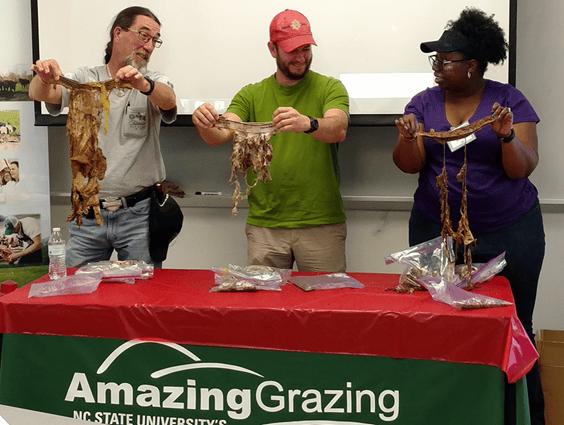
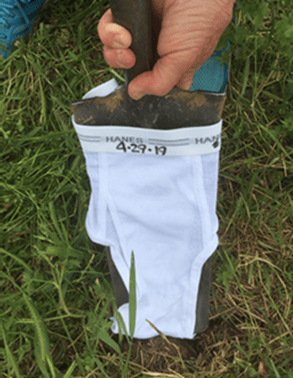
As we concluded our meeting we returned to this underwear idea. Wouldn’t that be a surprise for the students when we dug them up! They probably would never forget it. While it seemed a little embarrassing, we decided to try it. We buried new men’s cotton underwear for 2, 4 or 8 weeks in either healthy pasture, overgrazed pasture or an area that was frequently tilled and rarely planted. Our colleague Dr. Sharon Freeman took on the job of managing the underwear demonstration, and over the years it became a big hit with the students. Several times we had drought leading up to the course, so April Shaeffer and the students have fun memories of watering the underwear!
Now here is the rest of the story.
Some of those students in the NRCS course took the practice home with them and began doing it all over the country for their educational programs. One day I was listening to “Wait Wait Don’t Tell Me”, the news quiz show on NPR. They have a segment where the three panelists tell the story behind a headline in the news, one being true and the other two being made up. The true story headline was “Farmers Burying Underwear in Pastures to Study Soil Health”, from a local newspaper in Tennessee. After hearing the story the contestant did not think that one could possibly be true!
I did a Pasture Ecology Workshop with Dr. John Andrae at Clemson in 2014, and I took the underwear left over from the course with me to use as a prop. This year we had buried underwear in a newly tilled corn field that had been fertilized with nitrogen. Amazingly and surprisingly all the cotton was gone at 4 weeks, likely due to a very low organic matter, plenty of nitrogen and bacteria hungry for organic materials.
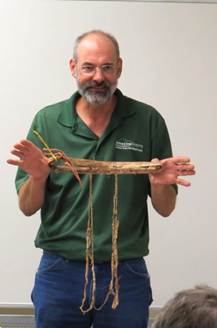
John had a newswriter at the workshop, and afterward he came up and said he had his story, “Researchers ‘Soil Underwear’ to Show Pasture Health”. He got a good photo of me, and within a few days of posting his article that photo became the number one image of me on the web!
Later that year I had a call from a gardening magazine in Canada who had seen the article asking me about the practice of burying underwear. She had seen the Clemson article and thought it would make a good story for her magazine. She wrote an article about it suggesting gardeners could enjoy using the practice to keep an eye on the biological activity in their soil. Apparently, many Canadian gardeners did so that year.
The following year we learned about the “Soil Your Undies” challenge issued by the Soil Conservation Council of Canada. The challenge was to bury the underwear and then dig them up and make a video of the result. You can see many of these videos on the web. The Soil Your Undies activity continues today as part of educational programs across the USA and Canada.
Three years ago, I was again listening to the radio and heard a story about a Citizen Science project in Australia where local civic and school groups were given a kit with men’s underwear and instructions on how to bury them. When they dug up the underwear they shipped them to the University for analysis. The most recent project that Steve had read about in Switzerland was similar and involved hundreds of citizen groups across that country.
This is just another example of how simple things can make learning fun. Hands-on activities like those commonly used at Amazing Grazing workshops can really reinforce the principles and make the students want to go home and apply what they learned.
You can find a short video on the web of me telling the story, and another longer one where Dr. Freeman instructs you on how to conduct an underwear burying demonstration.
~ Matt Poore for the Carolina Cattle Connection
The Alliance for Grassland Renewal is a national organization focused on enhancing the appropriate adoption of novel endophyte tall fescue technology through education, incentives, self-regulation and promotion. For more resources or to learn more about the Alliance for Grassland Renewal, go to www.grasslandrenewal.org

