
This is a preview of an article written for the Amazing Grazing column in the September 2026 Carolina Cattle Connection.
Stockpiling late summer and autumn growth for winter grazing has been a practice used by beef producers all across the nation as a foundation for brood cow wintering programs. In our region, producers can have success with stockpiling tall fescue, bermudagrass, and even summer annuals. The practice has the major benefit of being less expensive than feeding hay, and it is also much better for cows and the farmer to have grass during the winter.
Despite the advantages of winter stockpiling, we still see this approach to be underutilized. Most farmers allow cows to roam the farm and eat every last shred of grass before they start in with hay feeding, often sometime around Thanksgiving. This inevitably means overgrazed pasture and a long winter hay feeding period, often 120 to 150 days.
To successfully stockpile you need to take good care of your grass stands through the summer. If you overgraze, then when you try to stockpile there will be little response from the stressed crop. If you do a good job of rotational grazing, and grass stands come through the summer with some residual biomass and vigor. You can simply skip some of the pastures in your rotation and let them stockpile until you need them. Clipping to reset the plants for fresh growth at the end of summer is a common starting point.
We have had good success in a variety of demonstrations with both stockpiled tall fescue and bermudagrass. For bermudagrass, you need to fertilize with nitrogen as you would for the final hay cutting, and then just let the grass accumulate until needed. In our experience the best approach is to start grazing these stands when they still have a little green to them as the cows will eat them much better, and will continue eating them after they completely freeze off. Stockpiled bermudagrass is good feed for dry cows, but often will need an energy supplement to support lactating cows. Plan on grazing stockpiled bermudagrass during the fall and early winter before quality deteriorates.
Tall fescue is the ideal grass to stockpile
Tall fescue is the best grass for stockpiling as it holds it’s quality well into the winter. I spent most of my career researching this system, looking at supplementation programs and systems of allocating forage. We found that we could adequately develop replacement heifers on stockpiled fescue with a low level of supplement (3 lbs of a commodity feed or a protein tub). We also found that we could improve gains in heifers by being a little more liberal with our forage allocations.
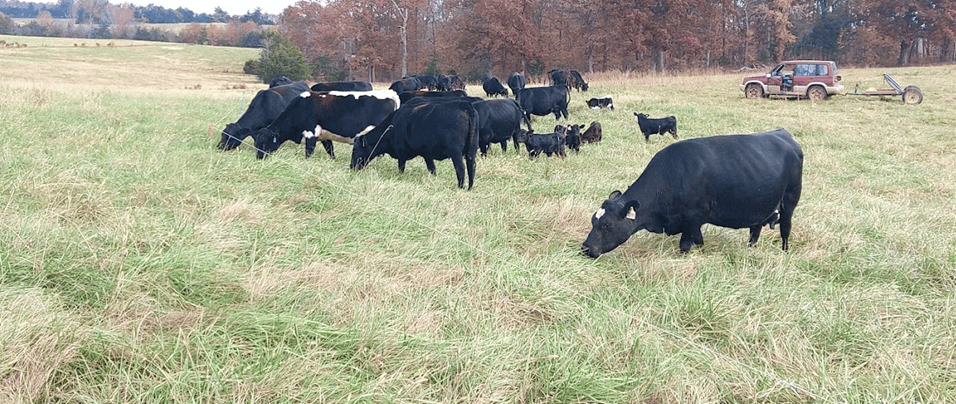
In our on-farm research on cow-calf farms, stockpiled fescue was a very economical option to hay for beef cows. We worked with many farmers across NC to help them plan their stockpile, add nitrogen about September 1-15, and then to use controlled strip grazing during the winter. The accumulation of forage was about 2500 lbs/acre and this supported 107 cow grazing days per acre. The forage quality remained high throughout the winter, never falling below the requirements of a lactating beef cow.
To fertilize or not to fertilize
At one time we routinely recommended 50 to 100 lbs of nitrogen per acre to stimulate growth for stockpiling. This remains a good recommendation for bermudagrass, but for tall fescue there is some question about how much nitrogen is really needed.
In research conducted with Dr. Alan Franzluebbers, we tested the yield response of tall fescue to nitrogen on many farms in the region. We found that on some farms, especially those with new fescue stands on former cropland, there was a good response to applied nitrogen. However, on some farms there was little or no response. This was specifically because the plots with zero nitrogen already yielded very well! This was especially the case when farmers were doing a good job of grazing management, and where they had been managing pastures for a long time. It turned out that when there is a high level of soil biological activity, there is a lot of nitrogen cycling, making that expensive applied nitrogen unnecessary.
The trick is to predict if your fields need the added nitrogen to grow a good stockpile. There are new soil test techniques being developed that may help you in the future, but for now most farmers will have to use their observations to drive that decision. If you are growing a lot of grass without fertilizer already, then chances are if it rains you will grow a good stockpile.
Rain is a critical ingredient
One thing to keep in mind is that it takes rainfall to grow a good stockpile. Three of the last five years have not been good for stockpiling due to low rainfall. If you use rotational grazing, leave residual forage when you rotate to a new pasture, allow long rest periods, and manage for good clover stands, then as discussed earlier you may be a candidate for not needing to apply nitrogen. A huge benefit is that you will not lose out on that natural fertility if it does not rain. The nitrogen that could potentially become available will stay tied up as organic matter until such a time as the biological activity resumes.
If you need to apply nitrogen fertilizer to grow stockpile, there is a chance you might not get enough forage growth to pay for it if it is dry. If you do apply nitrogen, do it early and get it on just ahead if a good rain if possible. It is not a good idea to apply nitrogen when it is very dry, but sometimes we only get a few good rains in the fall, so keep aware of the weather. Keep waiting for moisture before you fertilize, and at some point (October 1 to 15 depending on where you are), save the money you would have put in the fertilizer to buy hay.
The high price of nitrogen these days is one factor that keeps farmers from stockpiling grass for winter grazing. It seems to be a big risk given the chance that it might not rain. However, this year with a major hay shortage and good soil moisture in much of the fescue belt, it may be a key opportunity to extend the grazing season which will be worth more than usual due to the high hay prices we are seeing.
Try feeding hay in the fall during ideal stockpiling conditions
One approach that has helped many farmers we have worked with is to do some hay feeding during late September and through October. If you know you will have to feed hay during the winter, why not move some of that up to when it is a bit easier? September and October is the time many of our beef cows are calving, so you can plan that hay feeding where it is convenient for checking cows and getting them to a pen if they need assistance. Typically, there is less problem with mud than in winter, the days are longer, and you will be spending a lot of time looking at cows anyway. It also allows you to graze through the holidays (when most folks are feeding hay), which is a big benefit to personal time management.
During that 30-45 day fall hay feeding period you can allow all the pastures to stockpile. When you start back grazing, use pastures with a lot of clover and other grasses like warm-season species or orchardgrass first, and reserve those that are mostly tall fescue for later in the season.
This year has been a big challenge with a historic drought and low hay supply in the region. As you look at your winter feed options, remember that closing some gates and stockpiling has great potential and is actually a pretty simple practice to adopt. It takes a little effort, but once you start adding stockpiling to your management system you will see a big return on your investment.
~ Matt Poore, NC State and the Alliance for Grassland Renewal
The Alliance for Grassland Renewal is a national organization focused on enhancing the appropriate adoption of novel endophyte tall fescue technology through education, incentives, self-regulation and promotion. For more resources or to learn more about the Alliance for Grassland Renewal, go to www.grasslandrenewal.org

